Images of Jupiter

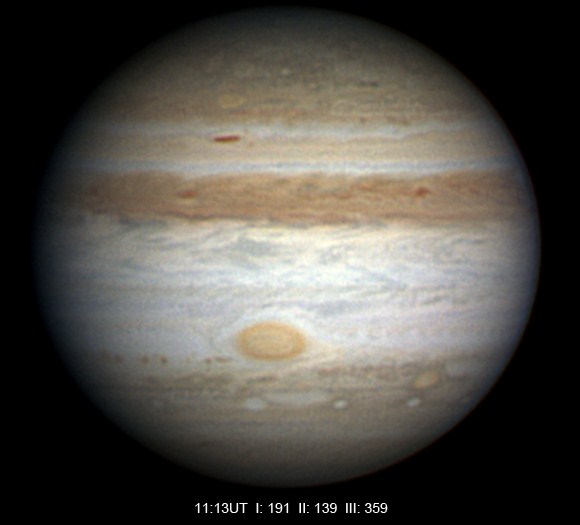
Here is an image of Jupiter taken by my pal Chris Go on 9 November, showing the absent SEB and the Great Red Spot as it appears now (N is up). Watch the SEB for developments:

Jupiter 9 Nov 2010 (our time)(N is up)

Exciting developments on Jupiter

Sky & Telescope is reporting news of the possible return of Jupiter’s South Equatorial Band. Christopher Go and Donald Parker have observed a bright round spot in the position normally occupied by the SEB. In the past, such spots have darkened, then spread out to form the usually red-brown “stripe” known as the South Equatorial Band.

The newly observed spot will transit Jupiter’s disk tomorrow night (Nov. 11) at about 12:30 a.m.** according to Donald Parker.

Be sure to watch Jupiter and follow any developments.

Sky & Telescope’s complete article can be found here: http://www.skyandtelescope.com/observing/home/107042728.html

Update 7:45 pm, Nov.11:
** Sky & Telescope have since corrected the transit time for the SEB “spot” to 5:28 UT Nov. 11 – which means LAST night. ( !! ) The spot is located at approximately 150 degrees longitude (system III) on Jupiter. To determine the current CML (central meridian longitude) on Jupiter for any given date or time, you can use the online calculator at: http://www.arksky.org/newcmcalc.htm .

mag 8.5 atlas and double sided planisphere

http://www.geocities.jp/toshimi_taki/

I found this by chance. Its a series of charts with a manual and index of objects. It seems to be very well done and has a lot of deep sky detail. See what you think.

Getting a handle on processing

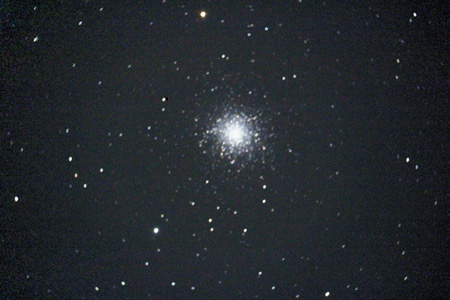
M13 my first glob photo

Here is the finished product of my M13 photo. Not bad for a first try even if I do say so my self.
Many thanks to Kerry for all her help in processing. A special thanks to all those who came by last night for my impromptu photo get together.

Waterdown Cubs

Two different Waterdown Cub troops joined together for a fun night of astronomy with members of the HAA. After a creating a human solar system and enjoying the opportunity to look at some meteorites up close, we all adjourned to the parking lot of Guy Brown School for some viewing under clear skies. Jim brought his big Schmidt-Cassegrain, Ann had her fine dob, Andrew also had his large dob, Joe had his 5″ Mak, Wayne his large binoculars and I had my small but mighty refractor. Michael ushered the troops to the various instruments, where they enjoyed views of Jupiter, M13 and Alberio. Most of the cubs correctly identified the yellow and blue colours of this lovely binary, and Jupiter showed fine detail on this particularly steady night, with some of the cubs even noting detail within the north equatorial belt.

All of the boys and girls were very keen to look through the scopes, and cub Jonathon was an enthusiastic assistant and helped set up and tear down the instuments.

Well over 30 cubs and many more leaders and parents enjoyed the evening, and so did the seven members of the HAA in attendance. Thanks to all for the great night!

Scopes in the City; another successful HAA Public Event

Last night 11 HAA members heeded the call and went out to McQueston Park for a cool evening of sidewalk astronomy. The array of telescopes looked impressive, as visitors had the opportunity to look through any of 2 Schmidt-Cassegrains, 1 Maksutov, 4 Newtonians and 2 refractors.

A slightly gibbous moon offered that “wow” factor with tremendous detail along the terminator and Jupiter received lots of attention due to a Europa shadow transit that was visible in even the smallest scope there (90mm). A meteorite was available for children to hold and examine, and of course there was lots of exchanges of information and sharing of eyepieces between the members. Jackie brought along a new 8″ Dobsonian that was carefully assembled and examined by many members, and deemed to give very fine views! Attempts to set up the Maksutov with a binoviewer and a pair of 13mm Naglers met with success, as there was just enough room to fit in these very large eyepieces. The effort was very worthwhile, as the view of the moon through this set-up was spectacular!

As the night progressed and the visitors dwindled, attention was turned to how well we could see some deep-sky objects from this very light polluted area of the city. Not surprisingly, filters helped tremendously, and merely blocking the light of the closest lamps improved the view a lot. Although I could see only 5 of the Pleiades with the unaided eye (and only that with effort) the younger eyes of Kevin were able to pick out many more, showing once again that your eyes are the best observing tool that you have.

A big thank you to all the members who turned out to share the night sky with the public and were rewarded with a fun evening that included some great views of the sky and some even better company.

Sidewalk Astronomy at McQuesten Park

There will be several H.A.A. members out at McQuesten Park tonight from about 7:00 pm untill 10:00 pm or so.We will be seting up our scopes to share veiws of the first 1/4 Moon. and jupiter.Please join us. See you there.

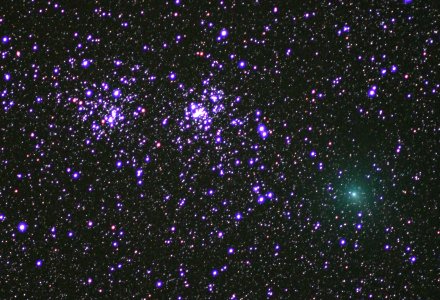
The Perseus Double-Cluster and Comet 103P/Hartley 2

Here is the Perseus Double-Cluster and Comet 103P/Hartley 2, side by side, from Spectacle Lake, Barry’s Bay, ON, single 2-minute image taken through Tamron 300 mm f/2.8 lens with Canon Digital Rebel 300D, on Thursday, October 7, 2010, at approx. 9:25 pm.

Perseus Double-Cluster and Comet 103P/Hartley 2, by Bob Christmas

— Bob Christmas

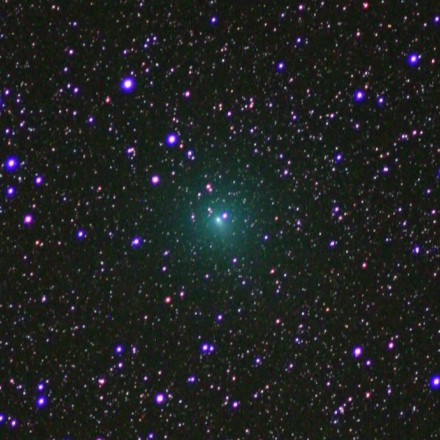
Comet 103P/Hartley 2 by Bob Christmas

Here is a small excerpt of one of my images of Comet 103P/Hartley 2 that I took from Spectacle Lake Lodge, near Barry’s Bay, ON, Sunday Night, October 3, 2010, 10-pm-ish.

Comet 103P/Hartley 2, by Bob Christmas

This is a single 2-minute exposure, Canon Digital Rebel 300D through a Tamron 300mm lens at f/2.8 & ISO 1600. Gamma-corrected and contrasted slightly.

— Bob Christmas

Prime Viewing Time for Comet Hartley

This month, Comet Hartley will be visible high in the sky just south of Cassiopeia. Sky and Telescope magazine has an excellent finder chart available on its website: http://media.skyandtelescope.com/images/CometHartley2-bw.jpg

Conditions will be excellent this week to view the comet because we are approaching new moon. If the skies clear (current weather forecasts are looking favourable for later this week), the comet should be visible in binoculars or small telescopes even from the city.

From Oct. 7 until about October 9 – a grand photo opportunity presents itself when the comet passes near the Perseus Double Cluster. You can get the jump on NASA – their EPOXI spacecraft will be imaging the comet from 1000 kms. away next month. So charge up your camera batteries!