Solarwatch notes

A Spotty Sun, 6 February 2007

Is it trite to say “It’s c-c-cold out there”, after the -20ish temperatures during the past week?

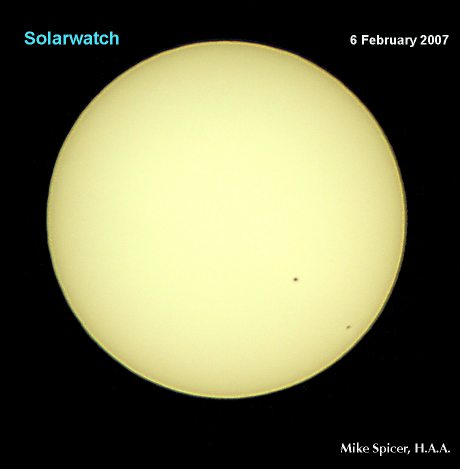
Here is what the sun looked like at 8:30 this morning through a 5″ refractor using an Orion glass “can’t-poke-a-hole-in-me” solar filter. The image has been reduced to 450 pixel wide JPG (shh… it’s an “interior picture”):

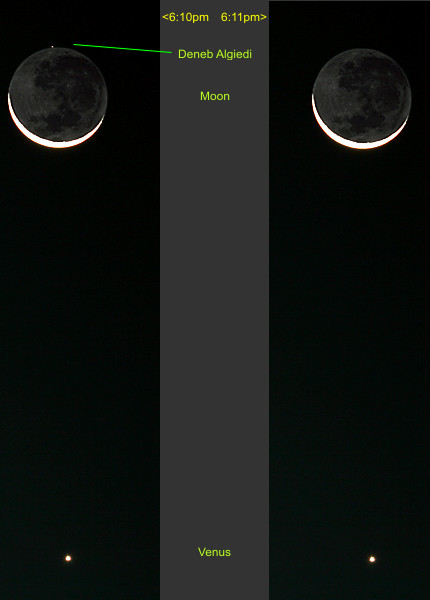
Image of Moon and Venus by Bob Christmas

Last Saturday (January 20, 2007), I decided to go to my brother’s place near Freelton, ON, to take a stab at imaging the sky with my Canon EOS Digital Rebel 300D digital SLR camera on my Super Polaris equatorial mount (I got a half decent shot of Orion, which I may post later)… and BRRRR!!, it was cold! -15 deg C.

Just before I left, I saw the moon and Venus setting over Mapleview Mall, from my condo complex parking lot, and I thought I try taking a few fixed-tripod images of them. Little did I know at the time that I would (barely) get Delta Capricorni right beside the moon, just ten or eleven minutes from being occulted by the moon! (Although Tim H. beat me to the punch!)

Report 21 January 2007

Binbrook Report for Saturday Jan 20, 2007 – by Tim Harpur

Observer’s Notes: COLD

Actually, I lasted about 3 hours before deciding to pack it in (just as Jackie showed up) – no wind, but cold and crisp (painfull on the fingers when touching anything metal) – excellent seeing though – at least until 8:30pm when we left.

I snapped off a few shots of the moon and Venus – and just happened to catch the lunar occultation of Deneb Algiedi.

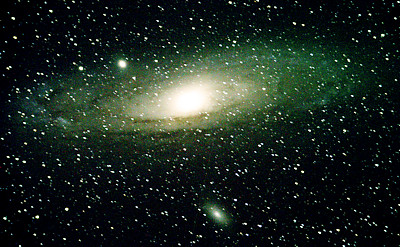
I also took a few shots of M31 (Andromeda), M32, and M110.

Astrophotos Always Washed Out?

Just starting into astrophotography, but getting a little discouraged by photos that are always washed out? Don’t be, the following is a typical long exposure image shot without the use of a filter.

This is the same image after having the colour space remapped (a process that literally takes less than a minute on a typical computer with the right software).

The only thing left to do to create the final picture is to stack a series of these images in software such as Registax and maybe do some final adjustments of the colour space.

Binbrook Tuesday Jan. 16, 2007

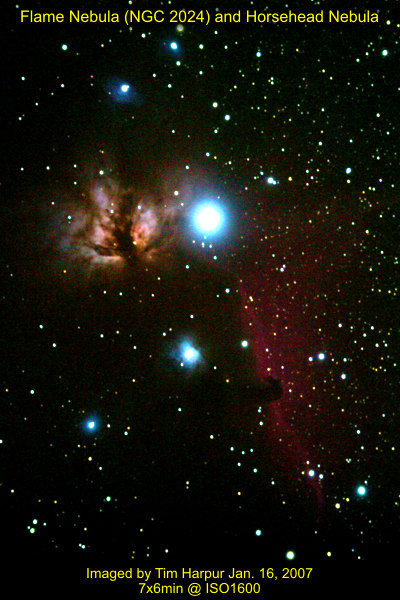
So it was a little cool – but almost no wind – and properly dressed – not bad at all and well worth it. Jackie and Ben braved the cold also. Crisp and clear – for the most part – we did have some clouds roll in for about 15 minutes – then they vanished – in all we got about 2 hours of very clear skies before the clouds came back for good.

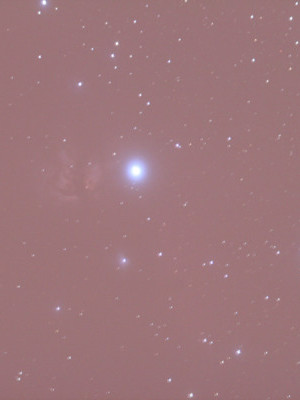
I took a little extra care on polar aligning and also, thanks to Mike, had new batteries for my illuminated guiding eyepiece. I spent most of the time imaging (6 minute exposures) the Flaming Nebula in Orion – then, before packing up, took a couple of shots of Orion’s sword again.

New images by Tim Harpur

New images of the Flame Nebula, the Orion Nebula, and the Pleiades have been added to Tim Harpur’s astro-photo gallery.

Sunspots in InfraRed-Pass and InfrRed-Block Filters

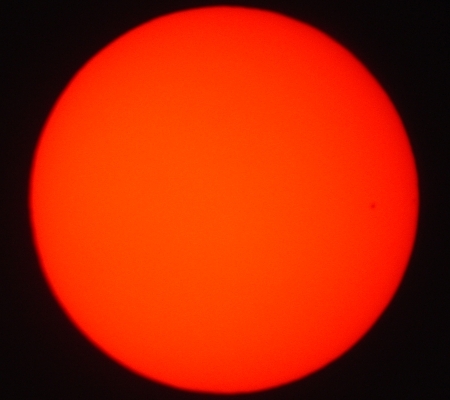
Sunspots 933 and 930 (on far eastern side) are about to disappear for the next two weeks, so today seems like the last day for taking pictures. A few years ago I purchased an IR-Pass filter in error. Rather than returning it, I decided to keep it for a “rainy-less” day. So, I set up my Orion this time powered by my Sphinx mount to eliminate tracking problems mentioned in the first blog (here) of 2007. I was curious to see what effect the filter would have.

Sun IR Pass

Equipment: Orion ED 100, SONY DSC-V1, Scopetronix 40mm on Sphinx mount

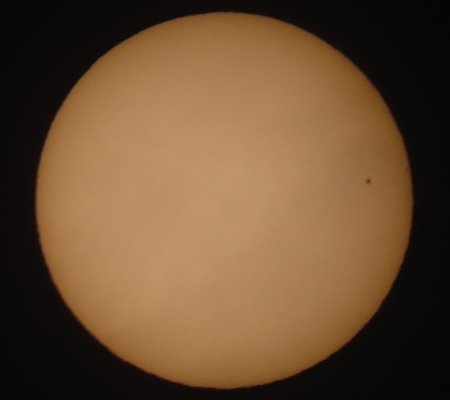
I removed the IR-Pass filter and threaded my IR-Block filter onto the diagonal. This filter is supposed to be used with digital cameras. However, I didn’t see any noticeable difference between the image of the sun I took today with the ones I took previously. Maybe I’ll see the difference with and without the IR-Block filter next time I image the moon.

Sun IR Pass

Equipment Orion ED 100, SONY DSC-V1, Scopetronix 40mm on Sphinx mount

Sunspot 933 is visible in both, but not as easily discernible on the IR-Block. If you look closely you can see Sunspot 930 on the far eastern edge of both images near the “equator”, ENE with respect to Sunspot 933. The latitudes of the spots in the two images differ because of camera-diagonal alignment.

Binbrook Wednesday January 10

COLD
  CRISP
    CLEAR
      and very CALM

The seeing was very steady and clear – all four stars of the Trapezium in Orion were clearly visible in my 80mm achro guide scope – the view in my Onyx 80mm apo was pinpoint sharp. I quickly set up for imaging – only to discover the battery for my illuminated guiding eyepiece was dead – I had to do my imaging unguided with exposures limited to about 1 minute. It wasn’t the cold – it was my dead camera battery that ended my observing session (after about 3 hours).

No wolves to keep me company – but there were a lot of geese making quite a racket.

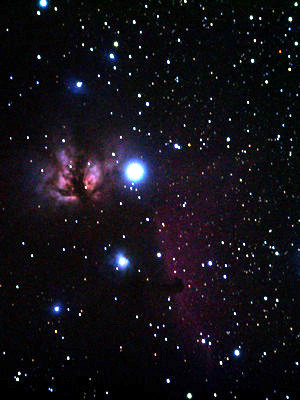
The following images are single frame shots – quickly processed – and drastically reduced in size – I will post the stacked and fully processed verions to my gallery in the next day or two. All imaging was done using my new Onyx APO 80mm refractor and Canon Digital Rebel XTi mounted prime focus.

Despite the cold I am planning on doing another run to Binbrook Saturday if weather holds for clear skies.

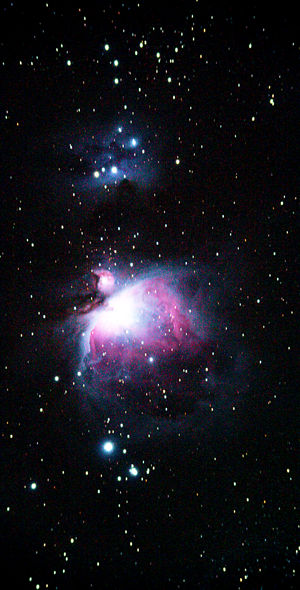
Great Orion Nebula

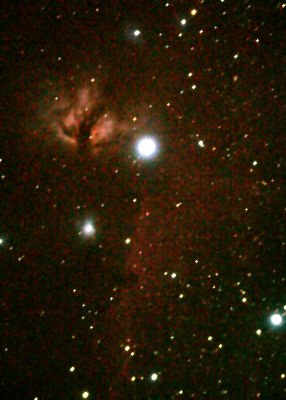
Flaming Nebula (and the Horsehead Nebula) in Orion

Observing, Wed 3 Jan 2007

The CSC was partially correct for the evening. I met up with Jackie already at the alternate site on Tyneside. The cirrus clouds were just dissipating, though there was still some high level ice crystals which magnified the glow around the moon. But the humidity stayed reasonable until about 11pm and the heavy winds that were forecast were never more than a light breeze. So considering the weather we’ve been having over the past few months, it was a reasonable observing night.

I set up while Jackie was observing with her new binos. Once I was polar-aligned, I focused on Orion and its glorious nebula. At that time, a friend who’s interested in joining a local astronomy group joined us. Jackie did her usual enthusiastic job of promoting our wonderful HAA club while we both tried to show him some of the constellations and interesting objects that can be seen with binos and scopes.

I also got a new digital camera for Christmas which I set up on a camera tripod. I took a couple of 15 sec exposures of Orion, the moon and Pleiades. Only the Orion shots were passable and even at 15 sec, star trails were evident. I guess the next present will be a camera attachment for my tracking mount – thank goodness my birthday is this month {grin}.

After finding some old standby’s to look at and trying a couple of other objects that I’ve only occassionally seen, frost started to form on the outside of the dewshield around 11:15. So before it started to collect on the scope and ourselves, we packed it in.

It was a joy to get out observing after the long drought. Even better was to have some people to share it with. HAA is a great club.

As a footnote, I went back outside briefly at around 2am and noticed a huge halo around the moon from the ice crystals in the upper atmosphere. It appeared to cover an area of about 30 degrees (if I had been more experienced and thought about it while I was outside, I would have made an accurate measurement instead of guessing after the fact). Not good conditions for astronomical viewing, but an interesting object just the same.


Sunspots II

This is a continuation of my previous blog of Jan 1. Jan 2 was another fine morning for imaging sunspots and sorting out the problems encountered mentioned in my previous blog. Good news and bad news about the RA motor drive on my Orion German Equatorial mount. The good news is that it now works, sort of. The bad news is that it only works when I slew to the east. It won’t slew to the west which means it won’t track a celestial objects. Back to plan B used yestereday, ie setting a 10-sec delay, manually pre-positioning the frame, then clicking the remote shutter and pray that when the picture is taken 10 seconds later, the spots of interest will be centred.

First picture is of entire sun using my V1. Sunspots 830 and 834 are clearly visible, whereas 833 is almost invisible. I increased the camera optical zoom to its maximum, 4X, and took another picture where all spots are easily discernible, as well as a faint fourth. However, that image is in my Gallery at HAA.

V1 image details: ISO 200, F3.5, 1/1000 sec at 9:59 am EST.

Second picture is a closeup of sunspot 330, the furthest west of the cluster. I chose it because of the difficulty of focusing the others. Now if I had used a reliable motorized mount, the issue would be moot. OK, I’m getting ahead of myself. The forecast for Jan 3 is for clear skies in the morning. I hope to use my tried and true Sphinx mount and see if the pictures turn out better. Stay tuned. Oh, by the way, did you notice that I set the colour setting on my H5 to “Natural” and obtained a more colourful effect?

H5 image details: ISO 200, F3.7, 1/15 sec at 10:39 am.

Sunspot 330 2007 Jan 2,