Star party at Pinery Provincial Park

For the Canada Day weekend, my wife and I headed off to Pinery Provincial Park with 18 friends for camping. Most of these folks had never camped before because they were fairly new visitors from China, where camping is virtually unheard of. They had also never looked into a telescope eyepiece before. On Sunday night I set up my 8″ Dob on the campsite as dusk deepened and the nearly first quarter moon shone crisply high in the west. I felt like an ambassador to the stars as a queue quickly formed and my Chinese friends glanced at a sight they had never seen before. They were impressed. As the sky got increasingly darker, Jupiter was peeking conveniently through the trees, so we checked out the 4 Galilean moons lined up on one side according to their distance from the planet. Some of the campers could detect faint bands on the planet surface, others could not. My experience as an English as a Second Language teacher paid off as I was able to answer some questions in a way that most could understand. One woman had only been in Canada for a few weeks, and so had to have my answers translated.

Then we had our campfire, playing games, singing, and telling stories until after midnight. At around 12:45 a.m., ten of us headed down to the shore of Lake Huron in the dark, following a trail through the woods and across sand dunes, some holding flashlights, some with lawn chairs or telescope parts. I carried my telescope’s optical tube, stepping cautiously over the occasional tree trunk and down sandy wooden steps in the deep dark with the light of flashlights flickering in front of my feet. Once at the beach we took in the summer night sky, which was hazy, but much darker than is possible in Hamilton. After our eyes had adjusted a bit to the dark, we checked out Jupiter again, now low in the southwest. Lyra was high overhead, so we observed the ghostly smoke ring of the Ring Nebula, M57. Not far away and also close to the zenith was M13 in Hercules. Finally at around 1:30 we checked out the Andromeda Galaxy, now rising in the northeast. The biggest ‘wow factor’ came from the Hercules globular cluster, which for many was the highlight of the star party.

We had an early wake up call the next morning in order to pack our tents and our gear for the drive back to Hamilton, so it was time to make our way back to the campsite. What a great way to cap off a weekend of adventure at the Pinery!


International space station across the Moon for parts of Hamilton

If it’s clear tommorow night ( July 5 ), then keep an eye out on the moon. At around 10:02 pm EDT, the iss is predicted to pass across the moon. Depending on where in Hamilton you are, the iss will either pas across the moon, or miss it. Just thought I let you know.

Submitted by Kevin Fetter

M27 & M57 images by Tim Harpur

Taken Saturday June 24, 2006 – Binbrook Conservation Area

Observers’ Notes

JUNE 17 BINBROOK RECAP BY DON PULLEN

With the predicted great skies and agreeing to pick up a new 6″ Newtonian from Mike, I was eagerly anticipating stepping up to a new level of observing. I set up the new reflector on my manual EQ-3 mount and set up my binoculars on the camera tripod with the articulated bino boom. I was ready for an exciting night of new discoveries.

Initial setup of the new 6" Newtonian

While they were still high enough to observe, I started with Saturn and Mars in the Beehive. They were nearly in the twilight so I had difficulty making out M44. I then turned to Jupiter and observed the 4 Galilean moons. I was finding planetary details a little disappointing.

As the night deepened, I turned to look at galaxies and other deep space objects. This was a completely different picture (no pun intended). After watching where Glenn was pointing, I found M81 and M82 – my first time to see these 2 galaxies in a scope. I had tried unsuccessfully before but this time they popped into view clearly. Was it the conditions or my new 6″ telescope?

Confidence boosted, I swung over to Leo before it set below the horizon to try for some galaxies I previously had been unable to find. I couldn’t find M95, M96 or M105, but a little higher up I found M65 and M66. Another treat – I could see 2 galaxies in the same telescope field of view.

A little haze was starting to appear in the sky, but I could make out the glow of the Milky Way. The observing conditions were turning out to be a bit of a mix. M57 was very easy to find for a change (for me). I then turned south and looked into the heart of the galaxy at the wealth of DSO’s available there. Between Scorpius and Sagittarius (the Teapot), I was able to locate M22, M4, M8 and M20. The globular cluster M22 and some of the nebulas were even visible in my binoculars. While I wandered over to chat with other members, Mike located the Eagle Nebula M16 in my 6″ – another visual treat.

I had not seen so many nebulas in one evening in the short time I’ve been with this fascinating hobby. I was fortunate to have a number of enjoyable and supportive club members with me. We were able the share the views each of us was finding. I wanted to keep looking all night but by 2am observing conditions were deteriorating to the point that faint objects weren’t visible. So the last of us packed up by 3 am and headed off for some sleep and reflection on the many new (or for some – old) objects seen.

A thoroughly enjoyable night.

New images of M13 and Beehive by Tim Harpur

New astro-images by Clyde Miller

Saturn, Comet – 73PSchwassmann Wachm, Jupiter, M17, M82, and the Moon.

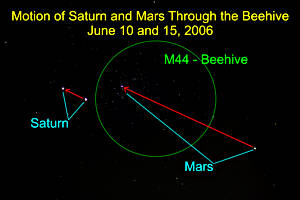
Mars in the Beehive Cluster

I got up to Tobermory last night and immediately set up my scope. Just before some distant haze showed on the horizon I was able to snap a few more shots of Saturn and Mars with the Beehive Cluster. I’ll post the images to my gallery later, but for now here is a thumbnail comparison of last night and of 5 days earlier – Mars is really moving against the background.

Observers’ Notes 15 June

Don Pullen observed from home Thursday night. He writes:

I read the Observers log each day and saw that a few people got out to Binbrook last night. Usually week nights are a problem for me, but I try. And I see Tim H is back up at Tobermory. I did go out on the deck to check the conditions and noticed how clear the sky was from central east Hamilton. I could make out 5 stars of Ursa Minor – normally I can only see Polaris. To the south I had a great view of Scorpius. How I regretted not being able to head out to a good location. If conditions were this good in my backyard, then the sky must have been great at Binbrook.

Hamilton Amateur Astronomers.. great club, great observing site!

New Beehive Images by Tim Harpur

I thought I’d try some wide field images last night – I shot the following using my Digital SLR mounted prime focus on my 50mm finder scope – it was just the right field of view to capture all 3 – Saturn, Mars, and the Beehive Cluster. Focusing was a bit tricky as the finder scope doesn’t actually have a focuser – and probably wasn’t intended for mounting a camera on.

Six images shot at ISO 200 for 1 sec ea. then stacked in RegiStax. The planets are somewhat over exposed – but it was nescessary to bring out some of the Beehive. As the two planets get closer together I’ll switch to one of my main scopes and get some more detailed shots.

New Jupiter images by Tim Harpur