Web resources

Here’s a link to the Aurora Cam in Yellowknife

Click here to get to the Canadian Space Agency’s aurora cam page


Here’s a link to the chart of 100 excellent double stars

Click here to be taken to the Astronomical League list of 100 great double stars

A few other things were mentioned:
here’s the link to the observer’s certificate. Please print one off, and check off your targets you have already done, or do once you have printed it. Turn it in to me at the meeting and i will get back to you with a duly crafted ‘real’ one!


Click here to download a pdf version of the certificate. No framing it until i re-make it for you though!

Watch for Aurora tonight!

It’s more than likely, since the moon sets early, and if the sky
is clear, look north for the green and red glow of aurora.

It’s been a while since we got a magnetic index of 6, and that’s what it is now.

Look up at midnight if it’s clear, every night, because aurora
are hard to predict!

Observe and Dash with Binocs

This weekend’s weather forecast is calling for alarmingly cold temperatures. Even a keen observer would be reluctant to drag all their equipment outside in -20 degree weather. (That’s cold enough to freeze your Bob’s Knobs off!)

Matthew Mannering has an excellent article on observing with binoculars in the January issue of our newsletter. In his article, he states:

“Binoculars also have a very important role in my winter observing. Quite honestly there are lots of times I wouldn?t go out if I had to haul my big stuff out of the house. Cool down times for a large scope just get worse as the temperature drops and I don?t have a secure yard to go leaving it outside for hours at a time unattended. Mostly, I just take out my binos and within about 10 minutes they have reached equilibrium with the outdoor temperature. In fact you can start using them right away although you will notice some astigmatism and the focus will change continuously until they reach equilibrium. Better yet, when your toes and fingers start to turn blue; which I find seems to happen all of a sudden, tear down time is close to zero.”

You can read his entire article on page 15 here: http://www.amateurastronomy.org/EH/January2011.pdf

Observing with binoculars is a great way to enjoy the crystal clear winter skies without having to spend too much time outdoors in these unappealing temperatures! You can check out the double stars in Orion that Steve mentions in his Sky This Month column (page 12 on this month’s newsletter – see the above link) and in his blog posting of January 15th.

Get your binoc’s pointed at the double stars in Orion

Here’s a listing of the doubles i was expounding in my Talk last night.

They are in Orion.
All of these multiple star systems are within a minute of arc
in size. The tightest one, Zeta, is only 2.4 arc seconds, and will
test your telescope, but don’t dispair, it’s a triple star and you can
separate the larger separation easily.

In order of increasing difficulty,

(1) Mintaka, the western star in Orion’s belt (2.2, 6.3)
(2) Iota, the tip of the sword, (2.8, 6.9). Note the colours
(3) and in the same field of view, Struve 747 (4.8, 5.7)
(4) Theta 2, a wider grouping just east of the Trapezium
(5) 1/3 degree south of Betelgeuse, is Struve 817. Evenly matched, 8.2 and 8.3. Can you discern which is the brighter one?

Now reach for the telescope…
(3) Lambda, Orion’s Head (3.6, 5.5)

(2) Rigel, the western foot (or is it a knee?) (0.1, 6.8, 1/600 of a degree)

(8) Theta 1, the ‘Trapezium’ in the heart of the Orion Nebula – do you agree it’s the finest looking multiple star system in the sky?

(9) Sigma, near the eastern star of Orion’s Belt… it’s one of the brightest and most massive double star in the sky.
Those stars are more than 30 thousand times brighter than the sun, each) (4.0, 7.5, 6.5) The close pair is 12 arcseconds.

(10) Zeta Orionis, the eastern star in Orion’s Belt. It’s a triple (1.9, 4.0, 9.9) (The close pair is 2.4 arcseconds apart)

9 of these are on the “Astronomical Leage’s” top 100 Double Stars.

If you observe them, do a little sketch. If you get these, and the other 90, there’s an award for you!

Clear Skies!

Steve

Winter-Solstice Lunar Eclipse, by Bob Christmas

This is the December 21, 2010 Lunar Eclipse; approximately 3:25 AM, from my condo complex parking lot.

Tamron 300mm f/2.8 lens; Canon Digital Rebel 300D; 0.5 secs at ISO 400.

— Bob Christmas

Lunar Eclipse Dec. 21, 2010 by Bob Christmas

The Eclipse

Watched the Eclipse from 2:25 to 2:50 this morning. At 2:37 I was looking through my binos and a brilliant meteor passed directly in front of the moon. It was startling as the contrast of the white flash against the orange background made me blink. We had partially clear skies in brantford and the seeing at times was very good. Easily saw the 3 globs in Auriga. M35 in Gemini and the moon just fit into the same field of view in my binos. Hope any who stayed up had clear skies! By the way, the time on the site is off by one hour so it looks like I posted this before it actually happened.
Follow up: It turns out that there was a meteor shower scheduled for last night; the Ursids. I guess I just got lucky being in the right place at the right time!

Lunar Eclipse coming Monday Night

Don’t forget…

It’s the first time we have had a Lunar Eclipse on the Winter Solstice
since the invention of the telescope.

It’s very late Monday night, (Tuesday Morning) and you can see it from anywhere.

Connect the dots

Canis Major won’t be in the early evening sky for a month or two,
but here’s a chance to brush up on connecting the dots.

I am including 2 renderings of Canis Major here…
Pick one and see if you can do better than a 5 stick figure in my star atlas.

Steve

Canis Major to Magnitude 6.0, designed for printing, then drawing the lines to make it look like something.

This one has a few less stars. I still see a poodle when i look at it.Best to right click, save the image, then print it.

Scope Clinic

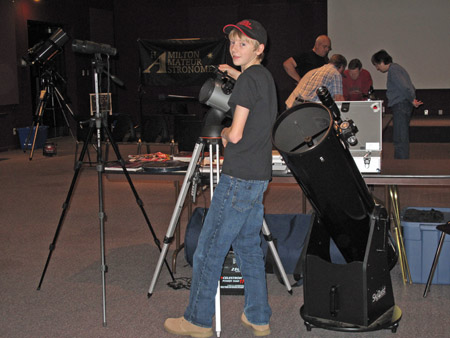
Kevin sets up to help at the Scope Clinic

Last night’s Scope Clinic was very well attended by club members eager to answer questions and offer recommendations to the public and other members about selecting astronomical equipment.

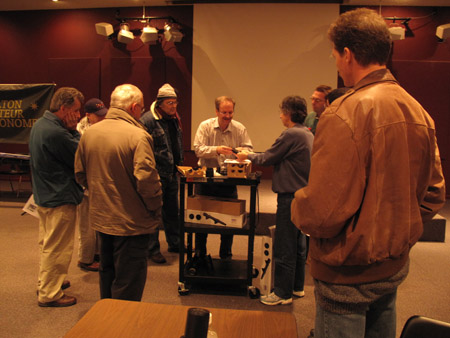
Steve Germann demonstrated telescope anatomy by assembling a Galileoscope in front of a crowd of interested spectators. The assembled telescope was tested and everyone had a chance to look through it before it was raffled off.

Steve assembles a Galileoscope before an enthralled crowd.

Due to the club’s efforts, I’m sure Santa will be delivering fewer “trash” scopes this Christmas!

Two Prominent Astronomers

Two of the most prominent astronomers of the 20th century passed away this week.

Alan Sandage was a cosmologist and assistant to Edwin Hubble. Hubble (after whom the Hubble Space Telescope is named) discoved that the universe is expanding. Sandage, an American, worked under him as a grad student and carried on his work after Hubble’s death in 1953. He went on to provide what was at the time the best, and oldest, estimates of the age of the universe. He also studied star and galaxy formation, discovered jets in M82 and created the first 3 dimensional model of the structure of the nearby galaxies.

And just yesterday Brian Marsden passed away. Marsden, originally from England but residing in the United States, ran the Minor Planet Center at Harvard for many years. An expert on asteroids and comets, his was the final word regarding the discovery of new solar system bodies. He also was director of the Central Bureau for Astronomical Telegrams for 30 years, where all initial reports of new astronomical discoveries were sent. First word of a new supernova, or comet often came from Marsden.

Learning about what’s out there is often enhanced by learning about how thngs are discovered and the stories of thier discoverers. Now would be a great time to read up on the work that these two great astonomers did.