Observations of a beginner star hopper.

Observing Notes, March 13 2007

The Clear Sky Clock called for good views from about 5pm to 9pm, and the temperature was above 10C. Who could ask for more. Well, it turns out that there’s a lot of mud at Binbrook now, and it never even occurred to me that they don’t plow the snow on those roads.

Now that I have signed up my first sponsor…
This evening I joined John Gauvreau’s night-school group and other members at Binbrook. My intention was to refine my skills as a star hopper, using my 15×70 binoculars as my visual aid, and my laser pointer in a pinch.

I arrived at about 7:10 and found everybody already there. The sun was setting. With care you could pick out Sirius in the blue sky. It was not long before the stars of Orion started to be visible to the unaided eye. Thin clouds were present over perhaps 25 percent of the sky, and constellations like Orion were drifting in and out of view. In my case, when looking for Orion’s belt, some help from Jackie with a laser pointer allowed me to see what I could not see a few seconds before. Its amazing how it helped… (or perhaps the clouds drifted away at the right time)

Tonight’s mission was to pick out a smattering of Messier objects, and employ the index, star charts, star hopping and averted vision to prepare for the MM. The emphasis was on being able to seek a designated target.

I tested my ability to align binoculars with something in the sky by seeking the Orion Nebula. I must say that this is the first time I got a full appreciation of the nebulosity without relying on photographs. That’s not bad considering the amount of cloud and haze which at times competed with the low surface brightness objects.

We decided to try to observe Mira… After several attempts, John provided star hopping advice… but it was to no avail. Unfortunately a bit too late to actually see it. It was down too low to the horizon, and the haze was pretty bad.

I continued my mission to observe the various Messier objects, primarily those considered binocular objects.

The Messier Marathon allows about 5 minutes per object. In some cases we were exceeding that.

Of course it was easy to pick out a few of the bigger Messiers, like M45. But some of them were such that I would not have considered it a positive identification. It takes a trained eye to distinguish nothing from something.

Using Orion and Gemini I tried to star hop to the Beehive Cluster (M44). I could see a hint of it in the sky but not align it in the binoculars. Even at 11 pm we could still see all around. (but not read the star charts without a flashlight).
There was a lot of sky glow from Hamilton reflected in the clouds.

I learned a few things…
I probably need a finderscope for my binoculars; a Nexstar scope is not all that easy to align, if it’s daytime or cloudy, and makes a lot of noise when slewing; what looks like a 150 degree angle on a flat star chart turns out more like 110 degrees in the sky. When the wind blows, my tripod shakes, and Sirius makes nice lissajous patterns; I need a gadget to elevate my binoculars higher than my tripod does. I will head for Home Depot tomorrow. I need more than a 4 inch scope, (or darker skies) to pick out the Messier objects considered dimmer than binocular objects, but my binoculars appear to be equal to the task for the 60 objects so designated. There are enough stars in the binocular field that star charts cannot show them all, so it’s not easy to star hop through binoculars. M40 seems to be somewhat of a hoax; I could see more stars than in the star charts, but nothing even remotely cometary. The constellations are actually pretty big;
2 inches on my star charts is 4 inches at arms length; My green laser is likely a 20 mw version; By the time I asked for advice on the Andromeda Galaxy, it had set; and the Beehive Cluster looks magnificent through my binoculars;

Some of the telescope Messier objects are a challenge even with a GoTo scope properly aligned. M56 and M66 gave me a lot of trouble; letting my glasses touch the rubber rings on the viewfinders was a disaster. The smudges on them made clear focusing dependent on exactly what part of my glasses were in the optical path. I will be bringing plenty of lens cleaners for my glasses next time. Also, reading glasses… (and a rocking chair, perhaps?)

I don’t think I can snatch the pebble yet.

The Rangers came at about 10pm and suggested that they might close the park later in the week because of possible damage to the grass.

Jim continued to serve up treats with his scope, calling us over as needed.
I saw a double star (cannot recall which) but the 2 were about a factor of 10 difference in brightness. It was a welcome change to have the scope already pointing in the right direction.

We packed up around 11 pm.

As Jackie observed, there’s a lot of walking around in an observing session. My apologies to the grass… we made quite a field of mud just walking on it.

With a little help from friends, our cars were pushed back onto the roadway.

A rather long drive to the ‘alternate’ observing location afterwards, with a view to possibly doing the MM there if Binbrook is muddied out.

I would recommend setting up on the pavement next time, and parking the cars further down the lane, but leaving one blocking the lane against unexpected vehicular arrivals.

HAA member on S&T website!

Our own Anthony Tekatch graces the article of today’s Sky & Telescope lead web story – check it out!

http://skytonight.com/news/home/Star_Counters_Wanted_.html

Lunar Eclipse – Hazy Images

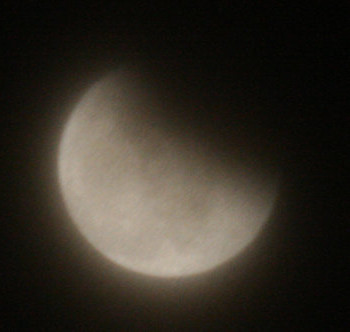
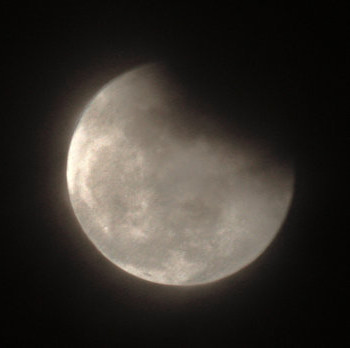
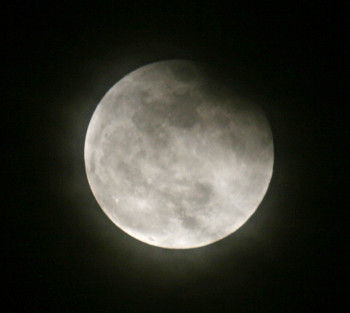
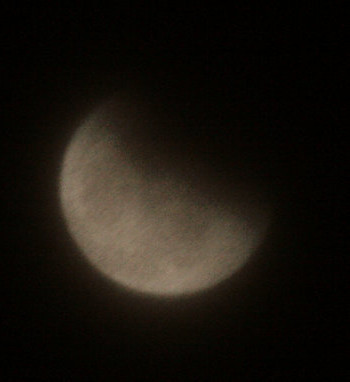
Sorry it took so long – I had a severe system crash and spent yesterday re-installing and restoring backed up files. I just finished data recovery on the memory card and now have some of the (cloudy) images of the last 15 minutes of the eclipse.

Lunar Elcipse (through clouds) 2007-03-03

Lunar Elcipse (through clouds) 2007-03-03

Lunar Elcipse (through clouds) 2007-03-03

Lunar Elcipse (through clouds) 2007-03-03

Lunar Elcipse (through clouds) 2007-03-03

It Was Clear

The people of Hamilton ARE interested in our activities. When over 50 guests show up for an event that is so obviously clouded out, you know that our efforts are not in vain. One couple had even come from Toronto!
I received many positive comments on all aspects of the Eclipse Night (as described below), and will just add my thanks to Darla, Brian, Steve and Mary Ellen of the PCDC, and to the many HAA members who each contributed in their own way to make the night another success – you guys are great!

GOES 11, 12 Energetic Spike

From Mike Jefferson:

“GOES 11,12 reported an energetic spike last night @ ~ 11.00 EST. It may mean long-distance radio problems and satellite communications ————- and, it may mean an aurora!!!”

Occultation Notes, 23 Feb 2007

LUNAR OCCULTATION OF THE PLEIADES, 23 FEB 07

Such a sunny, bright afternoon with the crescent Moon almost overhead…and could you see any of the Pleiades near that Moon, against the bright blue sky? I certainly did not see any stars through the eyepiece of my telescopes (and I tried a few). Here’s an image, reduced to a 450 pixel wide b/w in JPG format:

UPDATE: A GREAT OBSERVING NIGHT FRIDAY 23 FEB

It was cold with a brisk wind from time to time, but the sky was beautifully transparent – great for observing. Some friends were stopping by to observe with me so I set up an extra scope with a binoviewer (no waiting). I did some imaging while waiting for them to arrive.

The air was unsteady at first, so the images of Saturn I obtained were not better than those of last November. There are very few nights of excellent seeing and you never know, the air could settle down like it did tonight.

I tried out a pair of TeleVue 19mm wide field eyepieces, comparing them with a pair of 19mm Panoptics in the Denkmeier – the view was exactly the same, I could even use one of each in the binoviewer! So I have two excellent eyepieces for sale!

From the comments of all my visitors tonight, it’s obvious that aperture determines the best views. No one looked through the 6″ Mak for long when the 11″ SCT showed a much brighter Saturn with so many moons. Tim said he could see Enceladus – a surprise, since it was so close to the planet.

The patio is convenient – easy to come in from the cold. I don’t think we would have lasted long at Binbrook in the wind! I stayed out until 3 a.m. imaging a variety of objects. I wasn’t happy with the M-3 images from a few nights ago so I tried again tonight after imaging some galaxies. Here is a reduced-size/quality shot of a much brighter M-3 without any vignetting:

Solar Watch 2007

SMUDGED, YET SPOTLESS, SUN 21 FEB 2007

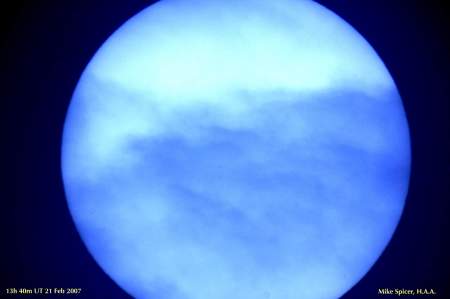
Here’s the sun from a few minutes ago, in much-reduced size and JPG format to fit here. That Clear Sky Clock keeps saying it’s very clear, but aren’t those clouds in front of ol’ Sol’s disk?

Variable Star Notes, 21 Feb 07

IMAGING VARIABLE STARS (“PHOTOMETRY”), 21 FEB 2007

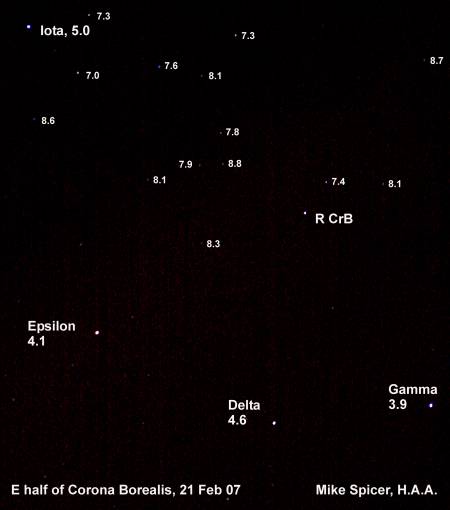
R Corona Borealis is my favourite variable star. After all, it’s easy to locate in the bright constellation of the Northern Crown, and it’s almost always about magnitude 6 – ie: at maximum brightness!

You estimate the brightness of variable stars by gauging them against nearby stars of known brightness. The AAVSO has charts for each variable, noting the most suitable comparison stars. Estimating brightness of stars is therefore part art, part science. It’s one of the more important contributions amateurs make to modern astronomy, well worth trying!

If you have a small telescope, an imaging camera and a V filter (a greenish colour) you can collect images of the variable stars and use the results to more accurately measure the changing brightness of variable stars. This is “photometry” and there is free software that will analyse the images to provide accurate readings. Telescopes and cameras are not just for taking “pretty pictures”.

Here’s an image of my favourite variable star, taken this morning with a V filter. R CrB is magnitude 5.9, or can’t you tell?

Observer Notes, 21 Feb 07

DON’T TRUST THAT CLEAR SKY CLOCK

It’s not Mr. Danko’s fault the CSC is misleading half the time… weather is hard to predict. Tuesday night the CSC predicted clear skies and good seeing from 8 pm on… alas, it didn’t work that way. I left a dinner engagement in time to be home at 8 pm… cloudy. Had to pass on observing with Steve K…. cloudy. The sky finally cleared at 2 a.m.

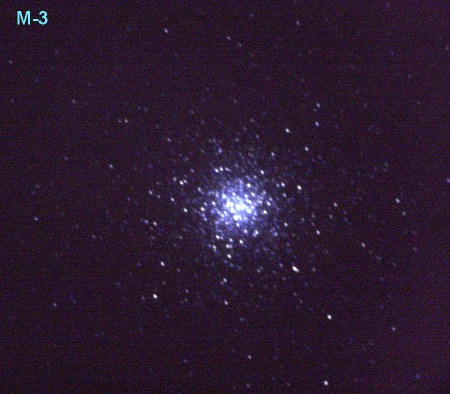
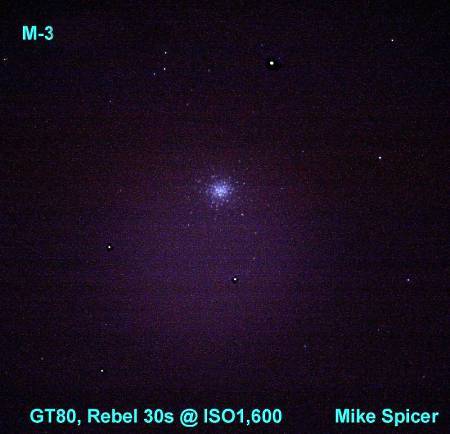
Transparency was excellent! I checked on a few variable stars with big binoculars… R Leonis stood out naked eye bright like a cherry in the sky. Saturn had passed the meridian and was out of reach for my 11″, but I set up a little GT80 refractor with the Rebel piggy-back to take some images of the sky. I tried a 135mm telephoto and then switched to imaging through the scope (using a barlow lens and diagonal). Clouds badgered my efforts. The seeing was poor but I managed a few images, and here is one of M-3, a globular near Arcturus:

Now, you may wonder why the centre of the image is so bright. That’s what happens when you obtain focus in a small telescope using a 1.25″ barlow lens in a 1.25″ diagonal! Lesson: use a 2″ setup on reflector so you can see the camera screen when shooting. That, and once achieving good focus, take a large number of shots for stacking purposes, to eliminate noise.

Jupiter in view in the SE

Up Before the Sun, 16 February

Scanning the very dark sky before twilight, Jupiter dominates the viw at magnitude -2, just 10 above the SE horizon. At the moment it sits between two ninth magnitude globular clusters, NGC 6235 and NGC 6287, moving closer to the latter with each passing day.

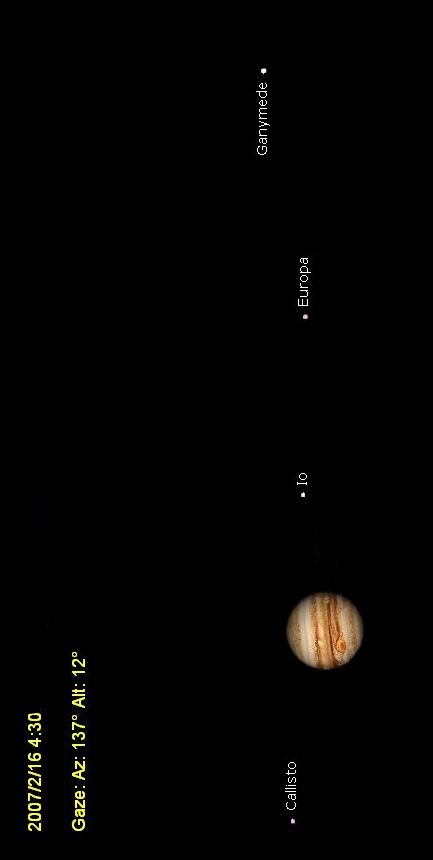
In a 6″ Maksutov with a zoom eyepiece (they’re very good) it is possible to make out a lot of detail even at the lower powers. The moons string out in a line with faint Callisto on the E side and Io, Europa and bright Ganymede in ascending distance from the planet on the W. The Great Red Spot is prominently separated from the SEB with a bright white boundary between them. GRS approaches the planet’s Central meridian and will be on it in less than an hour (5:30 a.m. in fact).

Here’s the scene:

Jupiter with the 4 moons strung out in a line