
Observing

Well, it’s been almost two months since I took a picture of the Moon, and you’re probably saying to yourself, “Gee, I wonder if John is feeling all right.” Not wanting you to think that there’s something wrong with me, here is a shot of the moon that I took tonight. Yup, John’s a geek and all is right in his world. Now, go outside and look at how beautiful the moon is.
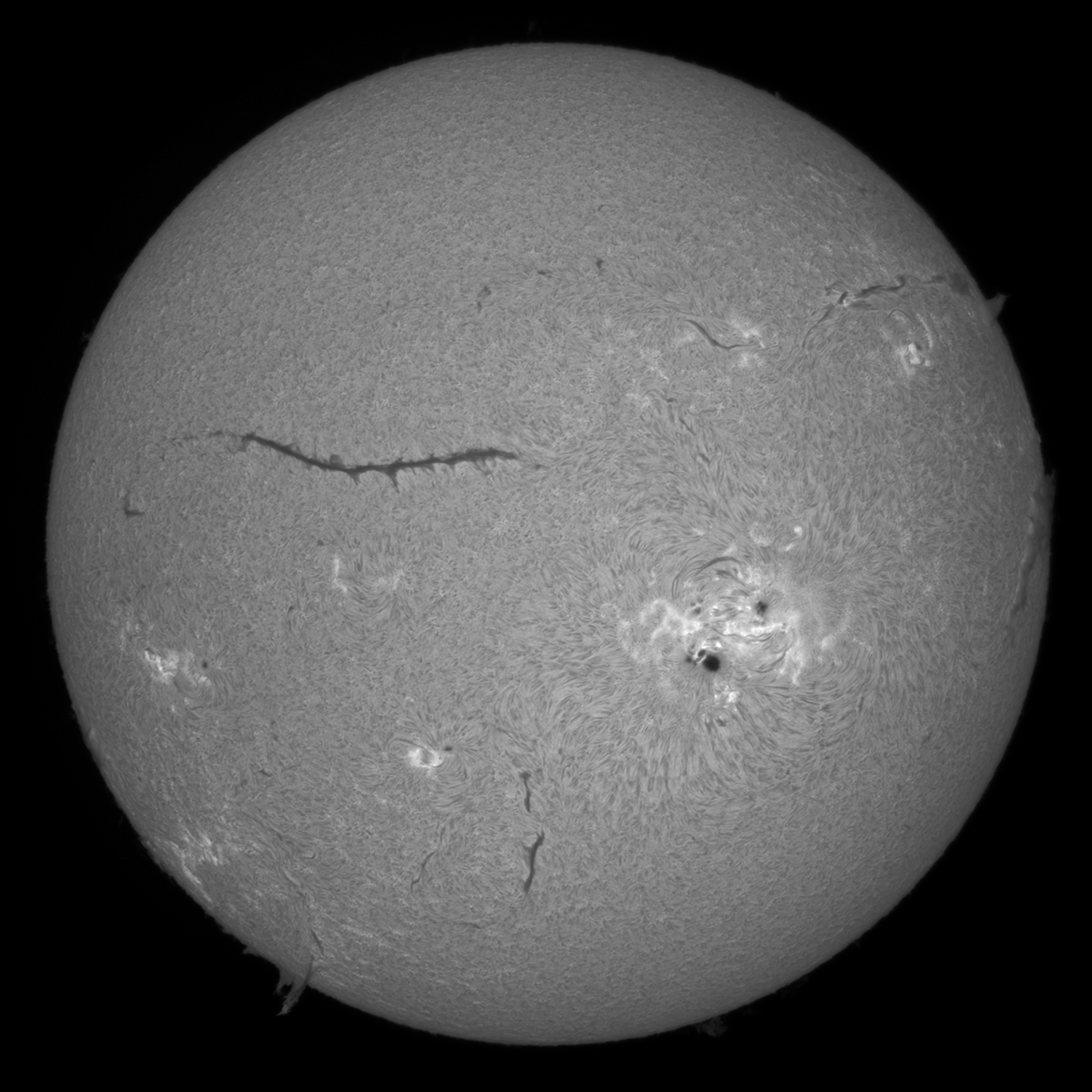
Bill imaged the Sun again today, just before an X3.1 flare was released. Sunspot Region 2192 appears to be be forming a new sunspot group. Check it out…

The largest sunspot region on the sun has now been dubbed the largest sunspot region of the current solar cycle. Here is a closeup view of the area from today (Wednesday, Oct. 22). Image was created by Bill Tekatch with a stack of frames from video shot with a monochrome Grasshopper 3 camera through a double stacked Lunt solar telescope.
This region should add considerable interest to images taken of tomorrow’s partial solar eclipse.

Today, Bill imaged the new, active, sunspot region which is just coming into view on the sun. This region was responsible for an X1.1 solar flare on Saturday, October 18. It will be interesting to watch for possible further developments as this sunspot region rotates into view.
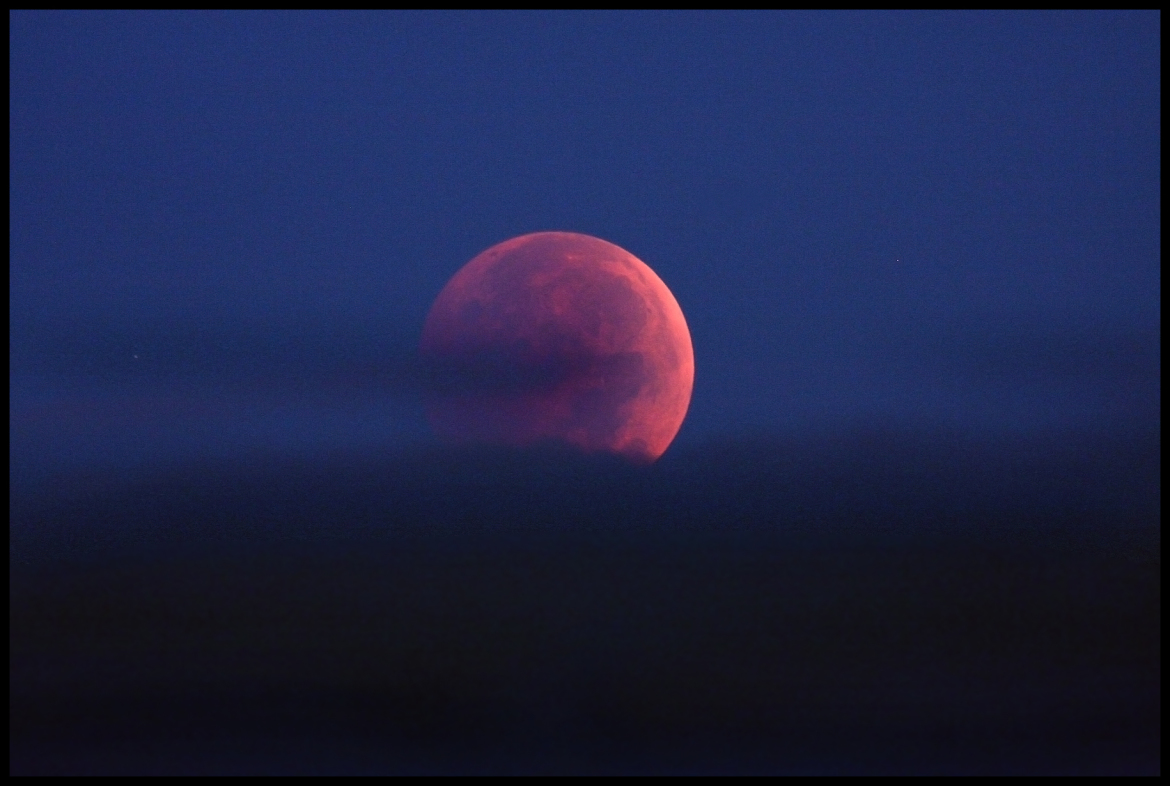
Unbelievably, the rain stopped, the sky cleared, and when I arose at 4am this morning (which was also fairly unbelievable), the moon was bright and full and headed towards the Earth’s shadow and a total eclipse.
I observed with Jim and we had some beautiful views of the eclipsed moon in the brightening sky as dawn came. The moon was red and dark this time, but part of that could have been due to it being so low in the sky.
Here are a few pics that I took. I hope you got out and enjoyed the eclipse this morning, and if you missed it, there will be another next year.

Using the same set-up that I used for the moon photo below, along with a Baader white light solar filter, I got this picture of the sun. I actually tried the day before, but had no success. Perseverance paid off though, and I am pleased with this result. Again, this is a 90mm refractor with a barlow.
Having my scope set up on my front lawn doesn’t usually attract much attention (by back yard has too many trees to see much of the sky) but setting up in the middle of the afternoon meant that lots of people stopped by to see what I was doing. So along with a couple of nice pictures, I did a bit of ‘sidewalk astronomy’ as well, and that’s always a good thing.
Remember, never look at the sun without proper solar filters and the knowledge to use them correctly.

This month’s full moon is tonight and I am hoping to get out and see its rising. In preparation (and because I just couldn’t wait until tonight!), I went out last night to view and photograph the nearly full moon.
This image was taken with my 90mm refractor and a barlow to increase the image scale. I then converted the image to black and white and increased the contrast a bit. I hope to get an image of the full moon rising tonight.
The moon rises around 7:20 tonight, just barely south of due east, and I heartily encourage you to get out and see the moon and enjoy one of the loveliest naked eye sights in the sky.

I was fortunate enough to spend the past week in a cabin on an island in the St. Mary’s River, between Lake Superior and Lake Huron. There were two clear nights out of the six I spent there, and they were spectacularly clear and dark. I had my Unihedron Sky Quality Meter with me, and it registered 21.57, even with the Milky Way high in the sky, and I could see magnitude 6.1 at the zenith. That is a very dark sky!
I took one of the club’s 8 inch dobsonian loaner scopes with me along with my own 90mm refractor, and both provided spectacular views. Of course I enjoyed spectacular views of some old favourites, like the Lagoon (M8) and Trifid Nebula (M20), the Swan (M17) and the Eagle (M16), the North America Nebula (NGC7000), the Whirlpool Galaxy (M51) and many more. The 8″ dob and the dark skies gave much nicer views than I’m used to here in Hamilton with my scope.
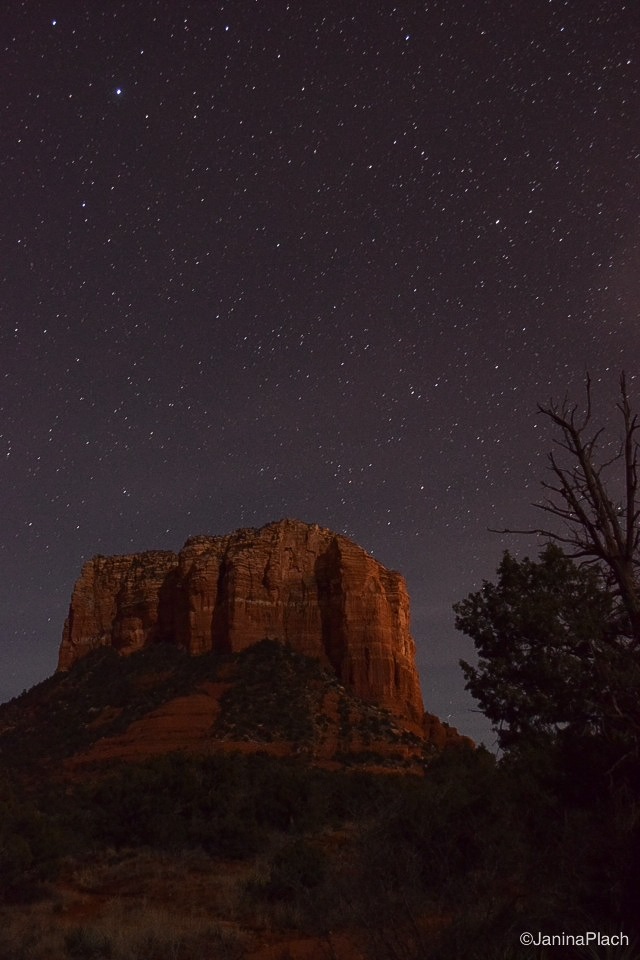
I received this photo from Janina Plach and asked her if I could share it with you. Great photo Janina! Deserts are stunning landscapes by day and equally magical by night. Recently, I had the opportunity to explore Sedona Arizona and try my luck at astrophotography. This red rock formation is named “Courthouse Butte” and was illuminated by moonlight.

Even though the conditions last night were not exactly as expected at the start of the evening, as the night wore on, it got better, and lot of work got done. Of the 10 members that came out last night, most had projects to get their equipment sorted out. I had to work out the setup of a new autogider scope and standalone guider, to work together, before I head down to Cherry Springs. Vince Chaisson was working out how his new Celestron C GEM mount works. Leslie Webb was tuning up an older Polaris mount that he hadn’t used for a wile. Matthew Mannering was getting the kinks out of his Sky Stopper wedge. Most of the group was ready to call it a night by 1:00 am.or so. I think we all where successful with our night’s work, as everyone seemed to be happy.