Moon rise over Jupiter

Well, the clouds rolled in just after we arrived – then after about 1/2hr the wind did a 180 and the clouds rolled back out the way they came – and suddenly it was so bright I thought I should have brought a book to read by the moonlight.

I stayed with viewing planets, the moon, and star clusters – sky was too washed out for anything else. We got a chance to watch a moon rising from behind Jupiter (at first I thought it was just distortion – but it was too consistent and growing, so I called Mike over to look) and the rings of Saturn were reasonably clear too. Looking through Mike’s bino viewer at the craters and mountain ranges on the moon was also a treat – there were some interesting sites along the shadow line.

I only took a few images – mainly of Saturn and Jupiter. I have processed the Jupiter sequence and will get to the others later. Unfortunately I don’t have the mount for attaching my camera to a barlow yet so my images of planets tend to be lacking detail.

Moonshine and a dirty snowball

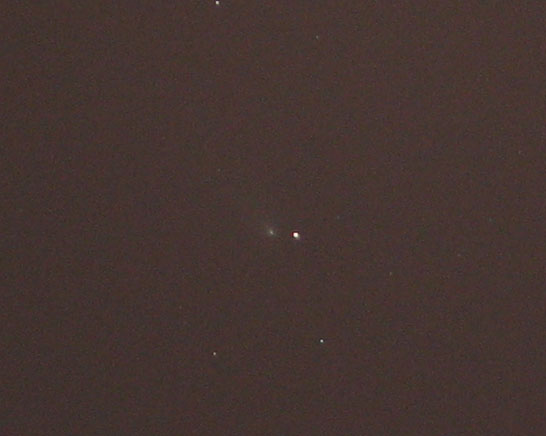
Taking Tim Harpur’s advice on focussing resulted in the best digital photos I’ve taken yet! It took some practice, but I managed to get decent images of the moon and Comet 73P last night from our backyard. I used my Canon G3 camera (an oldie but a goodie!) attached to a Scopetronix maxview adapter/eyepiece. For the comet, I used the camera’s longest shutter speed: 15 secs at f/2.0 and an ISO rating of 100 (my 400 rating causes too much noise in the images). Although the image is tiny, it isn’t bad for a first effort. (At least, that’s what I keep telling myself!) Because I took the image through the telescope’s star diagonal, the image is mirror-reversed.

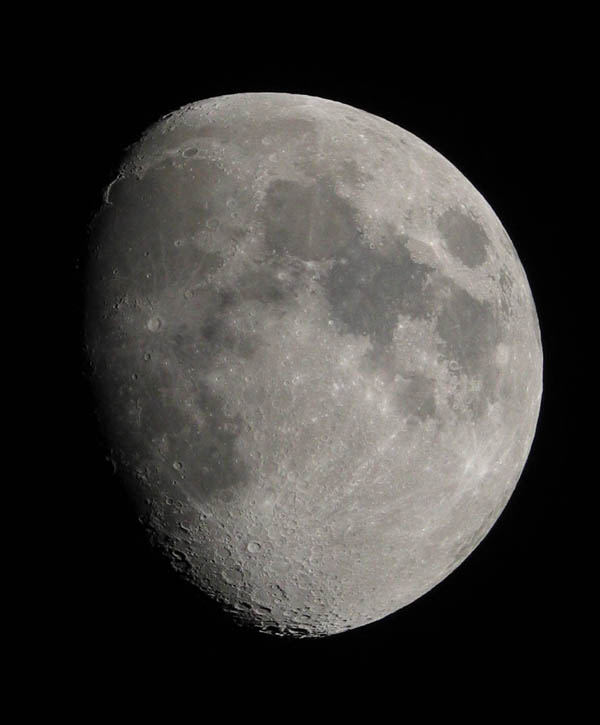
I also took an image of the gibbous moon. I used the photo editing software to un-mirror-reverse the image and crop it, but that’s the only processing I’ve done.

These are not nearly as good as the images Tim Harpur has been taking with his Digital Rebel XT, but, hey, I gotta start somewhere!

Ann

Comet 73P

Possible Nova in Cygnus

There is a report of a possible nova in Cygnus. Previously 12th magnitude, this star has outburst to 8th magnitude in recent days. The good news is that you should be able to see it in binoculars; the bad news is there is no shortage of 8th magnitude stars in Cygnus. Still for the adventurous the relevant links are below.

AAVSO Special Notice: http://www.aavso.org/publications/specialnotice/10.shtml

Provisional map: http://www.aavso.org/cgi-bin/searchcharts3.pl?name=n%20cyg%2006

Freaky Fridays for m-Io and my shadow

Jupiter has been my favourite planet to observe ever since I had a pair of binoculars. After getting my first telescope, I started to observe transits and look for the Great Red Spot (GRS) as well as all the other events that can be seen on this planet. I caught the double shadow transit in progress the other night and was quite annoyed with myself that I had been caught unawares. To ensure this wouldn?t happen again, I entered all the Galilean moon transits as well as GRS transits for the month of April into my Outlook calendar.

When I switched the view in Outlook to monthly and scanned the entire month, I noticed a peculiar pattern. Early every Friday morning in April, Io and her shadow will be transiting Jupiter. Interesting in itself, but the extraordinary part is the GRS will be transiting or at least prominent on Jupiter during each of these events!

Io will be crossing the northern hemisphere for each and so will not cross the GRS but will still give lots of pretty photo-ops I am sure.

Just what the world needed; another reason not to go to work on Fridays!

Saturn & a very abbreviated Messier Marathon

Unfortunately, we couldn’t make it out to Binbrook on Sunday night, so my daughter Alex and I went out in the backyard about 7:00 pm to look at Saturn and whatever else we could find in the evening twilight. Alex was very helpful. The first thing she did was grab hold of the telescope and pull it around to point it up at the sky. Unfortunately, it had been in its “park” position! After I re-calibrated the GOTO system and patiently (!) explained to her that she should let the computer do the pointing on this telescope, we had a look at Saturn.

Alex is getting to be quite an experienced observer, but I realized last night that this was the first time she’s ever looked through our big scope. When she looked into the eyepiece, her eyes flew open in wonder and she exclaimed “Mom! That’s Saturn!”. Saturn was breathtaking at 350X – seeing was easily 8/10 – and even in the twilight, its moons were easy to spot. We spent quite some time together enjoying the view.

Next, we looked at Sirius and then Betelgeuse to compare their colours. Always a neat way to introduce stellar evolution to kids!

Whenever the telescope was slewing around, Alex would play a kind of hide and seek with it. Another stern lecture ensued. This time highlighting the differences between a telescope and playground equipment!

Alex was quite interested in M42 – the trapezium was blazing away in a subtle cloud of nebulosity. But she decided that the Beehive Cluster was very boring. It was time to pack it in and get ready for school/work the next day.

I didn’t think of it at the time, but it might be fun to help Alex work on her own Messier Certificate. I wonder if any other parents have experience doing observing projects with their kids?

Leo Trio images by Tim Harpur [Updated]

Images from last nights Messier Madness taken by Tim Harpur. Added M3, M104, M1.

Images from Binbrook

Well, it was a nice night at Binbrook – a half dozen or so members showed up with a variety of scopes and binoculars. I did my usual and spent most of the evening imaging – I haven’t processed any of the shots yet, but having glanced at the images as I downloaded it would appear I have good shots of Andromeda Galaxy, the Leo Trio Galaxies (M65, M66, NGC3628), the Sombrero Galaxy, the Crab Nebula, and M3 (globular cluster). Once I’ve had time to process the images I will post them. Anyhow, it’s been a late night and I’ve got work tomorrow.

Update Monday March 27/06
I’ve processed the Leo Trio and they turned out well with all 3 galaxies in the field of view this time. I’ve started with the others and will post them to my gallery tonight. Andromeda, which was rather low on the Western (or North Western?) horizon, is seriously lacking contrast and in the end did not turn out to be a very good – only the core showed to an appreciable amount.

Notes from the backyard Monday March 20, 2006

It was a cold and breezy evening as I started to setup my 8? Mak and I began to become concerned as to the comfort level of the evening?s observing ahead. Being an eternal optimist, I set up on the lawn and not on the patio. This gives me the same eastern view but I can follow objects past transit without the house getting in the way. It also requires setting up tarps to block the neighbourhood street and house lights. If the wind continued to gust, I might have to scrub the session.

All the positive thinking paid off and it became quite calm around 10:30. I set up the tarps and started observing Saturn. It had passed transit and I was glad the scope was on the lawn. The seeing was poor; I had trouble seeing the Cassini division all the way around, even with the Ultra Wide 8.8mm. I thought I had found 6 moons tonight, but the interloper on the eastern edge of the eyepiece turned out to be an 11th magnitude field star.

By 11:30, I could make out Jupiter rising above the neighbours? homes and by midnight I moved the scope for a look. At first I had a look with my 52mm Erfle. This gives a nice 1 degree field of view with the Mak and I could see Jupiter?s 4 brightest moons, 2 above and 2 below. I found the view in the 8.8mm was too bright, so I got out a neutral density filter and could see some nice detail in the bands and Io was easier to see as it was approaching Jupiter. I had intended to catch Io disappear, but needed to get warm at the wrong time.

By this time, I could see Vega high in the east and decided to have a look at M57; the Ring Nebula. The 52mm Erfle showed a very distinctive ring amongst a field of stars and the 8.8 mm gave a larger but washed out view. Why? When I glanced over my shoulder, I could see the gibbous moon rising in the southeast.

I next turned my attention to the Hercules Cluster. The moon?s influence was far less while looking at M13. The core of this globular was bright and individual stars could easily be seen. I never tire of looking at it

As the moon continued to rise in the south, the advantages of the tarps became increasingly diminished. You really didn?t need a flashlight at this point and I knew the session would end soon, so I went comet hunting. I had spotted Comet Pojmanski the other morning with my 7×35 binoculars and was hoping for a treat to end the night. Unfortunately, Cygnus was still low on the horizon and sweeping the sky with both the 70mm finder as well as the 52mm Erfle came up empty.

By now, it was 3:30; I was tired, cold and wishing I didn?t have to pack it all up. Still, practice has taught me to be efficient and I had the site packed up and put away by 4. Even our cat, who generally loves to lurk near my feet when I come in the door, scurries at the sight of me carrying the tube through the door!

It was cold, the seeing was less than perfect, but it had been nice to get out with more than just binoculars for a change.


Observing Reports for March 2006

OBSERVING REPORT – 5am, Sunday March 3, 2006

In hopes of seeing the comet Pojmanski
I ran outside in my pajamski
But instead of the comet I wanted to see
All I saw was poor transparency ;( Glenn

Orion, Pleiades, and M65/M66 images from Binbrook

Alright, where were all the astronomers? Finally a beautiful night at Binbrook, and only Glenn, Gail, and myself showed up. Oh well, despite a few clouds at the beginning, it cleared up nice and with only a sliver of a moon it was a good sky.

With the Binbrook Conservation being relatively light pollution free I was able to do longer exposures at higher ISO – and also didn’t require so much filtering – which seriously damages those nice faint fuzzies. Only about half the shots turned out useful – the rest were plagued with double images caused by the occasional gust of wind we were getting. I have shots of (of course) Orion, Pleiades, and M65/M66 galaxies. So far I have processed the Orion shots – I tried something different – I took sets of images at 4 different exposure : 32s @ ISO 1600, 32s @ ISO 800, 10s @ ISO 800, and 2.5s @ ISO 800. I aligned and stacked the 32s exposures together, 10s exposures, and 2.5s exposures – then merge the images together in Corel Photopaint 10 – thus allowing to reveal the faint outer wisps while not over exposing the central nebule with the Trapezium stars. I learned something new last night – make sure the T adaptor is on tight as the slightest play will cause the images to rotate everytime the camera is tinkered with – I spent a good 2 hours rotating each set to match as they were all off by a couple of degrees.

All images were taken using a Canon Digital Rebel XT mounted parfocal on a Meade 10″ SN LXD75.
Images were process in Corel Photopaint 10, Canon Digital Photo Professional, and Registax.

by Tim Harpur

More Binbrook images – Pleiades (showing some decent nebulosity) and galaxies M65 and M66 (with galaxy NGC3628 unfortunately trimmed off the top – I’ll work on that next time) are now uploaded into my gallery.