Notes from the backyard Monday March 20, 2006

It was a cold and breezy evening as I started to setup my 8? Mak and I began to become concerned as to the comfort level of the evening?s observing ahead. Being an eternal optimist, I set up on the lawn and not on the patio. This gives me the same eastern view but I can follow objects past transit without the house getting in the way. It also requires setting up tarps to block the neighbourhood street and house lights. If the wind continued to gust, I might have to scrub the session.

All the positive thinking paid off and it became quite calm around 10:30. I set up the tarps and started observing Saturn. It had passed transit and I was glad the scope was on the lawn. The seeing was poor; I had trouble seeing the Cassini division all the way around, even with the Ultra Wide 8.8mm. I thought I had found 6 moons tonight, but the interloper on the eastern edge of the eyepiece turned out to be an 11th magnitude field star.

By 11:30, I could make out Jupiter rising above the neighbours? homes and by midnight I moved the scope for a look. At first I had a look with my 52mm Erfle. This gives a nice 1 degree field of view with the Mak and I could see Jupiter?s 4 brightest moons, 2 above and 2 below. I found the view in the 8.8mm was too bright, so I got out a neutral density filter and could see some nice detail in the bands and Io was easier to see as it was approaching Jupiter. I had intended to catch Io disappear, but needed to get warm at the wrong time.

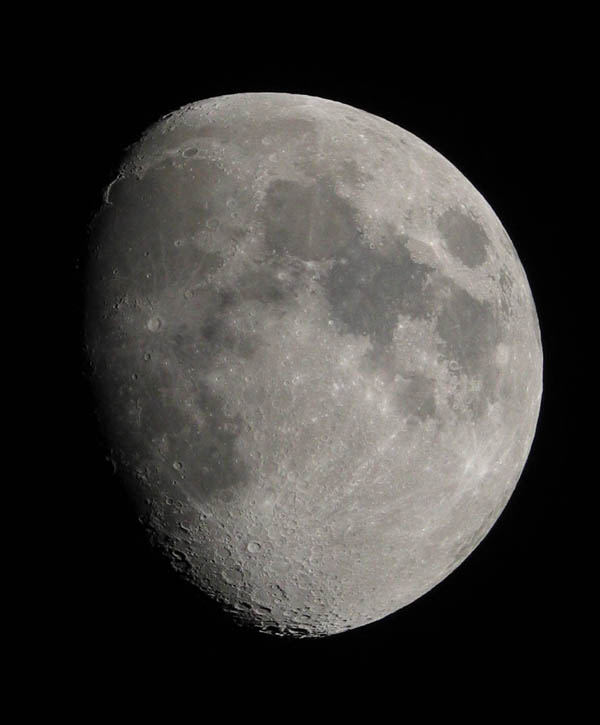
By this time, I could see Vega high in the east and decided to have a look at M57; the Ring Nebula. The 52mm Erfle showed a very distinctive ring amongst a field of stars and the 8.8 mm gave a larger but washed out view. Why? When I glanced over my shoulder, I could see the gibbous moon rising in the southeast.

I next turned my attention to the Hercules Cluster. The moon?s influence was far less while looking at M13. The core of this globular was bright and individual stars could easily be seen. I never tire of looking at it

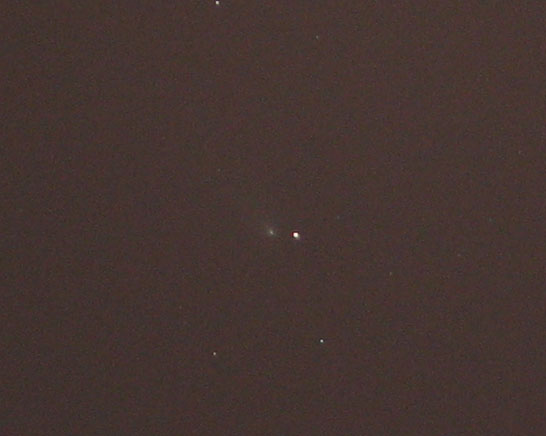
As the moon continued to rise in the south, the advantages of the tarps became increasingly diminished. You really didn?t need a flashlight at this point and I knew the session would end soon, so I went comet hunting. I had spotted Comet Pojmanski the other morning with my 7×35 binoculars and was hoping for a treat to end the night. Unfortunately, Cygnus was still low on the horizon and sweeping the sky with both the 70mm finder as well as the 52mm Erfle came up empty.

By now, it was 3:30; I was tired, cold and wishing I didn?t have to pack it all up. Still, practice has taught me to be efficient and I had the site packed up and put away by 4. Even our cat, who generally loves to lurk near my feet when I come in the door, scurries at the sight of me carrying the tube through the door!

It was cold, the seeing was less than perfect, but it had been nice to get out with more than just binoculars for a change.

Observing Reports for March 2006

OBSERVING REPORT – 5am, Sunday March 3, 2006

In hopes of seeing the comet Pojmanski
I ran outside in my pajamski
But instead of the comet I wanted to see
All I saw was poor transparency ;( Glenn

Orion, Pleiades, and M65/M66 images from Binbrook

Alright, where were all the astronomers? Finally a beautiful night at Binbrook, and only Glenn, Gail, and myself showed up. Oh well, despite a few clouds at the beginning, it cleared up nice and with only a sliver of a moon it was a good sky.

With the Binbrook Conservation being relatively light pollution free I was able to do longer exposures at higher ISO – and also didn’t require so much filtering – which seriously damages those nice faint fuzzies. Only about half the shots turned out useful – the rest were plagued with double images caused by the occasional gust of wind we were getting. I have shots of (of course) Orion, Pleiades, and M65/M66 galaxies. So far I have processed the Orion shots – I tried something different – I took sets of images at 4 different exposure : 32s @ ISO 1600, 32s @ ISO 800, 10s @ ISO 800, and 2.5s @ ISO 800. I aligned and stacked the 32s exposures together, 10s exposures, and 2.5s exposures – then merge the images together in Corel Photopaint 10 – thus allowing to reveal the faint outer wisps while not over exposing the central nebule with the Trapezium stars. I learned something new last night – make sure the T adaptor is on tight as the slightest play will cause the images to rotate everytime the camera is tinkered with – I spent a good 2 hours rotating each set to match as they were all off by a couple of degrees.

All images were taken using a Canon Digital Rebel XT mounted parfocal on a Meade 10″ SN LXD75.
Images were process in Corel Photopaint 10, Canon Digital Photo Professional, and Registax.

by Tim Harpur

More Binbrook images – Pleiades (showing some decent nebulosity) and galaxies M65 and M66 (with galaxy NGC3628 unfortunately trimmed off the top – I’ll work on that next time) are now uploaded into my gallery.

Binbrook Report

A Binbrook Report – Friday, March 3/06

I don’t remember inviting the clouds but they rolled into Binbrook about the same time we did. The forecast 30kmh winds blew them over the park in batches, forcing us to shelter by the picnic pavillion and make do with targets of opportunity.
Tim Harpur arrived just as Gail and I had set-up, and he wasted no time putting his nice new 10″ Schmidt-Newtonian on the also nice, also new Atlas mount. What a good-looking combination!
While I took advantage of the my dobsonian’s fast slewing capability, Tim took images of the Moon, Pleiades, and Orion Nebula. A new object for my log was NGC 2158, a small open cluster that is usually overlooked because it is rather faint and nearby M35 isn’t.
Out of the wind, the sub-zero temps didn’t seem too bad and by 9:15pm, the sky had pretty much cleared. We continued observing and imaging for about another hour; Tim taking several exposures of galaxies M65 & M66, and M1 the Crab Nebula while Gail & I checked out the likes of M96, M79, M44, M48. When the the cold began to creep through boot soles we finished off with a look at Saturn then packed up to a coyote serenade.
Not a bad night at all!

Binbrook Observing on Friday Night

Gail and I are hoping to end the Binbrook observing drought this Friday night. If the promised clear sky materializes, we’ll open the gate about 7:30pm.
Check back for confirmation – I’ll post by 6pm, Friday.

Hal Mueller’s Blue Moon image

Check out this Blue moon image added by Hal Mueller.

More images by Tim Harpur

M37 M38 and Saturn. Click link above to go directly to the images.

Orion by Tim Harpur

The weather was beautiful last night – I hope you didn’t miss out. By 9:00pm the wind had cut down and the sky was almost cloudless – I was still viewing from a light polluted area though. The temperature seemed rather warm – more so than expected, and I was out until 11:30pm imaging. After setting up my 10″ Meade Schmidt Newtonian OTA on an LXD75 GoTo mount and letting it cool down I checked the collimation with my new laser collimator and found it to be accurate and unaffected by the car ride over (I had used the laser collimator to collimate the scope before heading out). A quick polar alignment and I was good to go. I planned on spending most of my time imaging so after a quick view of Orion through the eyepiece I removed the 1.25″ focuser tube and replaced with my new T ring adapter for my camera – what a difference a collimated scope and imaging parfocal makes! I took some new shots of Orion that far exceeded anything I had taken previously – I don’t mean to be over exposing the Orion Nebula (just kidding) but I’m using it as my baseline for learning astro-photography – and you should still check out these new images as they are that much superior to previous attempts. Then I turned my attention on a few star clusters – the Pleiades, M37, and M38. Saturn was sharp but small in the fast wide field optics of the SN – looks like a good 2″ barlow is required for decent planetary pictures. I will be adding the images mentioned as I get them processed.

The first of many images to come are the Orion set:

Orion Nebula Feb. 25, 2006
Meade 10″ Schmidt Newtonian
with Canon Digital Rebel XT mounted parfocal.

19 images x 15s @ ISO 1600, 4 images x 15s @ ISO 800

processed with Registax and Corel Photopaint 10

By Tim Harpur

Observing Last Night

Saturday, February 25, 2006

Trying to observe, last night, was a lot like trying to cross a busy street. Though the low level winds had subsided, the upper level continued to push through batches of clouds that had me swinging the scope all over the sky.
Despite that, the transparency over Grimsby was quite good and the sight of Saturn sitting adjacent to a pretty combination of stars and moons made the effort worthwhile.
The sucker holes also afforded me brief glimpses of Nebulae M42, M43, M78, NGC2071, and open clusters NGC2244, NGC2112, and NGC2232.
A nice comparison, right now, is Aldebaran and Mars. Exhibiting nearly the same colour and brightness, if you observe Aldebaran first, the roundness of Mars is a good example of what to look for when identifying Uranus and Neptune among their neighbouring stars.
I just had time for a quick visit with M81 and M82 before the “busy street” turned into a parking lot but it was nice to finally do some observing.

New images by Tim Harpur

See these new astro-images of Orion and Saturn by Tim Harpur.