Possible Northern Lights

Space Weather News for Jan. 23, 2012
http://spaceweather.com

INCOMING CME: Big sunspot 1402 erupted on Jan. 23rd, producing a strong M9-class solar flare and a fast-moving coronal mass ejection (CME). Analysts at the Goddard Space Weather Lab say the CME should reach Earth on Jan. 24th at 14:18 UT (+/- 7 hr) and Mars a little more than a day later. Strong geomagnetic storms are possible when the cloud reaches Earth. Our magnetic field is still reverberating from a CME impact on Jan. 22nd, so another blow could spark impressive auroras at high latitudes. Sky watchers in northern Europe, Canada, Alaska, and northern-tier US states such as the Dakotas, Minnesota and Wisconsin should be alert for Northern Lights.

HAA and Winter Cub Camp

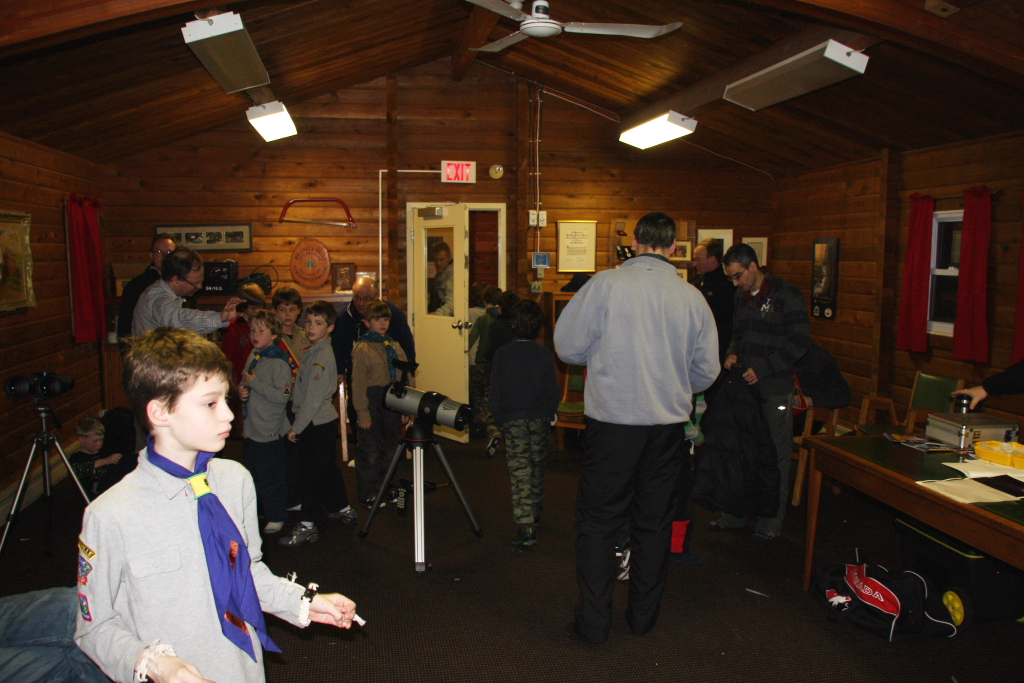
Sat Jan 14, 3 members of the HAA attended a regional cub camp at Blue Springs Scout Reserve near Acton. The HAA had been asked (via Brenda Frederick – HAA member and cub leader) to do a series of presentations to help over 60 cubs work towards earning their Astronomy badges. Since this is the type of thing our club loves to do, we jumped at the chance to help. My thanks to Joe McArdle and Steve Germann for coming along with me to put together an effective and enjoyable program for the kids (and their leaders too). We talked about types of telescope, showed them meteorite fragments, helped them find the North Star, talked about some constellations and legends surrounding them – and more. A full program where we broke up into 3 teams and rotated the kids through the various sessions.

We actually had clear skies, but their program was so full, we didn’t have time to set up any scopes afterwards to show the kids views through them.

A lot of fun as always, but now I have a sore throat from all the talking 🙂

ASX 9th Annual Symposium

The Astronomy & Space Exploration Society, based out of U of Toronto, will be holding their Annual Symposium on Fri Jan 20, 2012 at Convocation Hall (UoT) from 7pm to 10pm. There are 3 very interesting speakers lined up and admission is very reasonable if you order in advance. More information can be found at: http://tinyurl.com/79n7yc9
This may be of interest to HAA members and others who frequent our website.

Chance to see Russian Mars Probe

The Phobos-Grunt Mars probe that has been stuck in low Earth orbit since early November is due to make a series of favourable passes over Hamilton in the upcoming week. When a booster rocket failed to put the probe in the proper location, a valuable Mars mission was lost and instead of going to Mars, it is doomed to re-enter the Earth’s atmosphere in the new year. It may be a poor substitute for the lost mission, but it makes for a spectacular satellite going overhead, so see it now while you can. Sightings for the upcoming week can be found on the Heavens-Above website:
http://www.heavens-above.com/PassSummary.aspx?satid=37872&lat=43.096606&lng=-79.828561&loc=Binbrook+Conservation+Area&alt=197&tz=EST

Chance to see Chinese Space Station

Starting tonight there are several excellent opportunitites to see the Chinese space station, Tiangong 1, fly over. This unmanned station appears like other satellites, as a star (sometimes as bright as magnitude 0) travelling across the sky in a straight line and with no blinking lights.

Accompanying it is the Shenzhou 8, an unmanned craft being used to practice docking. The Shenzhou 8 will appear as a fainter light in the same orbital path, but could appear before or after the station. We don’t know how long the docking practice will continue, so get out and see this pair while you can.

Here is a link to the Heavens-Above website with sighting predictions for the station. Good luck!
http://www.heavens-above.com/PassSummary.aspx?satid=37820&lat=43.096606&lng=-79.828561&loc=Binbrook+Conservation+Area&alt=197&tz=EST

*****UPDATE*****
Shenzou 8 successfully returned to earth on November 17. You can still catch the Tiangong 1 space station as it flies overhead.

Solar observing

Janice and I were out at about 2pm today looking at the sun and counted 10 sunspots. We used a bushell 15-45×60 spottig scope with image projection onto a white piece of paper mounted on a clip board. Aim the scope by looking at the scope’s shadow on the ground, then focus the image on the paper. You can then increase the image size by moving the paper further from the scope and re-focusing. Checked on spaceweather.com to cofirm the sightings. Remember, never look directly at the sun with eyes or viewing through the scope!!

2005 YU55 Asteroid Closest Approach tonight

I have posted a finder chart on the club’s Facebook page for the asteroid, 2005 YU55. The finder chart is for observers in Hamilton and was made using Project Pluto star charting software. You can access the chart by clicking on the title of this blog entry.

YU55 is a 400 meter wide asteroid that will be passing between the Earth and our Moon this evening. The asteroid will be about 11th magnitude and moving very quickly. It will not be visible to the naked eye or in binoculars. In a telescope, it will appear like a point of light moving slowly against the background stars. To see the movement, you will need to watch its position change over time – it won’t be moving as fast as artificial satellites appear to do.

If the weather co-operates (!!) I hope you all have a chance to watch or record this exciting and rare event.

Io, Its Shadow and The Great Red Spot

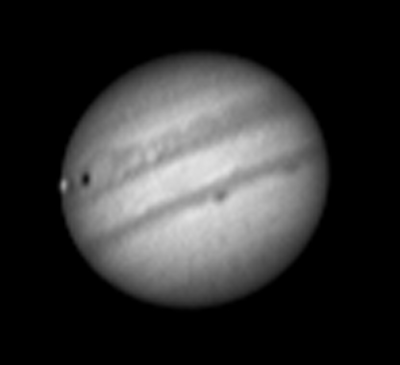
Matthew was right – Io and its shadow were crossing in front of Jupiter’s Great Red Spot tonight. I took some video of the event with a webcam, stacked the best frames using Registax v6 and this image is the result.

Jupiter’s moon, Io, and its shadow crossing in front of the Great Red Spot. Photo by Ann Tekatch.

Recent observations of jupiter

I was out tonight watching Io and its shadow transit of Jupiter. The shadow was very sharp and the moon was an indistinct blob beside it against the southern equatorial band (135x mag). With about 15% of the transit left to go, Io all of a sudden became a sharp tiny disk right beside the shadow. I followed it until Io separated from Jupiter. At the moment Jupiter is showing 3 dark brown spots on the northern eq. band. I’ve found out that they are called ‘barges’. Had a good look at the moon also, concentrating on the regions around Clavius and Copernicus. A few nights ago I was watching Jupiter and saw for the first time many more cloud bands in both of the mid-lattitudes clearly withouot filtering. I also saw Ganymede as a distinct disk for the first time. All in all, it’s been great observing Jupiter while its at conjunction. PS… While observing the transit tonight, I felt quite sure that Io was also transiting the Great no-so-red spot. A programme I use to check the grs position didn’t seem to agree, however i’ve been on cloudy nights and some one has announced that this was going to occur. So I watched a transit on top of another transit. Cool!!!

Lunar X on the moon tonight

According to my RASC calendar, the “Lunar X” will be visible on the moon tonight around 11:00 pm. Hope the clouds hold off long enough so I can take a picture!!! The “Lunar X” appears for a brief time around first quarter moon when the sun illuminates the edges of some craters, making an “x” shape. This appears along the moon’s terminator (the line that separates the illuminated part of the moon from the uniluminated side), about 1/3 of the way up from the bottom edge of the moon. It “may” be visible in binoculars, although I’ve never tried to see it with them.

Here is a link to some great photos of this lunar feature: http://www.astropix.com/HTML/SHOW_DIG/Lunar_X.HTM

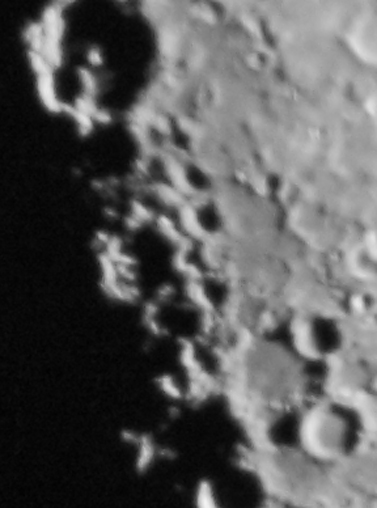
Update: Clouds moved in about 10:00pm, but I managed to catch the beginning of the Lunar X’s appearance. You can see it in the cropped photo below. The X is near the bottom of the photo and is just visible against the dark background.

The Lunar X appears near the bottom of this photo, highlighted against the dark background.