VENUS TRANSIT .. 5 June 2012

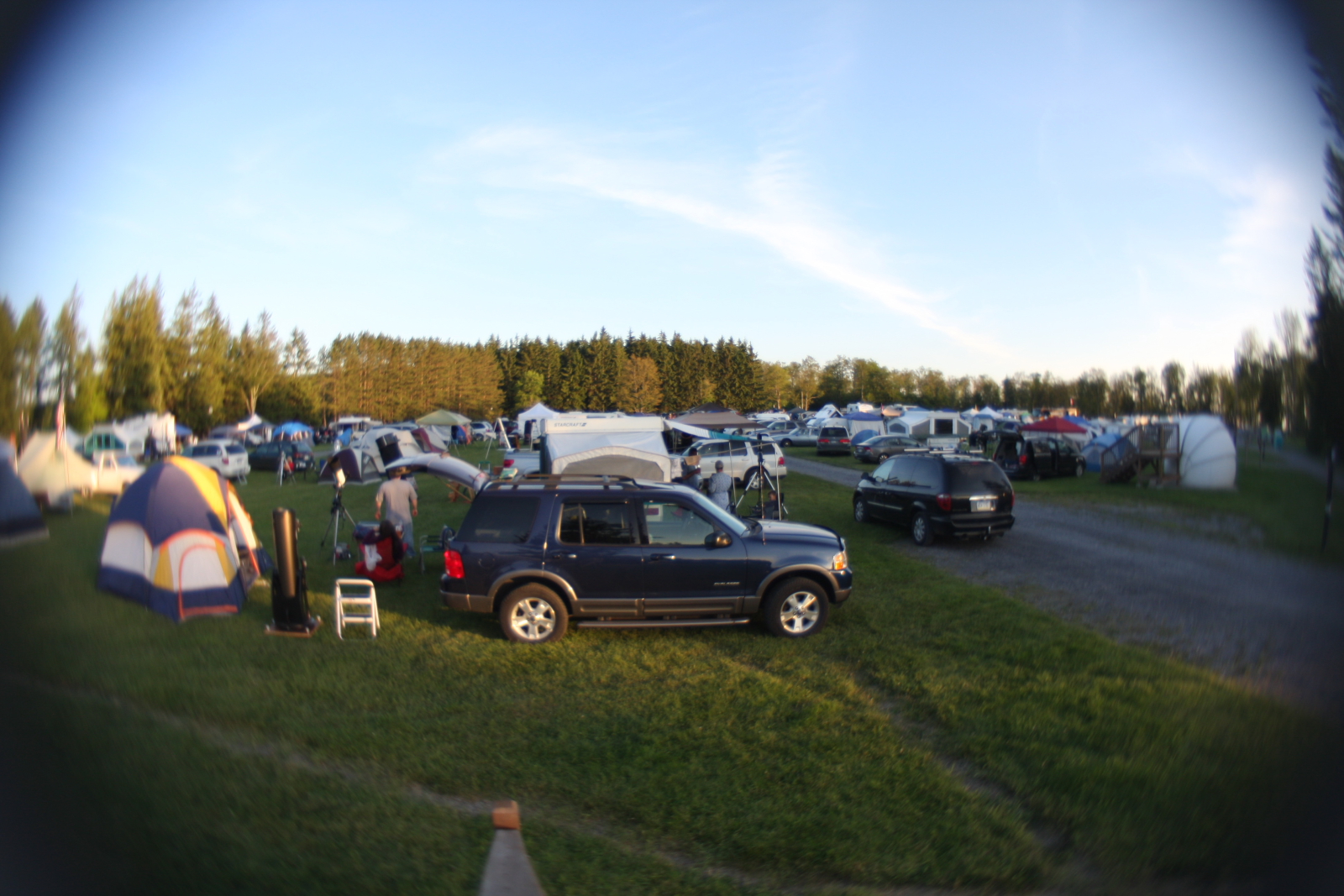
Tuesday, June 5th started out overcast with rain threatening but the clouds started breaking up in the afternoon, just in time to set up equipment and prepare for the transit event that started about 6 pm local.

My setup was an 11″ SCT with binoviewer and a separate 4″ apo, both with appropriate solar filtering, of course! Passers-by saw the telescopes on the front lawn and stopped off for a view of the planet Venus in silhouette against the sun. Every few minutes a thick cloudwould hide the view in the 4″ apo, but the big telescope was largely undaunted, and a binoviewer gave a 3-D like view of Venus and several sunspot groups.

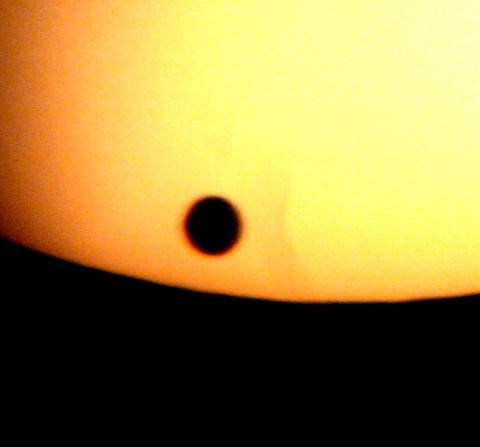
Therese took some handheld snapshots, one of which follows:

Therese – hand-held shot through 32mm Tele-Vue eyepiece on 11 inch Nexstar SCT

AstroCasm swap meet cancelled

This is just a personal note and FYI, it’s not an official club notification. I was asked to notify HAA members and others who may have been interested in attending.

Some of you are aware that the Hamilton Centre of the RASC had planned an event for the astronomy community called AstroCasm. This was to entail a daytime swap meet with vendors, plus a banquet in the evening.

Regrettably due to a major problem at the venue, the swap meet that had been planned, has been cancelled. The banquet is still scheduled to occur at a new location. Those with tickets should have been notified separately. Details can be found at the link provided.

Transit of Venus

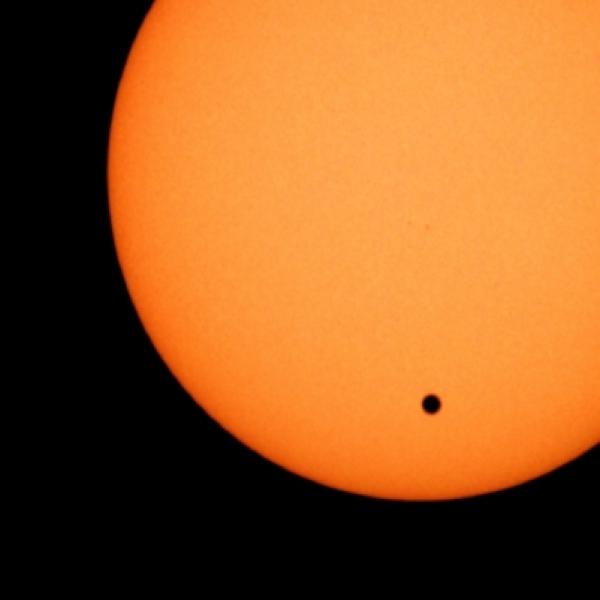
On June 5, 2012, there will be a rare celestial event – the transit of Venus. A transit is when an object passes in front of another, in this case, the planet Venus will pass in front of the Sun. The last time this occurred was in 2004 and it won’t happen again until 2117. So this will likely be the last chance to see this event during your lifetime.
Venus transit

For our area (southern Ontario), we won’t see the entire event. It will begin around 6pm and will end while the transit is mid-way complete at sunset. But the 2-3 hours visible from our area will provide plenty to see. The most spectacular parts of the transit are mostly at the beginning (ingress) and at the end (egress). During ingress and egress (the latter egress will not be visible from our area since it will occur after sunset) provides an opportunity to see something called the black-drop effect where the black dot of Venus appears to pull the surface of the Sun (or the Sun pulling on the surface of Venus) drawing the sharp edge into a “drop” effect. Fortunately this is potentially quite visible from our area.
Black drop effect

Special Note: Please do not look directly at the Sun either with your eyes or through any device such as a camera, binoculars or telescope without proper safety filters. The strong sunlight can cause permanent eye damage without adequate protection. There are properly approved solar observing glasses available or safe filters you can purchase to protect you. Alternatively you can also use a pinhole camera to project this transit safely onto a white sheet of paper. Plans for these can be found on the internet.

The HAA does not have any official plans to observe the Venus transit on June 5. Many of our members will be traveling to locations outside of our area to better view this rare event. However there are other groups in our general area which will be hosting special public viewing sessions. We encourage you to look up these activities and view this once in a lifetime event. They will all have safe equipment for viewing the event and most will have free solar glasses. Check out these websites for more details. There may be other events so check the internet and your local newspapers.

The closest to our area is McMaster University and McCallion Planetarium. They will be holding a large event on their campus:
http://www.physics.mcmaster.ca/planetarium/

The Dunlap Institute and the University of Toronto will be holding an event at Varsity Stadium:
http://universe.utoronto.ca/special/transit2012

The Ontario Science Centre will be hosting their own event:
http://www.ontariosciencecentre.ca/calendar/default.asp?eventid=1206

University of Guelph will be holding an event on their campus:
http://www.uoguelph.ca/events/2012/06/transit_of_venus_planetgazing.html

As will University of Waterloo:
http://waterlootransitofvenus.eventbrite.com/?ebtv=C

Several of the regional chapters of the RASC will be holding events in the area:
Mississauga (UofT Erindale campus) – http://mississauga.rasc.ca/
Niagara (Port Dalhousie) – http://astronomyniagara.com/

Partial Solar Eclipse 20 May 2012 – part 2

A number of the HAA members got out to enjoy the partial eclipse from our location. We knew there wasn’t going to be much of a show since we were only expected to get about 18% covered and the Sun would set before the eclipse completed. However that didn’t discourage us from trying.

Some members ended up at Binbrook Conservation Area to view the event from that location.

Ann Tekatch got some nice shots and posted them in her own Facebook album.
Ann’s album

Jim Wamsley also captured a nice sequence of images and has posted them on SkyDrive. If this link works, it should give you a slide show of his images.
Jim’s SkyDrive slideshow

And then I went down to Port Dalhousie (near St Catherines) to capture the event over Lake Ontario to try for a few extra seconds of visibility. It turned out to be a busy spot since the weather was so nice. So I ended up doing some sidewalk astronomy. I had several pairs of the solar glasses which we shared amongst the many people and I showed some of the images I had captured. A lot of fun.
Don’s Facebook album

Sample image
Partial Solar Eclipse

Partial Solar Eclipse Sun May 20, 2012

If you were in Northern California or Nevada, you would have an opportunity to see an Annular Solar Eclipse. This is an event when the Moon passes in front of the Sun. But the Moon is at or near Apogee, which is the furthest it gets in its elliptical orbit around the Earth so it appears a bit smaller and doesn’t quite completely cover the Sun leaving a thin ring of light (the Annulus).

If you’re not fortunate enough to be located there, you can still see a partial eclipse from most of the Western and Central regions of North America. However the visible duration of the eclipse is reduced more as you move further East. Sadly those along the East coast won’t see anything as the Sun will have set before the eclipse occurs.

For those of us in Southern Ontario, we do have a chance to see a small portion of this event. Sun will set during the eclipse so we might only see the beginning of it.

First a Warning: Never look directly at the Sun, even near sunset, without proper safety eye protection. This means using an approved solar filter or perhaps a #14 welders lens. Failure to heed these precautions could result in permanent eye damage. Another option is pin hole projection: one piece of paper with a pinhole held in front of another used as a screen. You can sometimes use the shadows of leaves in this fashion – though the shadows may be rather long due to the late time of day.

Since this event is going to occur near sunset and we won’t have much time, to maximum that little time, try to get as far West as you can and overlook water or a very low horizon. Also a mountain cliff could work. You want to minimize the obstructions on the horizon as much as possible. Look West (compass bearing 287 degrees from our area) and follow the Sun as it sets. It will begin approx 8:20pm from our latitude and end when the Sun sets at about 8:35pm.

The following is a chart showing the path of the eclipse and the areas which will see a partial eclipse. Click on image to see larger version.
Partial Solar Eclipse Path

NASA also has an interactive Google Map here which can give some information. It mostly shows the path of the total eclipse, not the partial areas. But it does provide start times for other areas – it just doesn’t indicate when sunset occurs and the end of your viewing. Note: this site is a bit slow due to volume.

Our Facebook page also has a link to the Sky&Tel’s website which has links to more information.

At the time of this posting, the forecast for area is expected to be clear on Sunday. Please enjoy safely.

Binbrook Observing – 16 May 2012

Forecasts for very clear skies drew out more than a half dozen HAA members to our favourite observing location, Binbrook Conservation Area. The CSC was indicating, while cear and above average transparency, the seeing was expected to be poor. Fortunately that part of the model was incorrect and we had very steady and crisp conditions. It was a bit windy initially, but it eventually settled down.

HAA members Gord, Vince, Les, Matthew, Don, Tony and Mike all showed up eager to get some observing in. And the skies didn’t disappoint. A variety of equipment was set up with DOB’s refractors and SCT’s of various sizes which gave us opportunities to view objects through different scopes for comparison. There was lots of conversation and swapping of gear so we could better learn which is best of our respective needs.

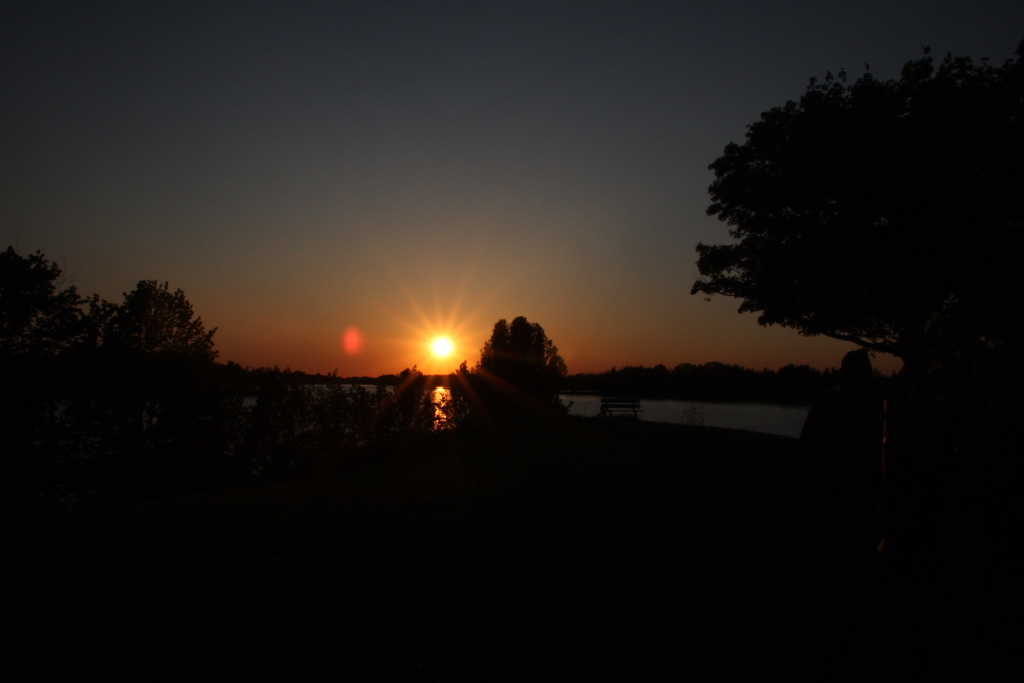
Sunset at Binbrook

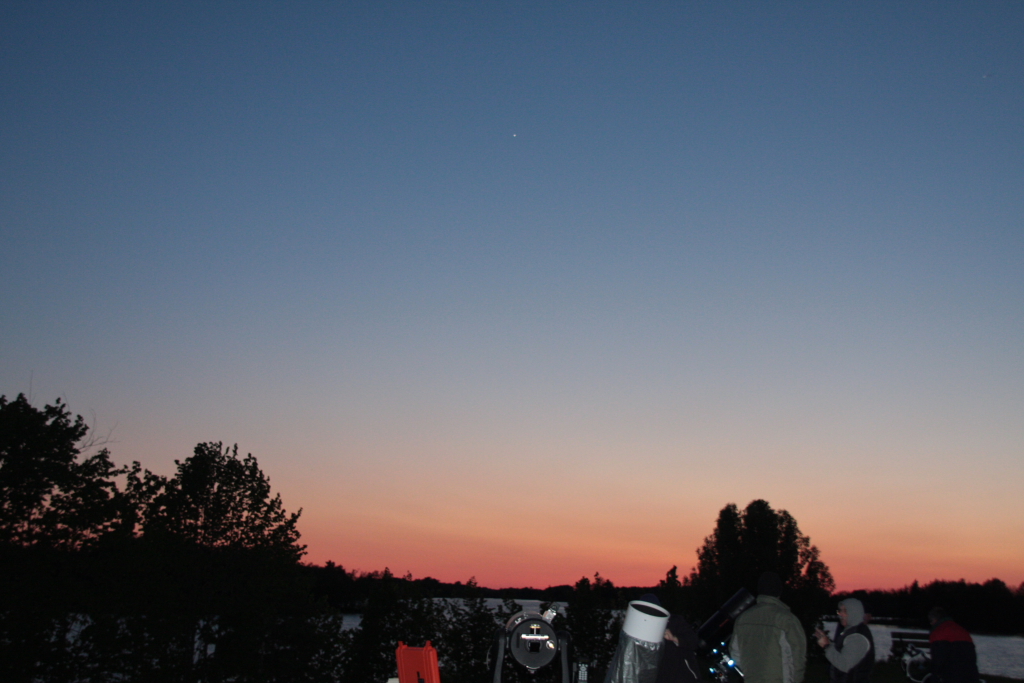
A beautiful sunset greeted us as we were setting up, along with Venus waving good bye as it gets ready for its transit of the Sun and transition to a morning star.

Setting Venus

More images can be seen in the album on our Facebook page.

March 31 Grimsby Public Stargazing Event

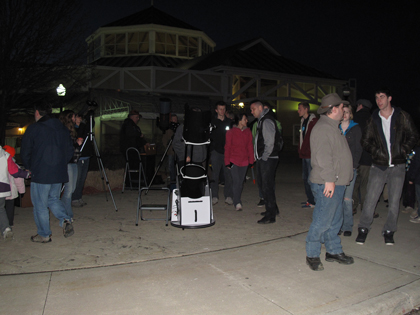
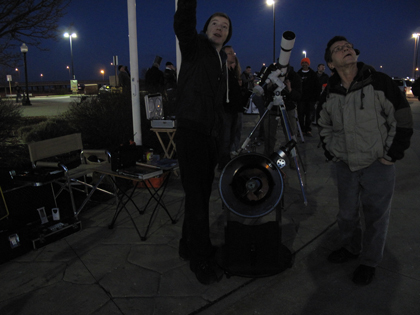
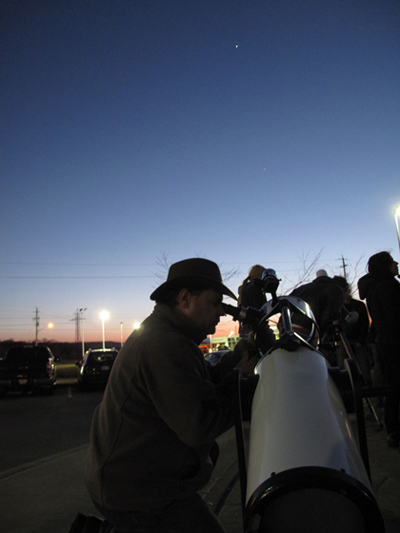
Our public event in Grimsby last Saturday coincided with Earth Hour and the manager of Grimsby’s Welcome Centre turned the building’s lights off. This made it easier to show the night sky to the hundreds of people who showed up. Many HAA members also attended. (At least two dozen by my count!) So there were many telescopes and binoculars available to offer views of Jupiter, Venus, Mars, Saturn, the Moon, various double stars and Messier objects. I have included a few photos and hope that others add to this entry.

A view of the crowd

Kevin pointing out planets

Joe viewing Venus

Hubble’s “Hidden Treasures” contest

From our Facebook page, the Hubble team with NASA and ESA are sponsoring a contest to find some of the hidden treasures in the vast stored archive of the Hubble images collected over the past 22 years. It actually consists of 2 parts. First is to find things that hasn’t been found by conventional processing or the original science team (they may have been looking for other things). The second part is to use some free tools that have been made available to process images and submit them. You can work on one or the other task.


What I found interesting is that a professional tool (FITS Liberator) produced by PhotoShop for the Hubble team has been made into open source (free) for participants to use. It’s already a powerful and useful package, but making it open-source, many programmers can contribute to make it even better. And the beauty is that you can use it without having to purchase PS. Now you can have a powerful tool designed specifically for astro-photography for processing your own images.

Prior to the contest, there were amateurs who scoured the archives looking for interesting things and making significant discoveries (like comets, supernova, galaxy collisions, etc) that hadn’t been seen or recognized by the original science team. But there are huge quantities of images which haven’t been looked at. This contest gives regular amateurs like you and me a better starting point for us to get into the “game” (more tools, info and help). Amateurs from all over the world are getting into this project – and you can too!

The main link with more info, images, software downloads and more can be found here.

Moon Venus Jupiter Conjunction – Night #2

Once again a number of the HAA members headed out to Binbrook to take advantage of the clear nights and collect more images of the Moon-Venus-Jupiter conjunction. On Monday night, the Moon had moved enough in its orbit that it was now near Venus rather than Jupiter as it had been the night before. Hopefully some of them will share their photos on this blog. I’m sure some will be appearing in the April edition of the EH newsletter.

My photo of the Moon and Jupiter setting below the Skyway was shown on CHCH news during the day on Monday so this inspired me to try again that night. I went to various locations around town trying to find interesting backdrops to go along with the wondrous view that the conjunction offered.

Below are links to some of the images I collected. It was fun running from location to location with nothing more than a camera. No telescopes, big tripods or other associated gear to haul around. Just the eyes and camera were all that was needed to enjoy this site (as is often the case for many night sky apparitions. All these images were taken under skies with lots of city lights, yet it was still something easy to see and enjoy.

Click on images to enlarge them.

Moon-Venus-Jupiter conjunction at Discovery Centre

Conjunction from behind the old Discovery Centre on the waterfront. Too bad it isn’t used any more.

Moon-Venus-Jupiter conjunction at Harbour West

From Harbour West near Pier 4 and the Hamilton Yacht Club

Moon-Venus-Jupiter conjunction at Bayfront Park

Overlooking Bayfront Park with the conjunction behind.

Moon-Venus-Jupiter conjunction at Sam Lawrence Park

Sam Lawrence Park. Jupiter is just to the left of the prominent tree near the center of the image and some of the city lights are off to the right.

Moon Venus Jupiter conjunction – Night #1

Some of the HAA members ventured out to Binbrook Sunday night to enjoy the conjunction of the crescent Moon along with Jupiter and Venus. I wasn’t able to join them, needing to run out to Burlington and then get home quickly. But that didn’t stop me from taking my camera along and capturing some shots on my trip. It was very windy and quite cool, but with a camera tripod, I was able to set up quickly and take these images. You don’t need fancy gear to enjoy this beautiful viewing opportunity. Just your eyes are enough. But you can also use just about any camera to record this view so you can enjoy it over and over.

Moon and Jupiter conjunction setting below Burlington Skyway Bridge

Moon-Jupiter conjunction as it set below the Burlington Skyway bridge.
(Venus is hidden behind the bridge. Click to enlarge.)

Moon Jupiter and Venus Conjunction over Hamilton Harbour

Moon-Jupiter-Venus conjunction overlooking Hamilton Harbour.
(Click to enlarge.)

Tonight (Monday 26 March) is another opportunity to see this conjunction. The forecast is calling for clear skies. Tonight the Moon will be closer to Venus with Jupiter just below. Head out just after sunset and look West – you can miss these bright objects.