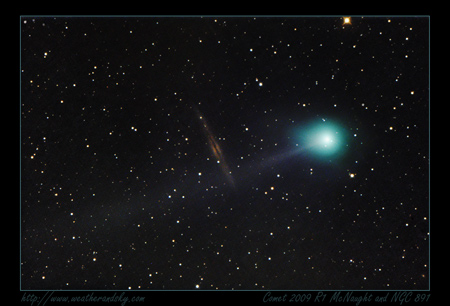
Comet McNaught meets NGC891

Hey gang,

I actually set my alarm clock for this very early in the morning on June 8th. It’s a 19min (1min subs) shot of Comet 2009 R1 McNaught and NGC891… it certainly took way more than 19 min to process though! Yikes! Deep Sky Stacker has a routine to stack the comet with no star trailing but unfortunately it wasn’t working for me. So I had to do it manually by running it so that it would stack just on the stars (so comet was blurred and NGC891 was sharp) and then again where it was stacking on the comet (stars were trailed). I blended both images in PS in lighten mode to get this final result. Hope you like it or at least find it interesting 🙂

McNaught, I believe is around mag 6.7 and still getting brighter.

The image below is almost a full frame taken with the QHY-8 and 8in RC (1625mm fl) so the comet is not that small.

http://www.weatherandsky.com/main.php?g2_view=core.DownloadItem&g2_itemId=7946

KerryLH

Mars meets Regulus, and more

It’s been cloudy for the past few days. But now we’re expecting a couple of clear nights. It will be a good time to get out and look for Mars as it passes the bright blue star Regulus in the constellation Leo.

The closest pairing, as identified in the 2010 HAA Calendar, was Sunday night (June 6), but Mars will still be close for the next few evenings. Here’s a sky chart showing the position of Mars in the Western sky.
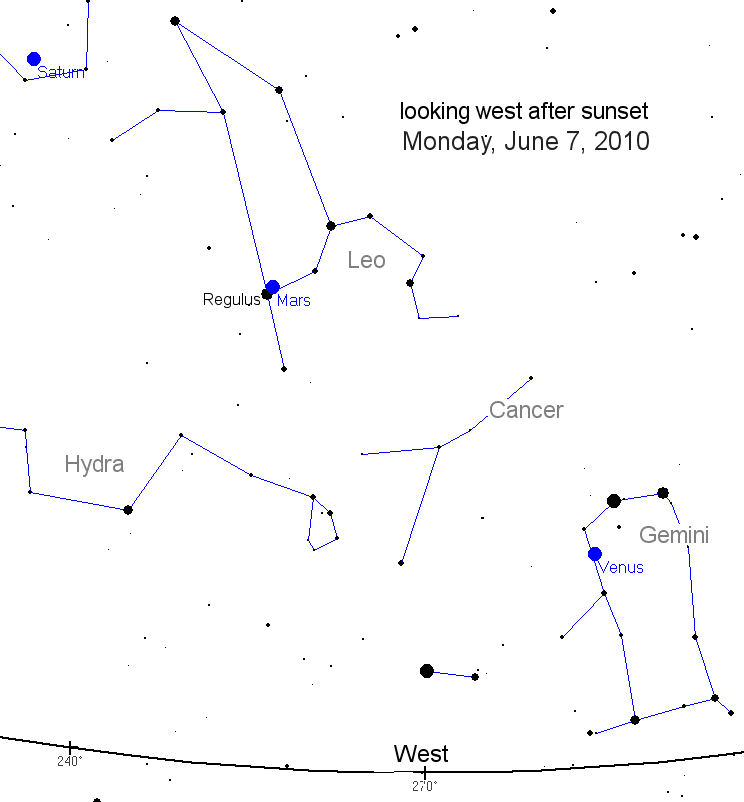
Mars and Regulus

And of course Saturn is nicely positioned nearby for another wonderful view. In a few months, Saturn won’t be positioned as conveniently or as high in the sky so now is the best time to enjoy it.

On Fri June 11, 1 hour after sunset, Venus will be in a straight line with the 2 main stars of Gemini – Pollux and Castor. This will be a pretty sight and photo opportunity. Find yourself a good clear view to the West without city light glow if possible.

Venus aligned with Gemini

If you’re an asteroid watcher, Ceres is approaching opposition (occurs on June 18) which is when this object is closest to Earth and easiest to see. It’s travelling through the constellation Sagittarius towards Ophiuchus.
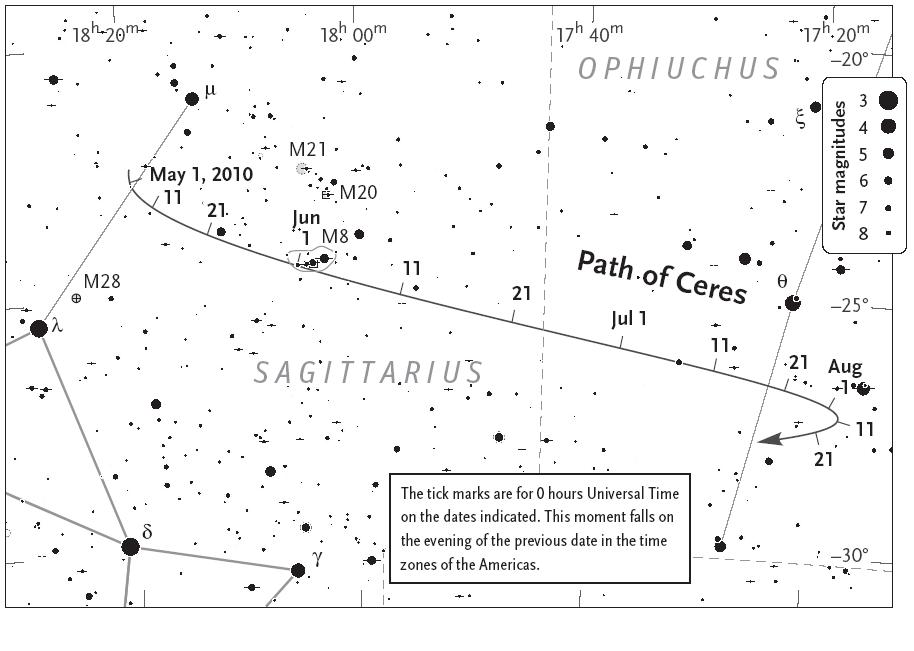
Ceres in 2010

Path of Ceres leading up to opposition.

It’s a faint object (mag 7.3), but one that most amateur telescopes 3″ and larger can detect. Even a good pair of binoculars are capable of spotting this asteroid when it’s this close. It will be interesting to see it change position each night. Just carefully observe the target star field and keep an image in your mind (or better is to sketch it). Then see what changes each night as you go back to the same area.

For the early morning observer, Jupiter is nicely positioned (with Uranus nearby). There was another asteroid impact on Jupiter recently (June 3). There are some videos of the flash from the impact over on Spaceweather.com.
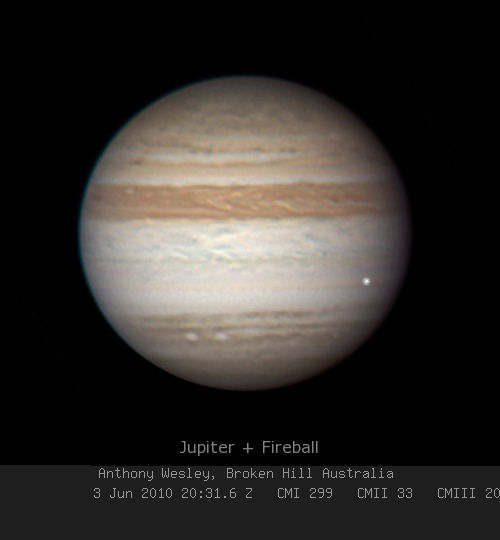
Jupiter flash
So far no one has seen a dark spot resulting from the impact, but you may be the first to detect it. The recent impact, the one from last year, and the detection that Jupiter lost it’s South Equatorial Band (SEB) was all first discovered by amateurs just like you – so you have just as much a chance of spotting the debris field as any one does. Don’t forget us when you achieve international fame for your discovery!

A reminder that the Cherry Springs Star Party is coming up later this week. There are a few spots left. Today is the last full day for online registration if you’re thinking about going. At $40USD, it’s a good deal. A number of the HAA membership will be there. It’s always a good event with lots of interesting speakers and a great location.

And be sure to check out the latest edition of our newsletter Event Horizon which is now online, for more things that will be coming up over the summer months.

Clear skies!

(images courtesy of Spaceweather.com and Skyandtelescope.com)

Observing at Tyneside – Mon May 24

If you’re not going out to watch fireworks, then I invite you to join some others at our alternate observing location on Tyneside Rd. I’ll be heading out for about 9-9:30pm.

The skies will be clear though the gibbous moon will be fairly bright. We may get lucky and see some sporadic meteors which will be our own private fireworks show. Plus with Venus, Saturn and all the other wonderful items in the night sky, who needs fireworks?

Since some have school or work tomorrow, we probably won’t stay too late. But even few hours of observing will be fun.

Sidewalk Astronomy at McQueston Park-Wed.May 19

(Wednesday, May 19)
Several club members are taking their telescopes to Hamilton’s McQueston Park to do some sidewalk astronomy tonight. We’ll probably arrive 8:30-9:00 and stay for a couple of hours. McQueston Park is on Upper Wentworth Street, just south of the Lincoln Alexander Parkway, on the east side of the street. Join us if you can.

Update:
There were 6 of us at McQueston Park tonight: Jim, Joe, Kevin & Ed, Me and Don. Together we showed the wonders of the Moon, Venus, Saturn, Mars and assorted stars to about a gazillion kids and their families. Many of them had never looked through a telescope before and there were far too many “Galileo Moments” to count! A very satisfying, but exhausting, evening for us.

13 Things That Saved Apollo 13

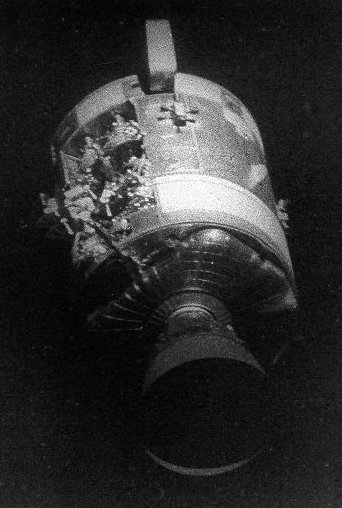
Last month marked the 40th anniversary of the Apollo 13 mission, which was dubbed as a “successful failure”. Due to a ruptured oxygen tank on the Service Module, the 3 astronauts nearly didn’t make it back.

No doubt many of you have seen the Tom Hank’s movie “Apollo 13”. While not entirely accurate, it was reasonably close in most regards. (Some artistic license was taken for dramatic effect)

Universe Today has finished their work on a series of web-based articles titled “13 Things That Saved Apollo 13”. It’s a 13 part (plus introduction) covering various things about what it took to bring these brave men back home. Some things match what was in the movies, and corrects some errors. Plus it has information that you may find new and interesting.

13 Things – Apollo 13

It features lots of fascinating photos and video clips of the events as they unfolded, and from interviews taken on the 40th anniversary celebrations held in Houston last month and elsewhere.

I had thought about preparing a presentation for the club some time, similar to what Randy Attwood did for Apollo 11. But when I saw this, I realized it would be hard to do much better than they did. Well researched and informative. Granted it is primarily through the eyes of a few individuals, but they were at the heart of the events and I don’t think they missed much in the areas they covered.

Apollo 13 damage

I think everyone will find at least one or two things to take away from this great series. I hope you enjoy it as much as I did.

Fun night at the BCA

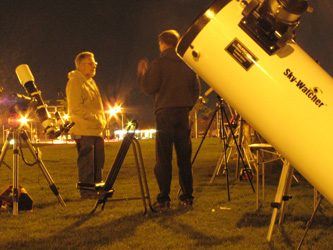
A phone call from John G.,to go out observing, prompted me to send out an E-mail to the membership to join us at the B.C.A. We opened the gate at 9:00 pm, and shortly after there were 9 HAA members happily setting up scopes. In the group were Ed & Keven Salwach and a new member, Jason Bourne. Also John G.,John M.,Joe M.,Andrew B.,Steve G.and myself. Scopes in use included 3 Schmidt Casagraines, 2 Apo’s, Keven’s small but mighty Newtonian, as well as various Bino’s.
Keven’s enthusiasm was infectious amongst the group as we skimmed through many of the spring galaxies and open and globular clusters. Keven’s excitement built as his “young eyes” peered through some larger apperture scopes. He was able to pick out details that the rest of us were hard pressed to appreciate with our “aging” vision. The viewing list included the Sombrero and Whirlpool Galaxies, M86 and 85 the Trio in Leo and much of the Virgo Galaxy cluster. M13 was also a stunning sight. There were many other celestial wonders too numerous to mention in this blog.
We wrapped up the night right about 12 a.m. as clouds were starting to roll in on us. Some of us reconvened for coffee and conversation at Tim Horton’s.
I invite the others that were present last night to please add to this blog or comment as they see fit.

Photo courtesy of Joseph McArdle

H.A.A. makes Spectator front page

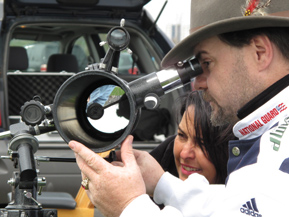
Even though the weather didn’t co-operate with us this Astronomy Day, that didn’t stop H.A.A. members from doing what we do best, getting out in the public and sharing our knowledge with others. This was evident in the Spectator front page photograph and caption by Cathie Coward. This showed Joe and Ann helping Gina Lippa collimate the telescope she has had for 5 years and was never able to use. Gina has become a member of the club and is now looking forward to joining us in the future, to put her scope to good use. Thanks Joe and Ann for a job well done.

Astronomy Day Report

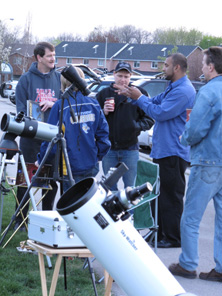
Many HAA members attended our Friday night event at McQueston Park. Although the skies were hazy, excellent views of the Moon, Saturn, Mars and Venus were shared with the public through over a dozen telescopes.

Astronomy Day (Friday evening) at McQueston

Our Saturday afternoon solar observing session was almost completely clouded out with just a few glimpses of a hazy solar disk through white light and h-alpha filters. That didn’t stop the public from coming out to ask questions and get help setting up their own telescopes.

Joe helps Gina set up her telescope properly.

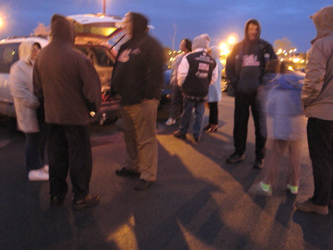
Nine HAA members attended the Saturday evening session at McQueston Park from 8:00 until about 9:00. True to the weather forecast, the skies were cloudy and a light rain was falling. In spite of that, about a dozen members of the public showed up. We couldn’t set up any telescopes because of the rain, but an impromptu tailgate party quickly ensued. John Gauvreau showed his meteorite and explained “falling stars” to an appreciative group while the rest of us answered astronomy and telescope questions.

Tailgate Astronomy in the rain at McQueston Park

About 9:00 the parking lot began to clear and the remaining HAA members headed to Tim Horton’s for well-deserved hot chocolates and coffees.

Lyrids Meteor Shower – Apr 21/22

As noted in the HAA calendar, overnight tonight (April 21 into the early morning of Apr 22) is the Lyrids Meteor Shower.

This is a medium intensity shower with an average of about 15-20 meteors per hour. However these travel at high speeds (over 100,000 km/h) when striking the Earth’s atmosphere. This can produce intense but very quick streaks. Some years have produced much higher strike rates. The average magnitude of these meteors are about +2 (similar to some stars in the Big Dipper), but occasionally can produce fireballs which are brighter than Venus and can leave a smokey trail which can last for a few minutes.

The Lyrids (also known as the Alpha Lyrids), which appear to emanate from the constellation Lyra, are remnant dust from comet Thatcher (C/1861 G1). We can see sporadics on any given night (1 or 2 per hour), but their point of origin if traced back along their path, will not be from Lyra. That’s how you can differentiate them.
(Speaking of comets, Phil Plait over at the blog “Bad Astronomy” has just recently added a “10 Things You Don’t Know About Comets” feature which might interest some of you.)

Lyrid meteor shower skymap

Click this link for a larger version of the map or this link for more info (courtesy of SpaceWeather.com).

If the skies remain clear overnight, the best viewing will be in the early morning several hours before sunrise. If you are a night owl or can get up really early, this meteor shower can be a rewarding show. Like all meteor showers, you will see more from a dark location than from within the city. So perhaps consider a trip out to Binbrook or some other rural area.

It’s also a fairly broad shower, which actually runs from about Apr 16 through to 26, but the peak is during this evening. So if you don’t see them tonight, you can try over the next couple of nights or early mornings, though the rate will drop off. Sadly we probably won’t see any of these on Astronomy Day from the location of McQueston Park due to bright lights and time of the event. But you can be sure we’ll be trying.

Good hunting!

Clear Skies Bring Many Out to Observe

Sunday night saw clear skies attract several observers out to the alternate site, where even a cold, stiff breeze couldn’t dampen our spirits. The air was not too transparent, but very steady and the wind kept the telescopes dry.

Jim’s 9.25″ pulled in a variety of objects, while Don showed spectacular views of Saturn through his 5″ refractor. Ann ran a marathon through a large part of the Messier list with her 6″ Dobsonian, and Jackie provided encouragement and coffee to all. I, naturally, brought my small but mighty 80mm refractor. Like Don, I took a few pictures of the moon. Here’s the Earthshine, also known as the ashen light, nestled in the overexposed arms of the sunlit crescent.

The Moon seen through my 80mm refractor.

My main objective was to photograph Mars next to the M44, the Beehive Cluster. I tried to get this shot last week but I was clouded out. That same night last week, Bob Christmas got a beautiful shot from his observing site up north. Compare this shot that I took last night, to his shot seen in his blog entry below (“Bob Christmas’ Images from Spectacle Lake” April 12, 2010).

Mars and M44 imaged through a camera being piggybacked on my 80mm scope.

Notice how much Mars has moved relative to the cluster. Mars is moving away from the cluster now, but still looks beautiful in binoculars or a wide-field scope. Be sure to check it out yourself.

A good night of observing is almost always the result of good company, and last night sure was a good night.

__________________________________________________________

FUTURE OPPORTUNITIES

Later this year, as the M44 sinks into the west, there will be another planetary encounter. On June 20th, Venus will pass even closer to the Beehive than Mars did. Venus moves appears to move across the sky quicker than Mars, so there are only a few days centered on the 20th to catch this sight.

For a really close encounter, wait until July 6th, 2011. Mercury will pass directly through the heart of the cluster. Knowing how fast Mercury moves in its orbit, you only have one chance to see this sight! The night before and the night after, Mercury will appear near the cluster, but only on the 20th will it appear as an extra star in the cluster.

Enjoy!

John