An Exciting Night on Jupiter

Well, I admit that I have no idea if it was an exciting night on Jupiter. It might have been, but if it was, nobody invited me to that party. Ah, the life of an amateur astronomer.

I can tell you that I had a pretty exciting night out at the alternate site looking at Jupiter. Along with a couple of other fine HAA members we waited for Jupiter to clear the trees so we could start observing the planet right away. There were two satellite transits in progress, as Ganymede and Europa passed in front of the giant planet. Accompanying them were their shadows, and it made a lovely sight. Ganymede’s shadow was significantly larger than Europa’s, which came in and out of view as Jupiter struggled through the low atmosphere. As Jupiter climbed higher, Ganymede emerged from the limb, showing a clear disk, at one point half on and half off of Jupiter’s disk. The view through Jim’s 8″ SCT was very colourful and clear. Within an hour Europa emerged as well and shortly after that Io appeared from behind Jupiter. As the evening started Jupiter showed only one moon, Callisto, and within a couple of hours all four Galilean Satelites were visible. The fine view of the surface detail on Jupiter was also excellent, but with the activity around it, with two shadows, two transit egresses and a shadow egress, it was all we could hope for in one night. We were all just thrilled with the evening’s observations.

Speaking of Galileo, Jim gave three women who emerged out of the park a ‘Galileo moment’ as they all enjoyed their first view through a telescope and were delighted to see Jupiter and its moons and shadows. After an evening of fishing and, uh…other acitivites best enjoyed in the wilderness, they were excitied enough with the view of Jupiter that their comments were of a nature that can’t be repeated here.

Jupiter is near oposition right now and as such is visible all night. I used ‘Starry Night’ software to predict the satellite events and it got the timings exactly right. Other similar software or the RASC Observer’s Handbook will do the same for you, so you too can enjoy this wonderful Jupiter season. I’d love to read about your Jupiter observations here on the blog, or send them to your friendly local observing director ( observing@amateurastronomy.org ) and I will be happy include them in a report.

Out of Town Observing

Many of the HAA members are going to be observing out of town this weekend. For those so inclined, you might want to consider joining them at either of these 2 locations.

This weekend is Starfest (Aug 19-23) at River Place Park, just north of Mount Forest (off Hwy 6). This is an annual right-of-passage for many amateur astronomers.

With skies that are darker than Binbrook, far from any major city, it boasts a very large open camping field with lots of room to observe the night sky. And since it’s a star party, there are 3 days of speakers, presentations and demonstrations for the beginner and more experienced astronomer. Many astronomy dealers will also be there with bargains to help you fill any gaps in your gear. This is about a 2 hour drive from the Hamilton/Burlington area. Go for the day or camp overnight.

Information, fees and directions to Starfest can be found here:
Starfest Info

River Place Park

Alternatively, some other HAA members are heading down to Cherry Springs, PA, USA for a long weekend of observing in even darker skies.

This is the home to the Cherry Springs star party in June, and the Black Forest star party in Sept. Beautiful country and very dark skies, with a very well set-up astronomy field for observing and camping. Camping is $10US a night (very reasonable). It’s about a 5 hour drive (including border crossing, etc). With many Canadian and American astronomers heading up to Starfest, this field should be quiet, but with great observing.

Information about Cherry Springs can be found at:
http://www.dcnr.state.pa.us/stateparks/parks/cherrysprings.aspx

And Google directions:
Cherry Springs State Park

Observing at Tyneside – Sat Aug 15

New member Vince Chaisson is looking for people to go observing with him tonight over at the Tyneside location. If you are interested in joining him please leave a comment so he knows he won’t be alone.

Map to Tyneside location:
http://www.amateurastronomy.org/sites/binbrookCA/BinbrookTyneside1.jpg

Except for a risk of fog, the conditions are looking pretty good for tonight.

Pleiades Occultation

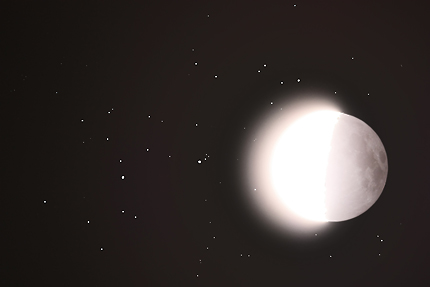
Early this morning the last quarter moon slid in front of the Pleiades, rewarding any early risers with a beautiful sight. I will give a brief description of my experience here, but I hope to see other reports from around the club posted as well. It will be fun to read everyone’s different experiences.

I rose around 4 and popped outside for a quick binocular view (to check the sky condition and be sure that the celestial clockwork really had brought the moon and Pleaides together. Hey, it was 4am and I was a little sleepy!). I then set up my small but mighty Orion ED80 refractor, and was immediately rewarded with a wide field view showing a bright moon and many of the brighter Pleiades. A few experimental photos (very hard to get the bright moon and faint stars in the same picture. Ok, more than hard for someone like me – impossible! Maybe someone else has better results) and a few shots of the moon itself, which provided a wealth of detail. I could count 5 terraces on the inner wall of the crater Copernicus. I was slow getting my scope up due to a set-up error on my part (remember, sleepy) so I missed the disapperance of Electra at 4:30, but I watched as others disappered behind the bright limb of the moon. I also saw Celeano just as it reappeared from behind the dark limb (just lucky, as I didn’t know when it would reappear). Overall, a very worthwhile event.

I rounded out the morning, as the sky was now brightening, with some views of Venus and Mars. Although the disk of Venus looked large when compared to Mars, it was tiny Mars that showed detail on its surface. As daylight overtook the sky I returned to the moon for a last look at Copernicus. What a fun session. I look forward to hearing about your observations.

The moon is overexposed in this 10 second exposure, although the dark side shows well. The original shows more of the fainter stars.

Pleiades Occultation morning of Aug 14

Thanks to a heads up from our EH editor, Tim Philp, the moon will be occulting the Pleiades star cluster early on the morning of Fri August 14, 2009.

Starting around 4am local time, the moon will slowly glide in front of various stars in the Pleiades cluster, causing the stars to wink out and back again. I haven’t checked if there will be any “grazers” from our latitude, but it will be a nice show, easy to spot with the clear forecast predicted for the early morning. (The only weather risk appears to be some fog.) At that time, the moon will be high in the sky, almost due South.

Each star occulted by the moon will blank out for about an hour (the time it takes the moon to travel it’s own width across the sky). Since it’s passing through the heart of the cluster, it will take several hours and may continue past sunrise. (This will be “potentially” an interesting opportunity to see stars with a scope during early daylight since the moon will be easier to spot, and therefore know where to find some brighter stars.)

This will be visible from anywhere, even from within the city, and you won’t need a scope. But binos or a scope, as well as a darker location, will allow you to see more stars being covered, and generally make the show even more impressive.

So if you are an early morning person, or are willing to make the effort, you should be well rewarded. This will also be a great photo-op. You might even catch a few straggling Perseids.

Perseid Watchers, look for R CrB

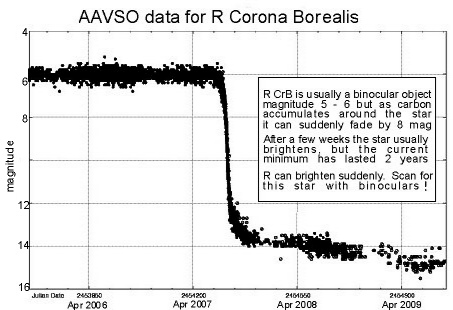
Three years ago during the Perseid meteor watch, observers were able to catch the long period variable star Chi Cygni overhead, shining at magnitude 3.5 – the brightest it had been in decades. This year, alas, Chi will be at minimum during the Perseid shower but observers can scan the western sky for R CrB, a variable star in the constellation of Corona Borealis, the Northern Crown.

R CrB fades and brightens suddenly! Most of the time it is between magnitude 5 amd 6, a naked eye object if you know where to look. It has been beyond the reach of 12″ telescopes for the last two years, but you never know when it may pop back into view!

Perseid Meteor Shower

The following is taken from the SpaceWeather web site. There will be a bright moon, but this meteor shower is always worth watching. You could see early Perseids already! Stay tuned for information on club observing activities on Perseid night.

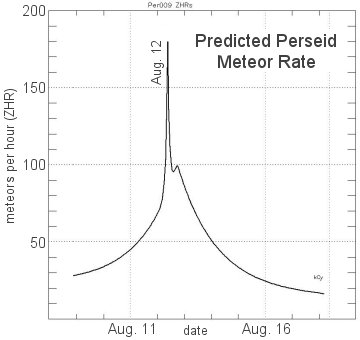
“POSSIBLE PERSEID OUTBURST: This year’s Perseid meteor shower could be even better than usual. “A filament of comet dust has drifted across Earth’s path and when Earth passes through it, sometime between 0800 and 0900 UT (1 – 2 am PDT) [4-5am August 12, local time in Hamilton – John] on August 12th, the Perseid meteor rate could surge to twice its normal value,” says Bill Cooke of NASA’s Meteoroid Environment Office. The following profile is based on the debris stream models of veteran forecasters Jeremie Vaubaillon and Mikhail Maslov:

The filament was shed by Perseid parent comet Swift-Tuttle in the year 1610, and this is one of Earth’s first encounters with it. “In addition,” notes Cooke, “the main Perseid debris stream, which we run into every year, may be denser than normal due to a gravitational enhancement by Saturn. The total combination of these effects could result in as many as 200 meteors per hour (ZHR).”

Side Walk Astronomy in the Park

5 Members showed up at the park on Upper Wentworth and the Linc last night. We all had a good time showing the about 60+ people(young and old) views of the Moon and Jupiter.There was still wow factor in the Moon even though it is only a day or so from full. The terminator showed lots of detail of craters and mountains. Jupiter was showing lots of detail the equitorial banding and the colours were clearly evident. Many questions were asked and answered and many (O My God’s, wow’s and cool’s)were heard from the public.
Hopefully some of the other members will add the comments to this blog.

__________________________________________________________________

From John G.

You’re right Jim, it sure was a lot of fun.
As the night wore on and the public left we had a good look at Jupiter.
There was a 6th magnitude star (45 Capricorni) right in line with the Galilean moons, and it gave the appearance of 5 moons. Jim was able to correctly identify which of the 5 was the imposter. Well done, Jim! You can look tonight for yourself and see 5 “moons” on one side of Jupiter.
Meanwhile, Steve K. and I were trying to identify the impact scar on Jupiter, and had a great time comparing views through our two 5″ achromat refractors, and comparing the clean, bright image of Steve’s orthoscopic eyepiece with the comfort and wide field of my Pentax. Both gave excellent views, and we were able to see a wealth of detail in the bands of Jupiter (including festoons and knots) and yes, we did see the impact scar in the south polar region. Unfortunately we didn’t stay late enough to see the GRS come around the limb. What a fun night!

side walk astronomy

A Few members will be out at McQuesten Park on Upper Wentworth south of the Link tonight for some side walk astronomy – feel free to join us.

A Sunspot Tease

Bert Rhebergen, the local sunspot expert, called me tonight with a heads-up about a possible sunspot (or sunspot group) just about to come into view on the solar disk. Tonight about 8:00 pm, he spotted a complex group of faculae on the limb of the sun. Bert explains that faculae (which appear as lighter patches on the sun’s surface when viewed through a white-light solar filter) often accompany sunspots. The patch swinging into view may be associated with a new sunspot. So I would encourage anyone with a proper solar filter or a PST to dust them off and watch the sun over the next few days.

Of course, any note about solar observing has to contain a warning to only observe the sun through a proper, safe solar filter.

Stay tuned for further developments…

Ann T.