Public Night In Grimsby – April 4th

Members of the Hamilton Amateur Astronomers will be sharing an evening of Astronomy, telescope equipment demonstrations, and viewing of Saturn, the Moon, and other celestial objects.

We will be setting up in Grimsby on April 4th,

(note: the event was a success. there will not be a repeat of it on April 5)
with a rain/cloud date of April 5th, at 8 PM,

and will remain until about 11 PM.

Currently, the rain and clouds are forecast to clear out late Saturday afternoon making for a clear night.

There is a nice promo article in this week’s Grimsby Lincoln News:
http://www.thegrimsbylincolnnews.com/news/article/246033

(The article does say it starts at 7pm – but G&G can be there for any early arrivals)

Those who come early will be able to see what it takes to assemble and set up a telescope.

If you have a telescope, bring it along: we can help set it up and point it at Saturn for you. If you have binoculars, by all means bring them too. Binoculars are an excellent and easy to use way to get more from the sky.

As part of the International Year of Astronomy, we will also have some handouts to interest children and adults.

Detailed directions can be found here:
http://amateurastronomy.org/sites/grimsby_murray/map.php

Sidewalk Astronomy Wendsday April 1

As the weather for the weekend is looking “iffy” at best, forecasting cloud and rain Fri. Sat. & Sunday,I am going to set up my scope at the park in front of the Tim Hortons on King St. in Dundas.If the sky is clear this afternoon as predicted. I should be there by sunset or shortly after. Please feel free to join me with your scope, or just stop by for a look through mine.

M46 and NGC2438

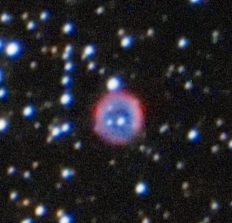
This pretty open cluster skimmed barely above the treeline. Probably as low as I can get in the southern direction from home. It’s in the constellation Puppis and has a little planetary nebula NGC 2438. The cluster is fairly rich with about 150 stars that range from mag 10 to 13. Also nearby is another open cluster M47… which can probably seen in the same field of view with binoculars.

Imaged with the C6-SCT @f6.3 and QHY-8

Crop showing Planetary Nebula NGC2438

Larger version:
http://www.weatherandsky.com/main.php?g2_view=core.ShowItem&g2_itemId=5075&g2_imageViewsIndex=3

KerryLH

Chomping at the bit!

This is my first post so please forgive any mistakes I may make. Three weeks ago, I ordered a 12″ Skywatcher Collapsible scope from KW Telescope. By this weekend, it still hadn’t come in so they lent me their “test-bed” version. I will need help learning how to collimate it correctly, but I gave it a go and was able to use it tonight for the first time. It was amazing! I have never seen so much detail in the Orion nebula, or so many small craters on the moon (I’m used to a 80mm refractor). Collimation wasn’t bad up to about 110x. I am looking forward to Grimsby on Saturday and would appreciate any help from other members on how to collimate properly. Maybe I’ll even have my own 12″ by then.
Hopefully see you all there.

Cubs night was a success

Some members of the HAA club executive were available and invited for an astronomy presentation requested by 97th Hamilton Wolf Cubs, last night.

The format was designed to support their ‘Astronomy’ badge requirements, and is in 5 parts.
* A cub with an astronomy badge has learned about how to find the North Star, and how to show someone else how to find the north star.
* We taught them about Meteors, and had a sample meteorite to pass around for inspection. There was a discussion about the northern lights, (Aurora Borealis) and its southern counterpart (Aurora Australis), planets, (and what the controversy about planets is all about), nebulas, comets, satellites, eclipses, and galaxies.
* How to use a planisphere, a star map, and how to locate several constellations in the sky, in this case, Orion, the big dipper, Cassiopea, Little Dipper, and Cepheus.
* Aboriginal legends about the night sky and constellations are read, learned and re-told.
* The phases of the moon, and what the moon does to cause the tides.

We were prepared with sufficient written material, meteorites, hand-outs and star maps to do the evening’s presentation without a clear sky, but we were lucky that it was a good night, with just a few low clouds to the west.

We set up a few telescopes, and some of the cub parents brought telescopes.

After the meeting, when the parents returned for their kids, they all had a chance to see Saturn, the Orion Nebula, and the Perseus double cluster.

Lighting at the church, was, as expected, pretty bright, and as a result, I could not point at the Pleiades, as all I saw was a white glow from the light, but other items were visible.

If you are a club member, have participated in a public night of the HAA in the past, and would like to volunteer for a future event like this, and have some week-nights free during the Winter season, a telescope, or a desire to talk about an aspect of astronomy to a keen audience, contact me and I will include you on a mailing list. We need about 6 volunteers for each event.

York U hosts the HAA

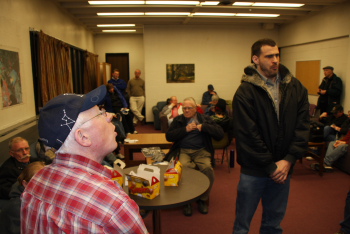
Regrettably the clear skies that greeted us at the start of our venture from Hamilton didn’t follow us to North Toronto, but approximately 40 members and guests enjoyed the trip to York University.

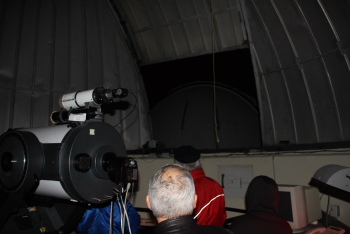
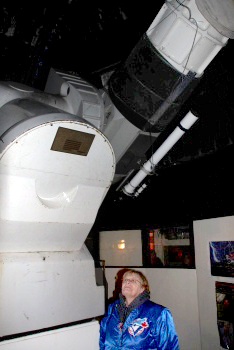
After stops for refreshments and appropriate enticements for the York students, we arrived around 8pm and were greeted by Dr. Paul Delaney and 2 of his undergrad students: Christian and Ian. All were very knowledgeable, friendly and patient as they showed us around the observatories and the 2 main scopes: a 40cm Meade LX200 and a 60cm f/13 Cassegrain.

York’s 40cm LX200 and opening the dome in hopes the sky may have cleared.

HAA member Brenda standing beside York’s 60cm to show scale of this big scope.

As part of their very active outreach programs, they host free weekly public observing nights on Wednesdays at the observatory. So if you missed this trip, you can go down on any Wed night and join one of the public nights.

And for the IYA, they are running a 2-hour live web cast from the observatory on Monday nights. From this link, you can participate in the blog at any time and at select times, see what is being captured by the telescopes or the all-sky camera.

After our tours, we retired to one of the staff lounges where donuts were served and Paul held court to a captive audience. He answered questions on a wide range of topics including Mars exploration, telescope design, imaging technology, space tourism, manned missions to the moon and Mars, and more. As always, he was very gracious and very accommodating. He also had a selection of the official IYA Galileo moment cards and planispheres which he made available to anyone who wanted them.

Dr Paul Delaney entertaining and educating the group which he does so well.

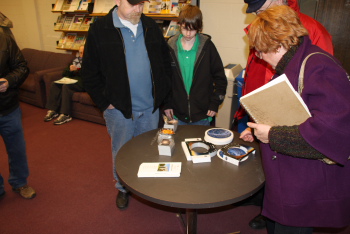
Some of the goodies that were provided.

We extend our deep and sincere thanks to Paul and his students for such an enjoyable night. Even though we weren’t able to observe, I hardly seemed to miss it with all the other interesting things being shown and discussed.

Sun-Earth Day – NASA webcast

As we all know, March 20 is the Vernal Equinox (start of spring in the northern hemisphere). It is also Sun-Earth Day and NASA is celebrating it by encouraging daytime astronomy.

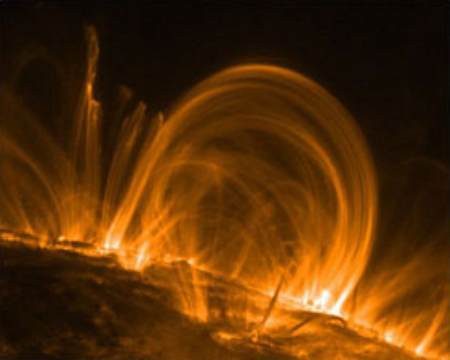
Solar Flare

They will be hosting a live webcast on NASA TV ( HERE ) for 1 hour, starting at 1pm (EDT) on Friday March 20. If you can view it during this time, it should be very interesting for all members and the public. There are also some promotional videos on this page.

It is also expected to be rebroadcast at 8pm on their Educational channel ( HERE ). But check the first link above for details/confirmations.

If you watch this and enjoy it, feel free to post your thoughts, or use one of the emails on the “About Us” page and let us know.

Sunday March 15 was a good night for observing

We got out to our Burlington observing site Sunday evening (the 15th)with my 6 inch Schmidt-Cassegrain and Moe Chaput’s 10 inch reflector. Comfortable observing conditions, especially as compared to January! I re-acquainted myself with some targets from this time last year including the Eskimo Nebula (NGC 2392) – very nice, could see some detail that hinted at the heart shape but to me it looked more roundish and irregular. I also looked at Tau Canis Majoris Cluster, an open star cluster, and a favourite of mine, as the bright blue-white star that shines from about the centre of the cluster burns with the brightness of 50,000 suns. Then I keyed in the specific RA and DEC to get to my next target, V Hya, a carbon star in Hydra, the part of the constellation near Crater, roughly RA 10 hrs 51 min and DEC -21 deg (sorry I don’t have exact coordinates right now – It is marked as a variable star “V” in the Sky & Tel Pocket Atlas on page 36 and it also appears in Sue French’s book). This is a very reddish looking star – I thought it looked brighter a year ago, maybe it is piling up carbon soot in its’ atmosphere and shining less brightly. Finally checked out Saturn: the seeing was still very nice on Sunday night. Wow! Saturn’s rings are really skinny! I could see subtle banding on the planet’s surface and that ever so slim shadow of the rings across the surface. Only saw three moons for sure: Titan, Tethys and Rhea – been more successful at moon-hunting on other nights. My observing partner, Maurice Chaput, bagged a couple of Messiers he was looking for: a couple of globulars, M68 and also M3, which was quite spectacular in his 10 inch hand-made reflector. I gave M63 (the Sunflower Galaxy) in Canes Venatici a shot, but I had no luck. I am really looking forward to spring-time observing!

Binbrook – March 14th – An Exceptional Night

I will keep my impressions of the night brief in hopes that others will add to it. With about 15 people on the hill there was so much going on that this will need to be a group effort.
With the sky clearing nicely I checked the collimation of our 12″ dob to make sure we’d make the best of it. Glad I did as it was way off. However, with a barlowed laser collimator and Gail calling out directions as I adjusted the primary screws, we got it perfectly aligned within minutes.
Pretty well anything we looked at was a delight. We cruised through the usual popular items, sharing some views with a Ukrainian family that Ann Tekatch had adopted at the gate.
For me, the best part of the night, though, happened just before midnight. I’d decided to look for the Eskimo Nebula, and after aiming the scope to the general area with the aid of a Rigel Quickfinder I fine-tuned the aim with a 9×50 finderscope. To my surprise, I could see the nebula in the finderscope. When I got to the eyepiece, however, the nebula looked very comet-like. Then it hit me – I’d stumbled across Comet Lulin making a close pass to the Eskimo Nebula. In fact they were about 1/3 of a degree apart making for a nice pairing in the same FOV.
But the best was yet to come. Just as the scope’s tube was getting a layer of frost on it, I turned it in the direction of Saturn and WOW!!! I have rarely, if ever, seen Saturn so well-defined. Although the rings are nearly edge-on, at 214x magnification I could easily make out the difference in shading between A and B. The ring shadow across the globe was a dark, razor-thin line, and the gap between the rings and the planet appeared large enough to drive a truck through. The North and South Equatorial bands were tan lines across a creamy background and the moons Titan, Dione, Iapetus, Rhea, and Enceladus were bright points of light – the latter two sitting together right on the edge of the rings. What a fantastic sight on a frosty night.

Glenn

Shuttle Launch Tonight – March 11

At Approx. 9:20pm, the Space Shuttle Discovery will leave the launch pad for a mission to the ISS.

There are several links to NASA TV if you want to watch it live, online, here’s one:

http://playlist.yahoo.com/makeplaylist.dll?id=1369080

mage: A nearly full Moon sets as the space shuttle Discovery sits atop Launch pad 39A at the Kennedy Space Center in Cape Canaveral. Photo Credit: NASA/Bill Ingalls

UPDATE!
_________________________________________

The launch has been postponed. The next attempt will be Thursday at 8:54 p.m. EDT.
__________________________________________

UPDATE! UPDATE!

We’re now looking at Sunday March 15 ~ 7:43pm