Comet Lulin at Opposition

Sorry I’m a little late with this… I finally got around to processing the images that I took of this comet back when it was at opposition. Since this is a relatively large target I should have imaged it with my 80mm scope but instead opted for the longer focal length 6in SCT since the camera was already hooked up to it. Anyway I hope you like this more zoomed in perspective.

KerryLH
Larger View
http://www.weatherandsky.com/main.php?g2_view=core.ShowItem&g2_itemId=5070&g2_imageViewsIndex=3

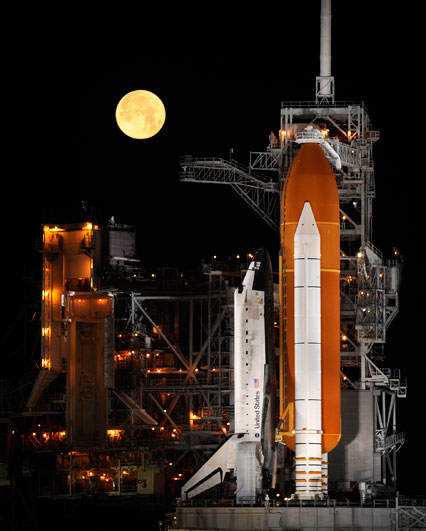
WORM MOON

This is an odd designation that I wasn’t aware of. From SpaceWeather.com’s website, here’s an interesting (if unromantic) moniker for the full moon (which we’re unlikely to see in the next day or two).

“Tonight’s full Moon has a special name–the Worm Moon. It signals the coming of northern spring, a thawing of the soil, and the first stirrings of earthworms in long-dormant gardens. Step outside tonight and behold the wakening landscape. “Worm moonlight” is prettier than it sounds.”

Reflections of Venus

Our own John Gauvreau had one of his photos posted on SpaceWeather.com recently. It’s a beautiful shot of Venus being reflected off the ice at Binbrook. Here’s the link to the image:
http://spaceweather.com/submissions/large_image_popup.php?image_name=John-Gauvreau-IMG_1747dsmall_1236570782.jpg

Kudos John.

February Demoted By The IAU

AP Reuters – Greenwich:

Emboldened by their success in declaring Pluto not a planet, the International Astronomical Union determined this week by a close vote that February is too short to be considered a true month. It has, however, been granted the newly created status of “dwarf month.” It shares this dubious distinction with several other calendar time spans, including Labor Day Weekend, Christmas Vacation, and the Time Between When You Were Supposed to Get Your Oil Changed and When You Actually Did.

“It only seems fair,” said IAU President Ron Eckers. “February reaches a peak size of 29 days, averaging only 28 days for 75 percent of the time. Recent research has shown that other periods, such as the Time Between When You Were Supposed to Get Your Oil Changed and When You Actually Did, often exceed this meager time frame. In fact, this erratic behavior only strengthens our case that February does not belong in the same classification as the eleven ‘true’ months.”

Eckers also warned that the crop of 30-day “so-called” months should be careful to maintain their number of days. “They’re already cutting it pretty close in my book.”

(Written by Michael Haber)

Four’s Company – Binbrook, March 6/09

Gail and I arrived at the gate at 7:20pm and I was switching the locks when Mike Griswald drove up. ?I?m not a member,? he kindly informed me. ?Not a problem,? I replied. ?You soon will be!?
Down by the boat launch we found the parking lot surprisingly dry and firm for this time of year so decided to set up there. Mike assembled a nice Stellarview Nighthawk 80mm refractor, with an 18mm Televue Radian, on a quick and easy alt-az mount, and we had brought our 6? dob and binoviewer set-up. As we were aligning finderscopes Ann Tekatch pulled in. From her collection she?d brought her ?scope of the week?, a Meade 80mm f11 refractor, also on an alt-az mount. Within minutes we were all aiming at our first target ? the Moon.
Gail found an interesting crater beside the terminator, near the South Pole. Using the Virtual Moon software she identified it as Newton. One of the older craters, Newton is about 82km wide and 8000m from rim to floor. Mike and I came across the crater Clavius almost at the same time. Clavius contains an interesting subset of craters, evenly spaced in an arc, and graduated large to small like a set of measuring cups. Inside the arc is a dome-like feature that is an eroded massif (mountainous region).
Ann then went hunting for the Davey crater chain, and after referring to Ruckl?s Atlas of the Moon, and Charles Wood?s Modern Moon, soon found it and showed us a thin bright line across the floor of the crater Davey. Bumping the power in our binoviewers to 210x, we were just able to distinguish the line of small craters as a linear series of bright dots.
Humidity was fairly high, yet the clouds that had covered our drive to the park had gone East and the sky steadily improved. The wind had died down considerably from earlier in the day and the record-setting temperatures of the afternoon were still a few degrees above freezing.
Mike?s scope gave us a nice wide field view of the Pleiades, and after Ann had finished her sketch of the crater chain she switched ep?s and gave us a sharp view of Saturn. We were spoiled by the all of the fine optics on hand and soon found 4 of Saturn?s moons despite the low altitude of the planet and the fair to middling transparency.
Even with the bright Moon, you can?t ignore the Orion Nebula and we were soon comparing views of the Trapezium. But at this point, the air over the park reached the dew point and within moments all surfaces were wet. It was time to pack up.
After a long cold winter with all too infrequent observing opportunities, it was nice to share some photons with friends. Thanks Ann. Thanks Mike. We had a good night.

Glenn

Mohawk at Binbrook

A group of astronomy students from Mohawk College were out at Binbrook Conservation Area, for a night of observing. A beautiful but cold night offered good viewing, and several club members were at the park that night as well.

Venus showed a beautiful, thin crescent, and not to be outdone, Saturn showed some equally thin rings. Not surprisingly, the views of Saturn actually elicited gasps and exclamations from the first-time observers! Jim W. showed some clusters and asterisms through his fine 8″ scope and Andrew B. offered up some excellent deep sky views through his 12″ Lightbridge. Don brought along his refractor and Jackie made everyone feel at home. My refractor offered up some wide field views as well, and before the night was through they (and we) had seen M81 and 82, the Double Cluster, The Pleiades, the Beehive, M42 and a smattering of other objects. Of particular interest was a view of the minor ‘dwarferoid’ planet Ceres, and all 6 stars in the Trapezium! Ann called in her contribution on her cell phone and pointed out the Lunar X on the first quarter moon. It was a beatiful sight and we all enjoyed finding it (I almost called this blog entry an ‘X File’).

One student brought her own scope and another brought a pair of big binoculars. All brought a great deal of enthusiasm that was certainly matched by the HAA members present. The mixing of these two great groups made for a really fun night for everyone.

The Lunar “X”

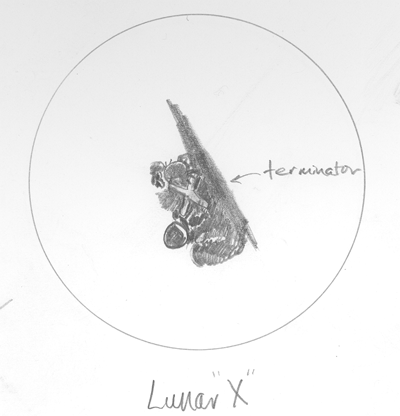
Recently, while reading some forum posts on the website, Our Dark Skies, I learned of an upcoming opportunity to view an optical feature on the moon called the Lunar “X”. During a narrow window around 1st. quarter moon, sunlight illuminates some of the crater ridges near the craters Werner, Purbach, Blanchinus & La Caille, forming the letter “X”. I’ve never seen or heard of this feature and I was curious to see if I could view it. Using an 80 mm f/11 refractor with a 24mm eyepiece (about 38x), I was able to spot the white “X” about 1/3 of the way up from the bottom of the moon along the terminator. It was small but obvious. I made a sketch of the view.

The Lunar “X”

For more information on the Lunar “X”, check Wikipedia: http://the-moon.wikispaces.com/Lunar+X

Ann T.

UPDATE

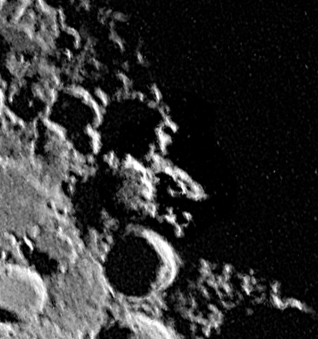
Here is a picture of the Lunar X that I took tonight, after Ann brought it to our attention, and you can see how closely it matches Ann’s drawing. Thanks Ann, it was really worth seeing.

John G.

The Lunar X

Great photo, John! I’m so glad you were able to photograph it. The “X” is only visible for about 4 hours at 1st. quarter. Its appearance began at about 2230 UT (5:30 EST) last night, so you caught it just before it disappeared.

Ann T.

Call it what you like, but catch it while it’s close by.

Whether you consider it the largest resident of the asteroid belt, or the smallest dwarf planet in the solar system; either credential should merit Ceres a look while it makes its closest pass to Earth since 1857. It won’t be this close again until 4164.
The next couple of nights are particularly ideal because:
a) it just might be clear out, and
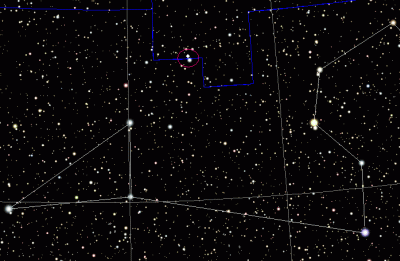
b) Ceres will be less than a degree from the close double star 54 Leonis – meaning that if you can find the double, the aster-dwarf-planetoid should be in the same FOV of a low-power eyepiece.
The components of 54 Leonis are mag. 4.5 and 6.3, and Ceres will be about mag. 7.
You can use this chart to locate it, or reference John Gauvreau’s accurate forecast in February’s Event Horizon.

Glenn

Comet Lulin and Saturn (Processed Images)

I stacked and processed the sequences of images I took of Comet C/2007 N3 (Lulin) on February 23, 2009, when it was beside Saturn. Here are a couple of results:

Saturn and Comet Lulin, by Bob Christmas

Larger versions are now in my HAA Gallery:
HERE and HERE.

Bob Christmas

A Dobservatory Report – Feb. 28, 2009

Were it not for a large system below Lake Erie doing some cross-border hopping, last night would have been a lot more fruitful for this backyard observer than it was.
I’d spent the afternoon making up a hit list of targets but ended up chasing sucker holes instead. But the evening wasn’t a total bust as Anthony Tekatch dropped by to join Gail and I, and we had nice views of the Moon and Venus, both showing a beautiful crescent phase. Comet Lulin, in the 6″ dob was a small grainy fuzz spot, and Saturn was a small olive on a toothpick – Martini’s anyone!
However, I was successful in one quest, and that was to see the fifth, “E”, star in Orion’s Trapezium. This we did with the 12″ dob. The seeing was somewhat turbulent but, surprisingly, it could still be seen even when a cloud passed over (under?) the nebula. The E star is mag. 10.3 and nestled between A & B which are the two stars in the Trapezium that are closest to each other. Apparently, a sixth star, “F” can also be had on a good night, but F is fairly tight to the C star and would need a fair bit of magnification in steady air to split the two.
If you want more information on the Trapezium, the following link will take you to an excellent web page on the subject:
http://www.astropix.com/HTML/B_WINTER/TRAPEZ.HTM
So, the next time you have the Great Orion Nebula in your sights, see if you can go a little deeper and pick up some bonus stars.

Glenn