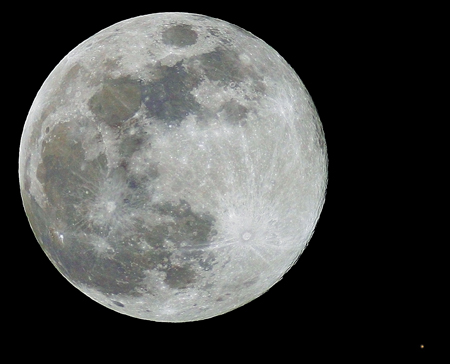
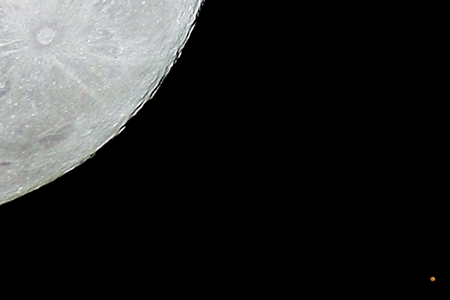
Mars and Moon – A close approach

Imaged with the Sky-Watcher 80mm and Canon DSLR on the camera tripod around 9pm, December 23 (last night) before the clouds thickened.

KerryLH

Happy Winter Solstice

Happy Winter Solstice to all HAA members and interested astronomers everywhere.

Today marks the longest night of the year. It was clear a good portion of last night and the CSC indicates we may get some clearing breaks tonight (but it won’t last the whole night, sigh). I did some visual observing last night, enjoying some of the brighter constellations, a few visible clusters and of course, Mars.

Hopefully we’ll get some clear skies over the next week or two so we can enjoy the long nights. They may be cold, but at least they are (usually) dry and steady. Just 6 months to the shortest night of the year so enjoy while you can.

Remember we’re hoping to see members and public out on Fri Dec 28 on the grounds of the PCDC for Mars observing near opposition.

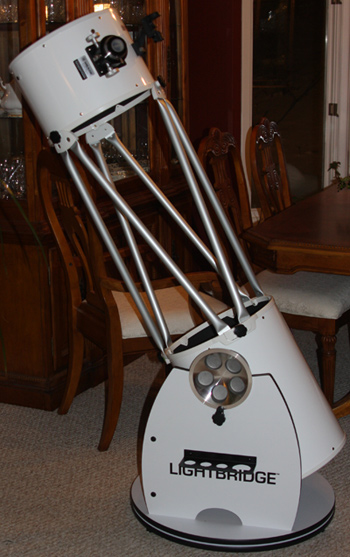
First Light on the Meade 12″ LightBridge

After much contemplation and procrastination I have finally joined the ‘Dob People’. Although some say, “Kerry it’s not just a dob it’s a LIGHTBRIDGE” :). I was thinking of waiting till next year for this purchase but with the rebate offer and lower prices I figured now was my chance to make the leap and purchase my first ‘Faint Fuzzy Interceptor (FFI)’. After a few set backs with a couple of missing attachment bolts and a red dot finder that didn’t want to collimate (actually it’s still not collimating properly but I know of a possible fix), I was finally able to get it all together.

The 12″ LB collimation process was a little daunting for me and I kept thinking that I should have payed attention when Steve was collimating his 16″(aka the GWS). After a little under an hour of reading the manual, figuring out the laser collimator, installing Bob’s Knobs and fiddling with lots of screws, I managed to collimate it well enough… I think. I took some advice about labelling the struts so that I didn’t have to keep collimating everytime I had to reassemble the scope. Later in the evening I took a peek outside and noticed the viel of cirrus covering the entire sky. I could barely see the stars… but there was the moon. Yippee it was a go for a first light on the moon. I was surprisingly able to manage partially dissasembling the scope in the dining room, carrying it down to the driveway, and reassembling it all with not much time and effort. Once the scope was cooled down I was greated with an absolutely spectacular (but hazy) view of our nearest neighboor. No photograph to date has provided me with such detail. I popped in the 10mm plossl and WOW!!! The terminator especially was a sight to see. Afterwards I scooted over to the only other object that I could see through the clouds, Mars. That was another sight to behold. With just the provided Meade 4000 26mm 2″ eyepiece I was able to see a hint of some dark features on the surface. Was I dreaming? With all my years in astronomy I have never seen any real details on the surface (pretty sad but true). When I magnified the view with my 10mm plossl I was able to confirm it. A little later the cirrus thinned out a bit more and I was able to scan around. I was very impressed with how sharp the star field looked even through the provided 2″ eyepiece. The stars and clusters were lacking some luster through the clouds but they were still very nice to look at. I can’t wait to take this scope out again, hopefully under better conditions.

KerryLH

A new comet is in town: 8P/Tuttle

Another exciting comet is in the sky for our viewing and photographing pleasure. Comet 8P/Tuttle is brightening fast and could reach magnitude 6 in January. It is currently magnitude 8 and can be seen between Cepheus and Casseopia. It will appear as a fuzzy grey patch in small scopes, larger scopes will show the greenish colour. On December 30th it will pass very close to M33 (~0.4 degrees).

Various finder charts:
http://aerith.net/comet/catalog/0008P/2008.html
http://media.skyandtelescope.com/documents/CometTuttle_DecFndr_BW.pdf
http://www.cometchasing.skyhound.com/comets/8P.gif

Comet Holmes Pics by Bob Christmas

Three images of Comet 17P/Holmes are now in my HAA Gallery.

You c-c-can still see the c-c-comet

Providing you c-c-can handle the c-c-cold, and know what to look for, Comet Holmes is still a naked eye object if you use averted vision.
The fact that my scope was already set up and at the ambient temperature in the d’observatory prompted me to take advantage of the brief advent of clear sky, last night.
In the 9×50 finderscope, Holmes appears somewhat similar to M33 in binoculars at a dark sky site. The telescopic view is, naturally, larger and brighter but the halo is now quite diffuse and I’m not sure if I saw the nucleus, off-center, or a star shining through.
Higher power may have provided the answer but that would have meant switching eyepieces which would have meant taking off my gloves and, well, you get the picture.
From Holmes, I wandered up to Cassiopeia to check out the colourful double Eta Cass., NGC 457 (the ET cluster), open cluster M103, and open clusters NGC 654 & 663 which, though I’m pretty sure I’ve seen before, I haven’t previously logged.
At that point, my feet started to reach the ambient temperature so I packed up, but just having that hour under clear skies felt good. Apparently, the next clear sky opportunity will be the middle of next week, maybe, so get out when you can.

Tail-less Comet

Ed Smith sent in these links about everyone’s favourite comet:

http://www.meade4m.com/cgi-bin/article.cgi?ID=409

http://www.astroleague.org/index.html

Yet another change worth noting. Thanks Ed!

The Lofar II Radio Antenna Project – Reports by Mike Jefferson

Introduction

Here are reports on the recent readings from the LOFAR II radio antenna, and their compliance with GOES 10, 11 & 12 readings.

I became involved with this project, at my own expense, to involve HAA with a network of like observatories, work on solar (‘stellar evolution’) research, make contributions to variable readings, compare our results with satellite output (So far, we have been right on the money!) and supply data to HAA membership that might wish to know about sunspots developing, meteor showers, auroral activity and, if we’re lucky, GRB’s. The learning curve has been steep. I have two domiciles to manage and am involved with numerous other activities. So, working on this project has been whenever I have been able to find blocks of time. It is not like visual-photographic-spectroscopic studies where the target is either acquired or it is not. There is not a radio system, anywhere, that is ‘turnkey’. Most of the time, one is ‘feeling’ one’s way along the procedure. You can’t see the image. Several weeks ago, I had almost given up, after 8 months. Then, things started to happen. It seemed that it was too good to be true. However, it is not. We have a great system here and it works independent of weather, all day, every day! Like SNO, it is totally indoors. We now have two receivers: one operating @ 0.52-30 mHz and 87.6-108.6 mHz; the other @24.0 kHz. It is truly an ITT – information technology telescope.

November 10, 2007

At 9:43 PM our signal is ~1.25 V which is exactly where it should be for a quiescent sky condition at night. Saw Comet Holmes in binoculars earlier this evening, too. Skies are full of water vapour and not very transparent.

November 12, 2007

There were some unsettled readings (minor) from 8:30AM-12:55PM EST and 1:53-3:07PM EST. All were below an A-class but exerted some minor influences on our readings. They were confirmed with GOES 10,11,12 satellite readings.

November 13, 2007

Tonight, at 8:30-9:20 PM EST, we had a bottom-line A-class x-ray emission from the sun. I don’t know when it was ejected, but it hit the ionosphere at the above time.

From ~9:53-10:04 PM EST my cable was reduced to an ‘antenna’ that allowed HTZ FM(air signal) to swamp WNED FM(cable station) during this lull between low-level x-ray bursts. When the second burst hit at 10:04 PM EST the cable signal had already recovered, but through-the-air transmission of WNED FM suffered interference. Again, this is confirmed with GOES data!! This ‘guy’ is going to be one of HAA’s most valuable assets.

November 25, 2007

Sunday, November 25/2007 @ 00:30 we were hit by a very minor solar outburst. It is shown on the GOES 11 satellite site and we had a significant voltage rise and fall over that period of time ~00:15 – ~01:30.

December 2, 2007

We had a beauty of a B5 flare from the sun at ~ 3:00 PM EST that GOES 11 nailed. Sadly, we missed it because we were too close to sunset. So, it hit the other ‘side’ of the world and not us.

December 6, 2007

We show an output curve close to the GOES data. There is nothing spectacular beyond a mid-A output. However, it very closely resembles the GOES readings.

Our readings should be ~ -1.25 to -1.50 V @ 12:11 noon and we are getting ~0.0. This would indicate a rise in general solar activity, much of it probably having to do with the ‘new’ sunspot group.

December 11, 2007

SUNSPOTS — We are getting quite a steady and strong ‘wind’ from the sun. LOFAR II voltages are ~1V too high. It is hitting us at a B-level and is probably due to that monster sunspot grouping dead in the middle of the sun. The radiation from it is very intense and, I assume, very steady. It is about 1/10th of the sun in diameter. That would make it 10 Earths wide!!

December 18, 2007

You can see how much Stanford loves us!!!! Maybe we’ll be invited down for a talk or to see the solar centre. I may go to SAS in 2008 to present our spectral work and LOFAR II. Her remarks refer, I assume to all of our mailings, but this follows on the heels of Dec. 18/07 UT. -Mike

> Date: Tue, 18 Dec 2007 21:36:15 -0800
> From: dscherrer@solar.stanford.edu
> To: rasc2010@hotmail.com
> Subject: Re: LOFAR II – data for Dec. 18/07
>
> D*mn, you are blowing us away here. This is awesome!!!!
>
> Debbie
>
> Michael Jefferson wrote:
> > Hi Deb, This is a beauty! We bagged a C-1 @ UT 13:14!! and it is
> > right on the money with GOES. A second C is a 0.5 @ UT 20:51 and is ~ 2
> > hr.s behind GOES which I think may be due to us rotating away from it
> > and we are going into sunset at the time. It is way down in the evening
> > trough!!! Cheers!


Asteroid Occultation Anyone?

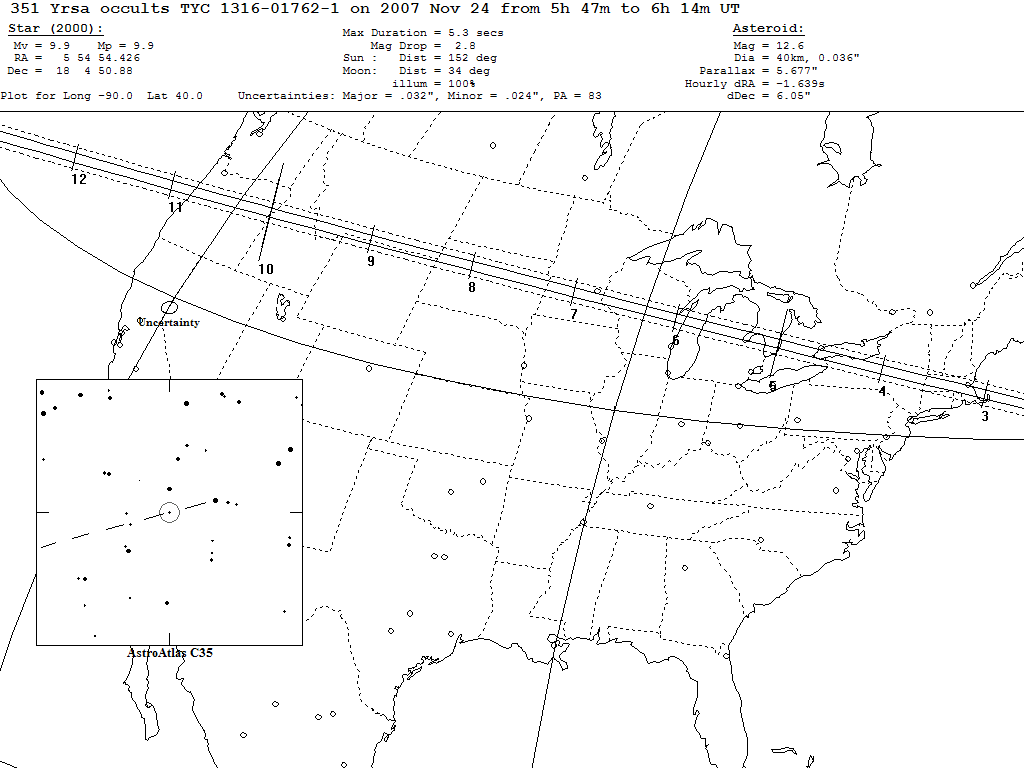
At about 1am Sat morn of 24 Nov, a small asteroid will occult a star that will pass close through our area. If you are interested in trying to capture this event, I have some information below.

The asteroid is 351 Yrsa which is a 40km wide mag 12.6 object. It will occult star TYC 1316-01762-1 which is mag 9.9. (The star is located between Taurus and Gemini) This means the light will be reduced from 9.9 to mag 12.6 (the magnitude of the asteroid).

Below is a map of the occultation path.

Path of asteroid occultation

The path image by default is only showing the western portion of North America. If you save the image to your local drive (or if using Firefox, use View Image), it will show the entire area included. You should see that the path passes right along the southern edge of Lake Ontario near us.

It will pass through our area at approx 06:04:32 UTC (01:04:32 EST) and will last for up to 5.3 seconds. The star’s position is at
RA: 05D 54M 54.4258S DEC: +18D 04M 50.879S (Degrees, Minutes, Seconds).

Binbrook Conservation area will be within the uncertainty limits. Ideal might be a road trip to the NW of Torontowould be an area between Burlington to Oakville or west of this area (thanks Glenn), or the Niagara-on-the-Lake area.

More details can be found at: This link including some sky charts.

Good hunting. I guess I should make it clear that I won’t be able to participate in this particular expedition (other obligations). This is for you intrepid explorers to find on your own.

Comet Holmes and Mirfak — Take 2

At 1:30-ish in the morning of Sunday, November 18, 2007, the sky in Burlington was clear, and Comet Holmes was visible, right beside Mirfak (Alpha Persei).

I took four pictures of Holmes from outside my front door, and here’s an excerpt of one of them. Canon Digital Rebel 300D; Tamron 300mm lens @f/2.8; ISO 400; 71 second exposure.

Cheers!

Bob Christmas

************ UPDATE ************

Here’s “Take 3” of Comet Holmes, right above Mirfak, at about 11:00 pm Sunday Night (November 18, 2007). Equipment and settings as above, but 74 second exposure:

… in the same magnification as the one earlier Sunday Morning:

… and here’s the same image, close up on the comet: