Near Miss – Asteroid 2007 TU24

As mentioned at the last HAA club meeting on Fri Jan 11, there is a reasonably large asteroid that will be passing close by on Mon Jan28/Tue Jan29.

Asteroid 2007 TU24 was discovered in Oct 2007 by the NASA sponsored Catalina Sky Survey. It is approximately 350m in size and is expected to pass by the Earth within 530,000 km (330,000 miles). This is about 1.4 Lunar Distances (1 LD is the average distance between Earth and Moon – approx 400,000km). So this one will pass just outside of the moon’s orbit.

Right now it is fairly faint, but as it approaches on the 28th, it will grow to about magnitude 10 which should be visible in moderate scopes (4″ or better). And it will cross the sky quite quickly. So fast that we won’t be able to use standard tracking rates on most computerized telescopes. You will be able to notice its movement against background stars as it passes through/near Pisces, Triangulum, Andromeda, Perseus and Camelopardalis. It will pass very close to M33 early in the evening.

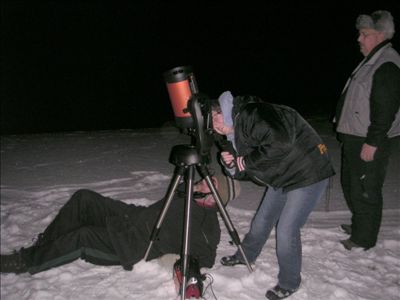
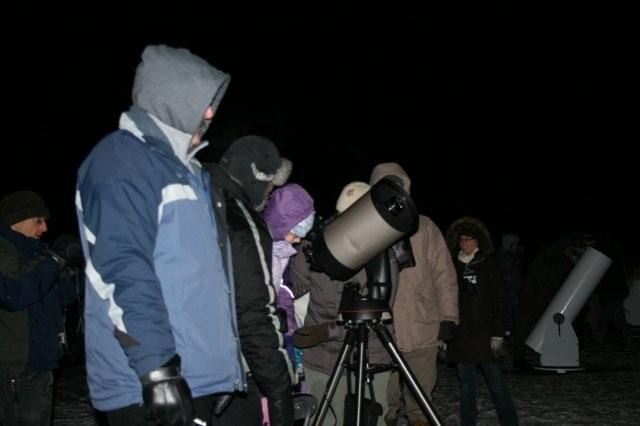
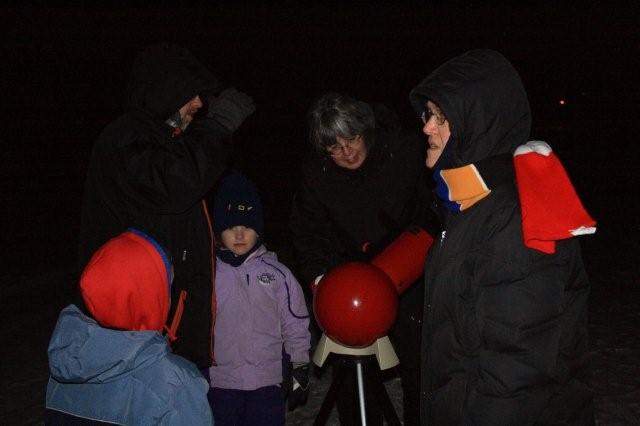
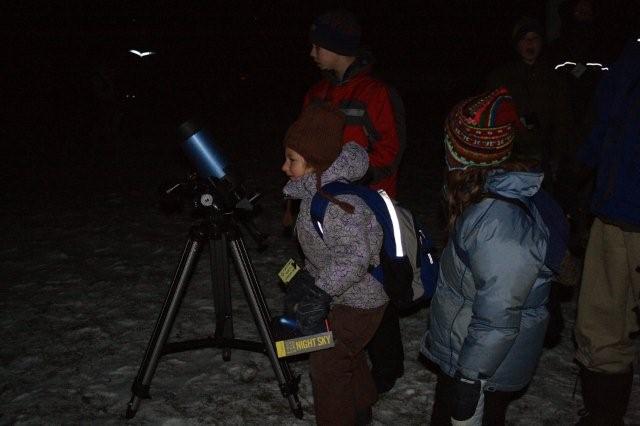
While challenging, this could be a unique imaging opportunity for those who wish to undertake this quest. For the others, if the sky conditions are good, we’re planning to head out to Binbrook to observe this unusual event.

Closest approach isn’t until about 3am on Tues morning, but it will be visible all evening. So we’ll expect to open the gates about 8pm and stay as long as everyone can tolerate the chilly temps. Current long range forecast is promising, but we’ll provide updates as we get closer.

According to NASA’s JPL NEO website, there are about 7000 asteroids of this size that have been discovered (or expected to be discovered) and one would pass this close to Earth every 5 years on average. They also make it quite clear that this one will NOT hit Earth nor cause any effects anywhere. (There has been a surprising amount of FUD relating to this asteroid on many websites and blogs.)

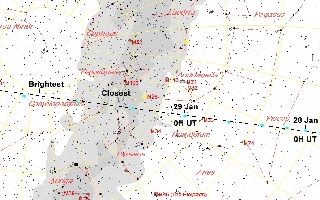
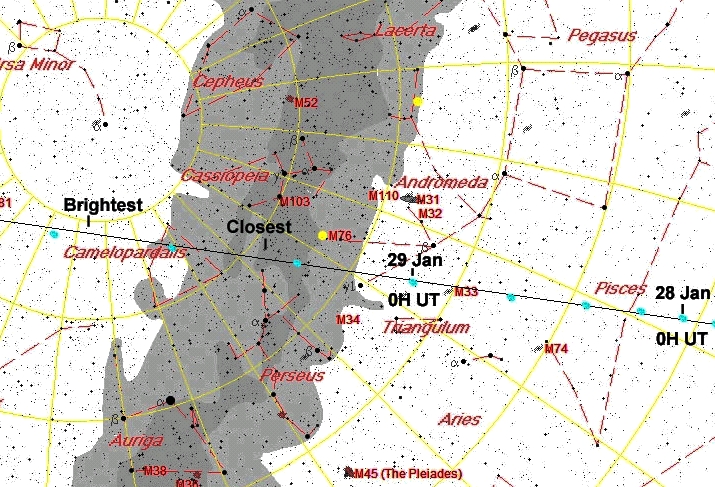
I’ve included a very scaled down image of the asteroid’s path.

Path of 2007 TU24 between Jan 28 and Jan 29, 2008

You can find a larger version (425kb) of this image at:

2007TU24h

(The dots represent 6 hours intervals, and 0H UT = 19:00EST)

This was obtained from JPL’s website and massaged a little so that it prints easier on most black & white printers.
(Original can be found at: neo.jpl.nasa.gov/news/news157.html)

I’ll be posting some more info shortly so stayed tuned.

Hope to see you on Mon 28 Jan at Binbrook.

UPDATE: Mon 28 Jan @ 11:00 am
Not surprisingly, the weather conditions are working against us. There is a new system moving in from the WNW that is going to bring some rain and wet snow. It should hit us around midnight (give or take a few hours). We may get lucky and the initial parts of the system may pass just to the north of us giving us a few hours of observing. Checking satelitte images and various CSC around the province, this seems like a possibility. If we were further south, then it’s pretty certain we’d have clearer skies for a better part of the evening. We’re right on the edge.

Closest approach (and therefore brightest and fastest apparent motion) won’t occur until about 3:30 am and its clear (no pun intended) we’re unlikely to be able to last this long. At least temperatures, winds and humidity aren’t expected to be too bad for the situation (at least until the rains start). And regrettably conditions Tuesday night are going to be worse for watching the asteroid depart. So it’s tonight or nothing.

Since the asteroid is only expected to be at magnitude 12 moving to 11 in the evening, it will be a bit more of a challenge to find – especially if there are some thin high level clouds. We’ll need to have accurate charts and coordinates to locate this object. I’ll try to get some printed up to bring along.

But we’ve gone out with worse forecasts. Sometimes we get lucky and it turns out better than expected, sometimes not. Let’s hope this will be one of the better experiences.

Therefore I’m going to suggest that we still give this a shot. It may look gloomy as we head out, but with the forecasted breaks, we may have a chance and I think this is one we don’t want to pass up.

I’ll try to head out and open the gate at 7:30’ish – it will depend on how swamped I am at work. I’ll try to get there earlier if I can. We’ll set up at our usual spot on the hill. Remember if the ground is soft/wet, then try to keep the cars on the roadway. If necesary, unload and then move it to the parking area.

See you tonight.

AIR TIME:

Just had a call from Shiona Thompson at 900CHML – she wants me to do a radio interview about the asteroid, Tuesday morning at 6:40am.
Tune in if you can – Glenn

C-c-c-cold clear nights

Over the past month I only had two opportunities to observe and image, and unfortunately clear and c-c-cold go hand in hand during the winter season.

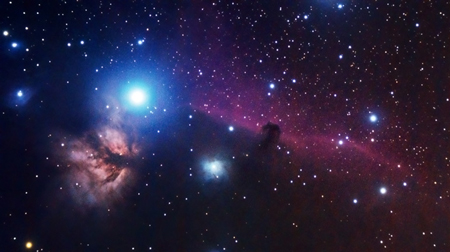
One of those evenings the meteorological data and CSC were both calling for lots of cloud cover but fortunately I was following the satellite imagery that day and found a potential clearing over Lake Michigan that looked like it would drift over our region by the evening hours. I felt a little nuts at first setting up in total cloud cover but I had faith 🙂 later that evening the skies finally became reasonably clear enough to image B33 Horsehead and Flame Nebula. There was a very thin layer of cirrus but it wasn’t enough to make my efforts futile. The effects of it were noted in the image below with Alnitak (Zeta Orionis) appearing even more oversized, and brighter than usual.

Canon 40D unmodded + 80mm, 3min exposures totaling 1.5 hrs @iso1600

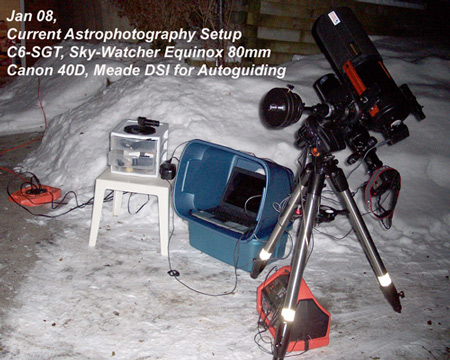
My wintery setup that night

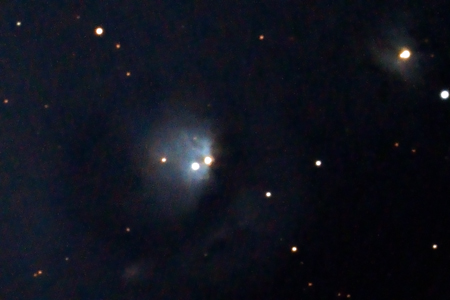
Again, another clear night presented itself this past Saturday, but sadly the moon was really bright and fairly close to my region of interest. As an experiment I imaged anyways. Kind of a bad experiment to try M78 which has a very pretty blue reflection nebula but very faint and interesting dark nebula/dust around it. I was happy to see that parts of it showed up after some post processing magic, but I had to crop it severely because of a bad gradient from the brightness of the moon.

Canon 40D unmodded + 80mm, 3min exposures totalling 1hr @iso800

That night got down to -12C and at first I thought I could handle it (esp since I could run inside frequently to warm up) but in the process of trying to debug/restart my guiding software a few times my exposed fingers felt like they were going to get frost bite… so I ended up giving up after an hour and a half. So -12C may be my absolute lowest temperature limit for extended imaging and possibly observing.

KerryLH

In Close Orbit Of The Moon

Gail and I took advantage of the lull in the wind, Friday night, to do some moongrazing with our new William Optics binoviewers. I say ?moongrazing? because we were able to bump the power up to 210x which gave us a view relative to being just 1067.5 miles (1718km) above the lunar surface. When you are able to use both eyes on such a bright target, that close, you really feel you are in close orbit.
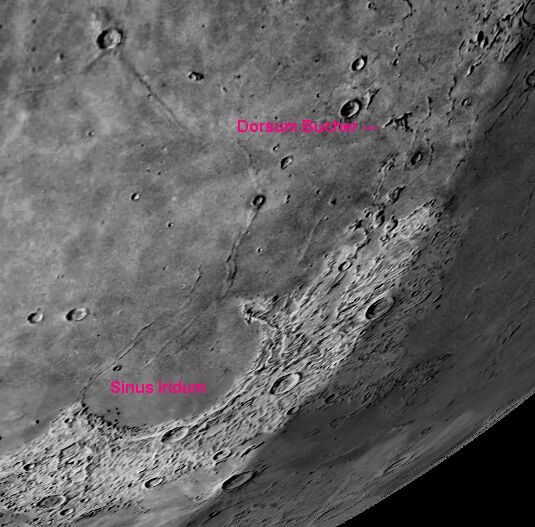
Much detail was apparent in the way of shadow peaks, craterlets, cliff walls, domes, and wrinkle ridges known as Dorsums. A feature that especially caught my eye was Dorsum Bucher. At low power (75x), it appeared as a small triangular formation with a couple of tiny projections off one side that made it look like a spacecraft. Higher power revealed the bumpy ridges that made up the boundaries.
In the attached graphic from the Virtual Moon software, you can locate Dorsum Bucher just up and right (Newtonian view) of the large bay Sinus Iridum, which is Latin for Bay of Rainbows. Luckily, my optics were better than those who gave the bay its name and no chromatic ?rainbows? were seen. 🙂
If you don?t have a copy of Virtual Moon on your computer, you can download it for free from: http://www.astrosurf.com/avl/UK_index.html

January LOFAR II Reports From Mike Jefferson

January 20, 2008

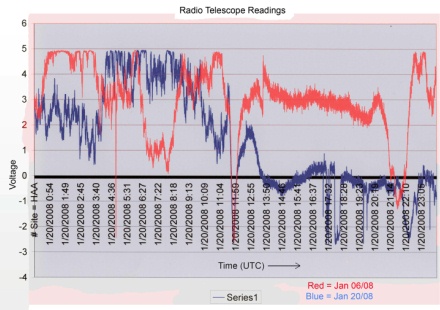
There are 2 chart sets here. Peter did them and feels the second is better than the first. I can’t see a difference. However, the one for Jan. 06 came right on top of the solar magnetic reversal, as indicated by Sunspot 981. It shows the ‘old’ magnetic field right before the sun went into its new cycle. January 20 is 2 weeks later and is reversed. Note how all the lines are ‘opposite’ each other, like opposing, standing waveforms. I have sent this to Stanford and maybe we should wait for a reply as to the analysis.

[LOFAR II data collected and reported by Mike Jefferson.
Chart of LOFAR II data refined by Peter McHugh.]

January 18, 2008

Right now, we have ~ 690,000. As of this time tomorrow night, we will have 700,000+, unless something goes suddenly haywire!! Pray! By next meeting, we should be in excess of 1,000,000 by 2 days’ worth!

January 6, 2008

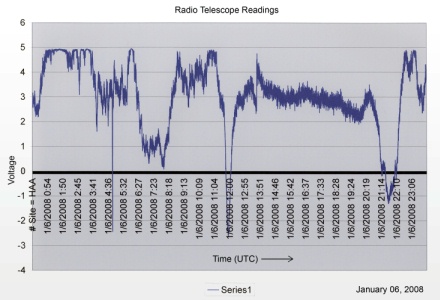
This chart of January 06/08 UTC is very interesting because of the high voltage levels between the sunrise dip (centre) and the sunset dip (right). Normally the trace would run much closer to the 0-line, slightly above and below it. In this observational log it indicates, not individual solar discharges, but a temporary large increase in solar x-ray radiation – a surge. However, several of the high, intense and dogtooth peaks may be large, individual discharges inside the surge of x-ray radiation. The ionosphere remained quite charged up for several days following. -Mike J. (HAA – observing 24 hr.s/day everyday)

[Chart of LOFAR II data refined by Peter McHugh]

Telescope Clinic a big success

Almost 20 scopes were set up tonight at the telescope clinic, in the Spectator auditorium, in Hamilton. I was surprised to see so many 10 inch and larger scopes there.

The event was also being covered by a Spec reporter with video camera. I figured the GWS would have to make an appearance.

He caught up to me while i was still setting the GWS up, and asked me questions about why i got into astronomy, and whether i think we are going to find life on other planets. My science and astrophysics interests, and desire to meet new friends got me into the club and to buy a scope. I have been well rewarded.

I told him i thought we won’t find any signals from other civilizations because they would already be here if there were any. When he pressed for an answer to the hypothetical, i remarked that i hoped if some civilization did send a message, that they would send some information about their technology to us, not just a hello, goodbye.

Astrology topics aside, i think everything went well.

I personally was able to talk to at least 6 DOB owners and help them align their scopes.
For lack of a dime, i had to reach for my super-knife to align Kerry’s scope. I got a lot of comments
on my dew guard which i was delighted to explain. Naturally the counterweight i use also drew some admiring remarks.

I had a chance to explain the workings of an equatorial platform to some DOB owners, and i also got some advice on how to clean my secondary mirror, which i think has dewed up once too often and needs a rinse.

All the Meades have their spring mechanism done wrong on their secondary support, resulting in an incredibly finicky and difficult alignment operation. I showed them how i changed my secondary holder so that the spring is done properly, and how easy it is to align my scope, with finger pressure, even on small screws. I am booked for some scope surgery after the next meeting.

It took 34 minutes from arrival till my scope was transported across the parking lot, up the stairs, throught the doorways and around the many visitors, and set up. Then 36 minutes to pack the GWS back into the car. Not bad. Usually it’s a bit quicker when i can park the car right beside where i am setting up. But it affirms my claim that Astronomy is good exercise.

An interesting slideshow was playing on the screen during the meeting, and at one point Mike Spicer announced that he had a scope pointed at Mars in the parking lot. I somhow was so occupied i did not get a chance to see it, but i have the scope in the car now so i am watching for the next chance at clear skies.

I was grateful for help from Kerry and Ann who helped carry and watched the car for me.

Afterwards about 12 of us reconvened at Kelsey’s till about 11:30 PM. Coconut strawberry smoothies. Mmmmmmmm.

Steve

Mars and Saturn Shining Brrrrightly !

January 2/3, 2008. A cold snap pushed the clouds away and I was eager to get a good look at Mars. In a month Mars will start to shrink (visually) so there is no time to lose to get those good views.
However I did gamble a bit – I only set up my telescope at 23:00. The Sky & Tel Mars Observer indicated Syrtis Major, a sizeable surface feature, would become visible at that time as that side of Mars rotated into view.
Around 23:30 I got my first good view of Mars yet. I have a Celestron NexStar 6″ SLT telescope. (I know, an Alt-Az telescope. I will review this telescope at another time. Suffice to say it is a very capable telescope, very easy to set up (ie: fun to use.)
I was using pretty high power, about x150. I used a Meade Series 4000 9.7mm eyepiece with a #23A light red Wratten colour filter.

My initial reaction was that the seeing was bad and Mars looked small. By comparison, I have been spoiled by a “fat” Mars in opposition in 2003 and 2005. Now in 2008 you have to be very patient and extra aware of what to look for. During brief moments when the atmosphere calmed down I could definitely discern the North Polar Cap and a dark region on the planet’s western limb. I could glimpse briefly the familiar “Upside down V” or chevron kind of shape of Syrtis Major. I tried a 2x Barlow but the seeing was too poor for that kind of power. After a while I noticed the seeing did not seem to crisp up as it had a few minutes before. I looked up from the eyepiece to realize that I was viewing Mars from between the branches of a “mature” tree. Shoot!

I quickly prompted the NexStar to slew to Saturn. Obediantly it turned to the ringed planet. Unlike Mars, Saturn did not disappoint at all. Still coolly and crisply beautiful. The Cassini Division is still evident but harder to see because the rings have closed up so much (only 7 degrees from our line of sight). But you still get that nice 3-D effect, partly because of Saturn’s rings and partly because Saturn bulges out at its equator due to its rapid rotation.

I played “Mike Spicer’s How Many Moons of Saturn Can You See Game” for a while. I am wayyyy out of practise. First I saw Titan at a bit of a distance from the planet, of course. After a while I spotted another moon closer to the planet at about 4 o’clock (Rhea)and after another while I glimpsed another tiny diamond, also around 4 o’clock and closer again to the planet’s rings (Tethys, magnitude 10.5). For some reason I did not spot Dione, which is the same magnitude as Tethys. I need more practise I guess.

Then around 1:00 on what was supposed to be a clear night, the clouds rolled back in.

But I had got my glimpse of Syrtis Major. I hope I get a few more chances to observe Mars at high power. After this opposition it will be a long time before we get another chance to view surface features of Mars with “backyard” telescopes.

Additional LOFAR Report from Mike Jefferson

This is a new LOFAR report sent to me by Mike Jefferson:

January 1, 2008

You need to look at GOES and SOHO(UVI & MDI)!!!! There is a huge object of interest @ 8:30 on the solar disc which is developing into a major sunspot group! Would be a great backyard project, except for the clouds! LOFAR II is getting this object as we speak, barring that nothing goes haywire! Right now, we’re getting C-0 radiation and it is not even facing us! Is there no way that some of these graphs can’t be put up on the site? I know it is possible, because the people at the UPS stores can do it for me as you have seen?!? – without printing up 300 pages of data.
To date, after 22 days, we have over 380,000 observations! The cost of this telescope is getting less and less/observation by the minute. Technologically, this is a very sophisticated instrument which is going to lead to some great stuff for HAA. We have a ‘new’ (Merry Christmas!!) fileserver coming online to replace SAL (the Aptiva) which is headed for lesser duties of image and chart processing. That will mean 3 computers having to do with running LOFAR II in some way!
There is NO other telescope/lens doing any astronomy, in this area right now, and there has not been much done at all in the last 3 weeks, except for the LOFAR II project!!!!! This is incredible – we look through the clouds and snow!
-HAA, observing 24hr.s/day everyday,
-Mike

A nippy evening of observing

I met up with Jackie and Jim who were already set up at the alternate site on Tyneside. They had been productive despite the frigid temps, already having bagged Mars, some fuzzies and comet Tuttle – though a little uncertain about the latter due to its faint appearance in binos.

Since it was so cold and getting there late, I didn’t bother with the small scope I had brought along. I just pulled out my 7×50 binos and began the search for Tuttle for myself. We were experiencing a few thin clouds passing through the area which made identification of some constellations a little challenging. Eventually I found Aries and Triangulum, and worked my way to where Tuttle was supposed to be for today. Sure enough, there it was. Faint but apparent in the binos. This was in the area where Jackie and Jim had been looking so it confirmed their findings. No discernable tail but a nice fairly compact but diffuse halo. I couldn’t make out a distinct core with the binos as Glenn had with his scope. Nearby was a faint M33.

Afterwards I decided to see how our old/new friend Holmes was doing since I hadn’t looked at it for about a month. It had moved out past Perseus B. I was amazed how large it had gotten since I last saw it. It was obviously a lot fainter, but had grown (a rough guess) to about 1.5 degrees across. It was located so that it formed a triangle with Perseus B and open cluster M34 which appeared brighter than Holmes, but not nearly as large.

Jim had the Orion Nebula in his scope so I tried to look at it with the binoculars. The nebula was quite prominent as usual and I could make out a few of the brighter stars near the center, including 1 of the trapesium stars. The Trapesium was very clear in Jim’s scope, even at moderately low power. Very nice on a cold night.

Before succumbing to the cold, I turned toward Mars. A small disk was resolvable in the binos, but Jim’s scope made it quite clear. Unfortunately due to cold problems with his scope, he didn’t elect to try higher magnifications so we couldn’t make out any surface details or see a polar cap. But it was very bright. We may have to try this again with a ND filter and a higher mag eyepiece. If we get really lucky, with the forecasted warmer temps, maybe we’ll get a clear night when we can last a little longer.

Jackie had just left and Jim and I were considering doing the same, when Martin from the conservation area stopped by for a quick and pleasant visit. We revisited a couple of our earlier objects for his benefit. Then before we left, I scanned the area around Mars and made out some old friends M35, M37, and a little further M44 and M45.

Generally the seeing was quite good despite a few thin clouds interrupting sections of the sky from time to time. It would have been nice to be able to stay out a little longer but I guess in our old age, we just weren’t as hardy as we used to be. Maybe it’s time to get some battery heated underwear! But it was really nice to get out for some observing after a long absence. And I had a chance to try out my new laptop with Carte Du Ciel for checking objects which proved to be quite useful instead of flipping through paper charts. The only problem was that after an hour, the screen started to get washed out from the cold. Hmm, maybe time for another toy, er, I mean tool. My birthday is coming up soon – is that justification enough?

Cheers!

A Comet for the New Year

Within range of small telescopes, and perhaps big binoculars, Comet 8P/Tuttle is presently cruising between Beta Ari and Eta Pisci. Though reports have it at mag 6, from our urban location this object, about 10′ in diameter, is fairly diffuse, though it does have a distinguishable stellar core.

Not a particularly easy find, especially on a cold and windy night, we had just about given up the hunt when Gail spotted it a little further North than our chart indicated. This comet is not expected to get much brighter than it currently is so grab it while you can.

Happy New Year Everyone!

Mars and Moon – A close approach

Imaged with the Sky-Watcher 80mm and Canon DSLR on the camera tripod around 9pm, December 23 (last night) before the clouds thickened.

KerryLH