Cometwatch 2007

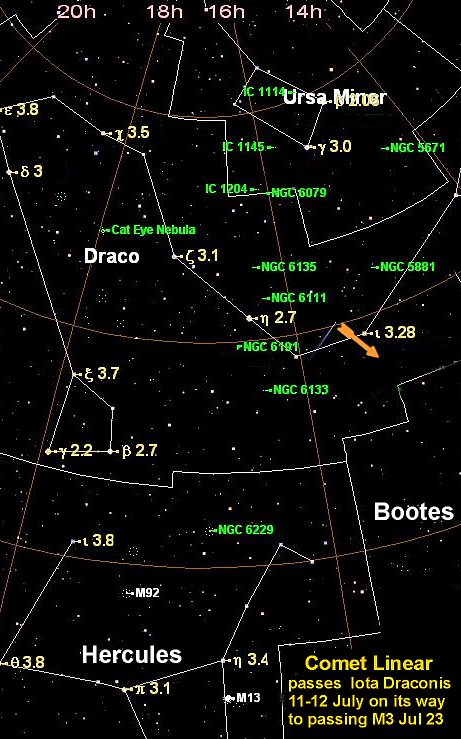
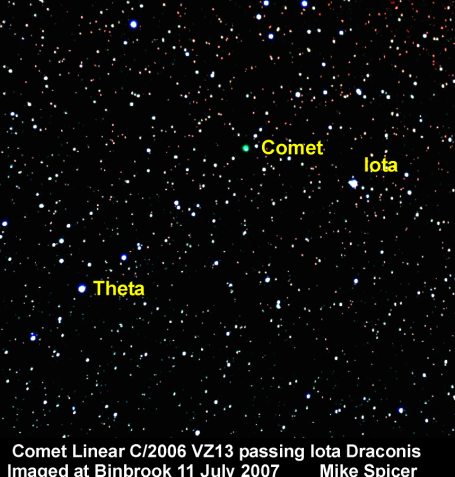
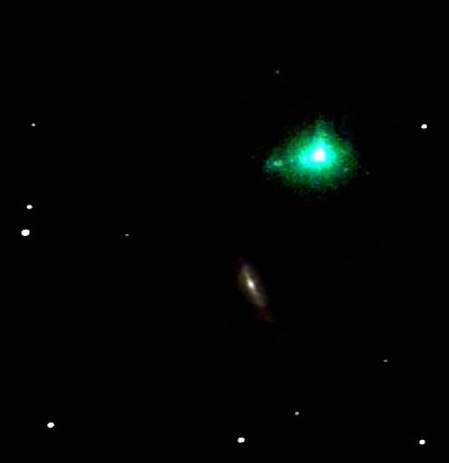
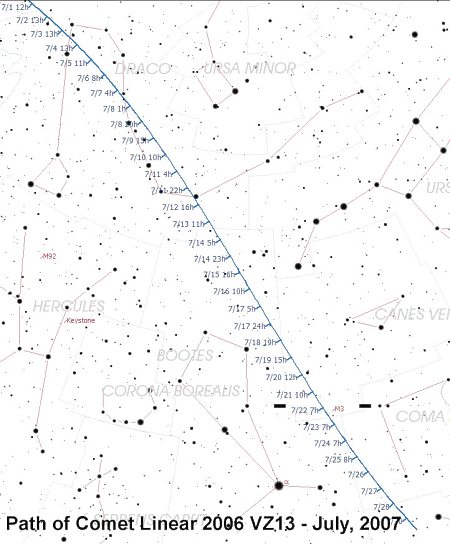
COMET LINEAR 2006VZ13 WILL PASS BY M3 THIS MONTH

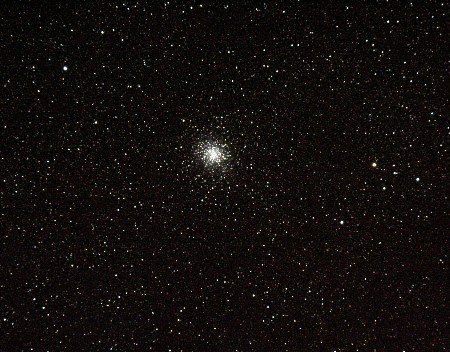
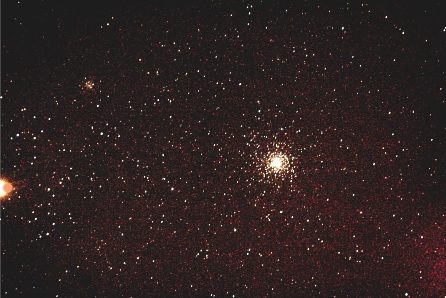
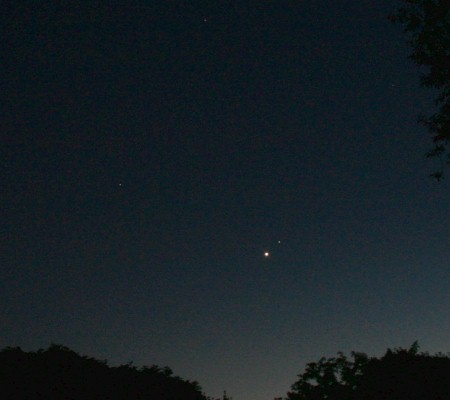
This comet sporting a 6′ halo, will pass by the globular cluster M3 the evenings of 23-4 July so you can compare the two:

Observers’ Report, 07-07-07

PERFECT WEATHER FOR 07-07-07 AT BINBROOK

“… and gentlemen in England now abed, will think themselves accursed they were not here…” runs the great speech from Henry V. We happy few who were out at Binbrook had a spectacular treat: perfect weather, very few bugs, sputtering meteors, several bright planets and a wonderful southern sky with a brilliant milky way… and no clouds.

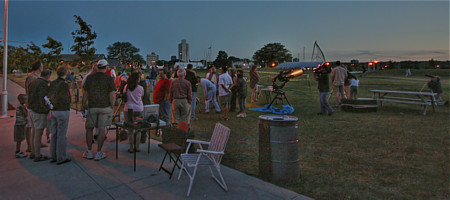
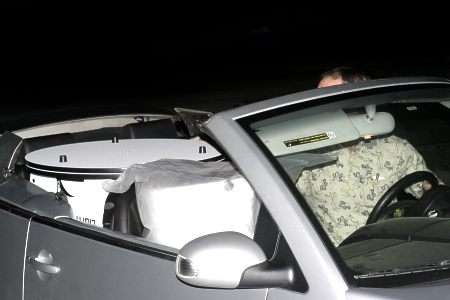
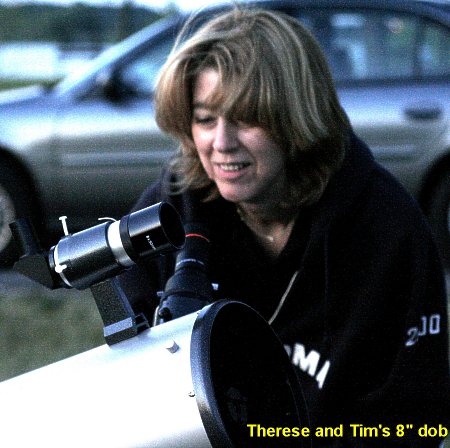
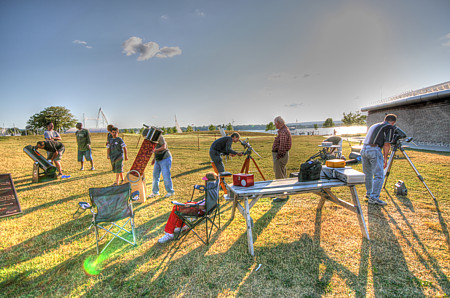
I opened the park at sunset and was set up, ready to observe with the 80mm apo on a TAL mount or image with the digital rebel, by 9:15 pm. Jackie did her alignment thing and started to observe the shadow transit of Ganymede by 9:25. Tim Philp and his friend Therese pulled in a minute later with his 8″ dob ready to go in a trice; Steve’s VW climbed the hill and disgorged a full binocular observing station, several green lasers and a Meade motor-driven reflector. A time-exposure can make darkness seem like daylight:

Dusk brought out Venus, then Jupiter, then Saturn as the sky darkened. Most were steadily watching the shadow of Ganymede complete its transit (seemed to be about 10 minutes faster than Starry Night showed it), with the 4 Jovian moons clustered to one side of the planet. For Jackie, who missed last night’s shadow transit of Europa, Ganymede’s shadow was both exiting to watch and a rare event.

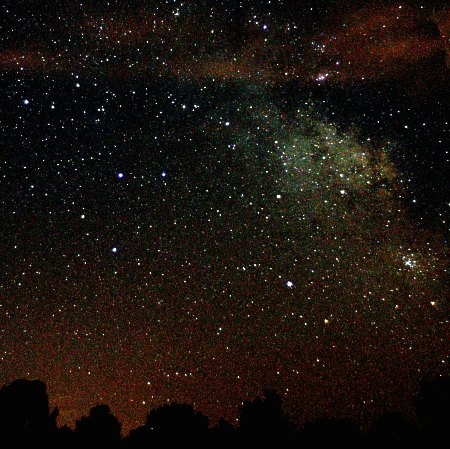
Once the sky became dark, imaging started in earnest, with focus on Scorpius and Sagittarius. Tim and Therese toured several Messier objects with the push-pull scope, falling behind Jackie and Steve’s tally using the go-to and her wonderful little apo. The sky was clear though the seeing was only fair. Therese learned to identify the Teapot, here’s a much-reduced image:

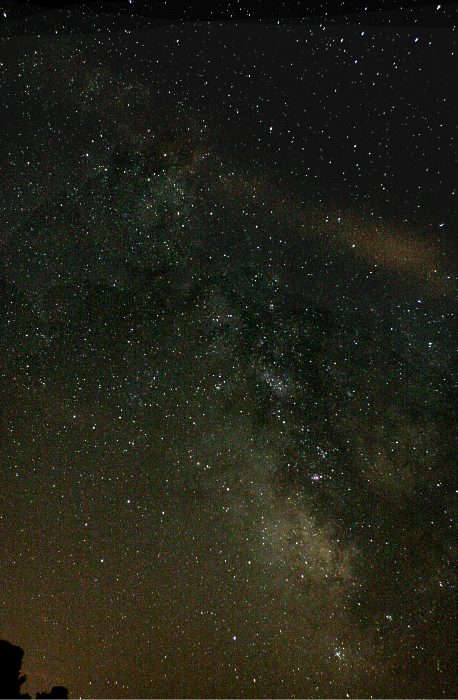
To really appreciate how the Milky Way looked, you’d have to turn your gaze higher to see it spreading up from the Teapot, through Scutum and Aquila… like this:

I was more satisfied with the Nikon 50mm F/1.8 lens I used tonight, than with last night’s Soligor lens. Star images showed no coma in the larger-sized image which I will post on my astro-gallery.

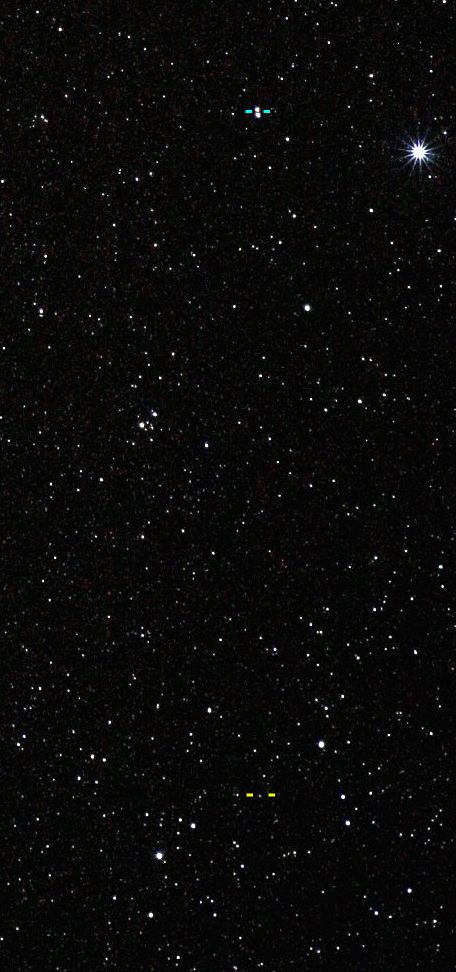
If you looked way up, the Milky Way ran right through Cygnus and showed a little colour overhead (a rarity for the Hamilton area). Tim took his friend on a tour of M57 and several globular clusters through the Milky Way, using a green laser as his finder (and it worked like a charm). I took just a small piece of the overhead sky shots, to show how beautiful Lyra looked. M57 is visible (between the yellow dashes), and Epsilon Lyrae is well separated (between the blue dashes):

Tim and Therese left at midnight but Jackie, Steve and I stayed for quite a while longer – several meteors including one at least mag minus 3 that swept slowly from the NE into Aquila, sputtering as it went. We listened for a sonic boom, but I didn’t hear anything as loud as when the raccoon fell into a garbage bin (apparently they can’t get out).

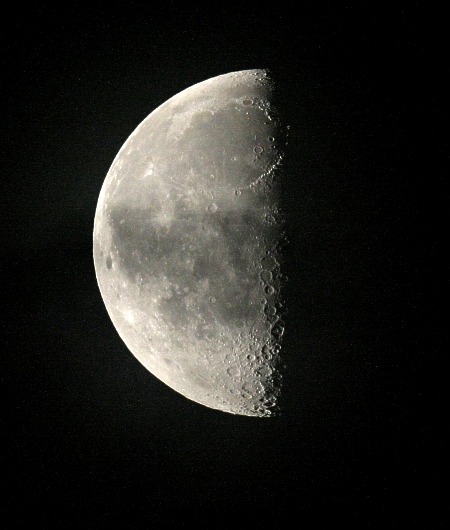
As the last quarter Moon rose over the lake, Steve and I imaged it and Jackie looked through a 5″ scope and a set of big binoculars (she loves that terminator). The temperature had fallen below 20 degrees when we finally packed up about 1:30 am.

A great night and to our friends who didn’t come out, take advantage of what comes by! November is only 110 days away and you’ll look back fondly on warm, clear summer nights!

Observers’ Notebook, 6 July

A PERFECT FRIDAY NIGHT AT BINBROOK, 6 JULY

I could not pass up the opportunity to try some wide-field imaging Friday evening at Binbrook. The sky seemed unusually clear with some high cloud and Jackie said she wanted to observe with her perfect little apo scope, so I had company for the session. She left for Binbrook before I did but somehow arrived about 5 minutes after me (go figure).

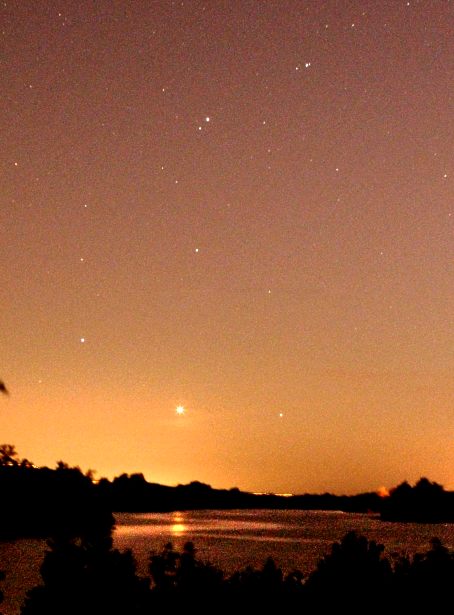
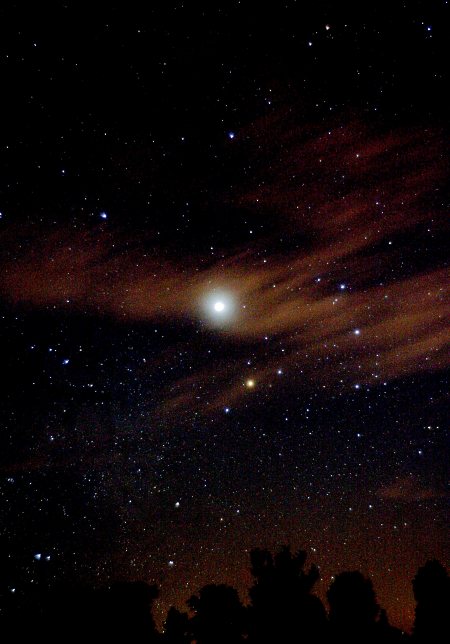
I set up a TAL clock drive mount with a SkyWatcherPro 80ED and had my scope polar aligned when Jackie pulled up. As she set up her go-to scope (aligned on the first try), I snapped some exposures of Venus settling toward the horizon over the lake, nestled between Saturn on the right and Regulus on the left:

It was simply a beautiful evening, perfect temperature, few bugs, a cooling breeze and even a couple of racoons in the nearby tree, watching with their bright green eyes. Of course July evenings are for imaging Sagittarius and Scorpius. We had the added benefit of Jupiter with a transit of Europa – Jackie spent most of her time watching for the moon’s shadow, but it was so far behind the moon that it didn’t arrive. TOMORROW we will set up at dusk to see the GIANT shadow of Ganymede on Jupiter (shadow transit ends at 10 pm). Imaging Sagittarius was my goal, let me know what you think of this much-reduced version:

And of course, capturing just about all of Scorpius and its tail (also much reduced to fit in this blog):

With her marvellous 5mm eyepiece Jackie captured excellent close-ups of M4, M22 and M20 and some dazzling views of the cloud banding on Jupiter. As we left Binbrook, the last quarter Moon was rising through the trees. I took a few images of it from home while downloading the above images:

If tomorrow is as good as tonight, we should have one really excellent outing. Bring your binoviewers! Remember, Tim Philp is coming out tomorrow with some (not all) of his astronomical equipment. It’ll be a night to remember.

Venus and Saturn by Bob Christmas

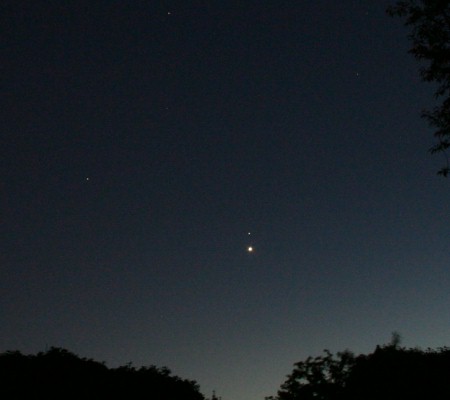
Here’s the positions of Venus and Saturn, as they appeared at Thorpe Park in Burlington, ON, just around the corner from my place. Venus is the bright one below; Saturn is the dim one above. Note the change of positions from one night to the next.

June 30, 2007 10:13 pm:

July 1, 2007 10:12 pm:

Stars and Fireworks at the Mullers: Saturday June 30

I joined the Mullers for some observing last night at their “GEM’n I Dob-servatory”. What a nice night of stargazing and good conversation! I really enjoy observing with Glenn and Gail. Glenn always has a line up of pretty interesting objects to look at. Since the moon was up and very bright we spent some time looking mainly at brighter objects. We started out by observing Venus and Saturn in the same eyepiece of their 6in Dob. Afterwards we turned the scope south to Jupiter. It was absolutely stunning in their Pentax EP. I have never seen so many bands on this planet (surprising since it was so windy). The moon was nice but because it was almost full it lacked in interesting features but we still enjoyed observing many of the craters. The night ended with some observing of really pretty doubles in or near Lyra… oh of course we took a peek at the Ring nebula. All this while there was a nice fireworks display across the street.

KerryLH

Observers Notes, 30 June

JUNE 30 SATURN AND VENUS

The western horizon held a spectacular sight in the West: Venus less than one degree below Saturn. I imaged with a 135mm lens on the Digital Rebel at F/11 (putting spikes on Venus):

By taking very short exposures it was possible to obtain images of both planets that showed detail (the crescent of Venus and the disk and rings of Saturn), if I cut out most of the distance between them, thus:

Catch Saturn and Venus, Sat. June 30th

This evening Saturn and Venus will be within 2/3 of a degree of each other in the western sky. This means they will easily fit in the FOV of low power eyepieces in your telescopes. The Full Moon shouldn’t affect the viewing of this bright pairing, too much, and while you’re at it why not swing over to the south for a look at Jupiter.
The forecast is for clear skies, mild temperatures, and few bugs, so why not invite your neighbours over for a look at this rare event 🙂

Late night at Binbrook

A number of observers showed up at the alternate site last night and stayed into the early hours of the morning (I was the first to leave at around 1:30am – I had to work today). While Mike, Kerry, and I imaged – others tried to determine just how much detail could be made out on various DSOs just looking through the scopes.

Clear skies, steady and calm after 10:30pm, no bugs, and a half dozen or so fellow observers – a good night.

The Omega (Swan) Nebula:

The moon (at 55.5% illumination):

———————————————————————–

Update By KerryLH :

Was a great night out but got pretty chilly near the end. It was fun observing with everyone… we even had two non members join in with their scopes. It’s nice meeting new people that are into the hobby.

I spent most of my night photographing through my Sky-Watcher 80mm Equinox and using the c6-SCT as a guidescope.

M8 Lagoon Nebula By:Kerry
3x4min

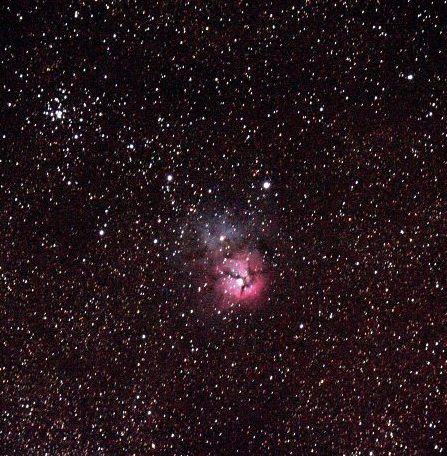
M20 Trifid Nebula By:Kerry
3x3min

I’d have to say these are the best nebula shots that I have taken to date… thanks Tim for the motivation to get a couple more manually guided frames. I was a little disappointed in the chromatic aberration in some of the stars since I was using an APO but apparently I can easily get rid of it with processing. I guess not all APOs are equal.

Lunar Observing

FANTASTIC THURSDAY NIGHT, 21 JUNE

What a Moon:

Mini Star Party Wed night

After carefully monitoring the weather conditions and checking Kerry’s reports, we decided to open up Binbrook. On the way up, I was getting worried when I saw the sky covered in high level clouds. Fortunately I needn’t fret as the clouds disappated for a clear night.

When I arrived, Jackie had just packed up her 80mm Nexstar after spending several hours of solar observing, and was in the process of setting up the 80mm apo for the night session.

Eventually John G showed up with his 5″ Dob, Kerry brought her 6″ Schmidt, Tim H had his 80mm apo on a table mount (wasn’t it a little cool sitting on the ground?). Jim W arrived with his 8″ Celestron and of course I had my 7″ Mak. Around 10:30 Steve G appeared with his 4″ loaner Newtonian and his parallelogram binocular mount. (Surprisingly no one set up any imaging equipment – it was going to be strictly an observing night.) We had a great variety of scopes set up and we had clear skies. On the shortest night of the year, we were going to make the best of it.

Early we had a great view of Venus, Saturn, Regulus and the waxing cresent moon all lined up in a row. We really enjoyed looking at the terminator on the moon, especially with the various binoviewers that were present. Between breaks in some mild unsettled air near the horizon, we could see many bands and colours on Jupiter and its 4 moons lined up equally on both sides of the planet. Coincidentally, there was a star of about equal magnitude in perfect alignment with the moons and it looked like Jupiter had gained a 5th Galilean moon.

John G had come prepared and notified us of the scheduled passing of the ISS and shuttle. Right on time they went by and we all had a chance to watch the two of them fly by, separated by about 35 degrees. While we couldn’t track with the scopes, we trained the binoculars we had on them. Regrettably we couldn’t make out much detail due to the low angle of their passing. But it was still a nice treat.

With all the equipment present, we spent a fair amount of time swapping pieces to see what we liked. Jackie had her Celestron binoviewer, I had my Antares and Kerry was trying out some Lomo’s she had borrowed. Everyone agreed that viewing with BV’s was a real joy. We trained them on the moon, globulars and nebulaes. The images were slightly less bright than with a single eyepiece, but the comfort of using 2 eyes and the increased perceived depth perception made up for the lack of brightness. After attempting to do a careful evaluation of trying each on different scopes and using the same eyepieces, I think the consensus was that the Celestrons and Antares were nearly identical. The surprise was the Lomo’s. Most felt they weren’t quite as bright or crisp as the other two. They were nice, but just not quite as appealing as the others. This was quite baffling since they have a very good reputation. Several hypotheses were debated, but we agreed we didn’t have enough knowledge to explain the difference.

In addition to trying out the various BV’s, we also swapped eyepieces around. Without exception, everyone agreed the best was John G’s Pentax WX EP’s. They were amazingly brighter and crisper than any of the stock eyepieces that most of us were using. Even on his 5″ Dob, M13 was as bright and clear (when we could get the scope to stay on the cluster) as on my 7″ Mak with a regular eyepiece. While great eyepieces, they were a little heavy for his small Dob. The rest of us were drooling and green with envy. (I think I know what I want for Christmas.)

Just as Kerry predicted, the clouds started to roll in around 1am so we decided to pack it in which was just as well. Since some of us had to work in the morning and if the good conditions had persisted, we might have stayed all night. A few of us stopped off at Tim’s afterwards for a nightcap.

It was an excellent night. We hit a lot of objects, each of us calling them out so others could come take a look. We had a lot of fun trying out equipment and enjoying each others company. What a great way to spend a summer evening with a bunch of active and enthusiastic HAA club members. Can’t wait to do it again. (How’s the weather this weekend Kerry?) And again our thanks to Binbrook Conservation Area for letting us make use of such a great location for our observing.