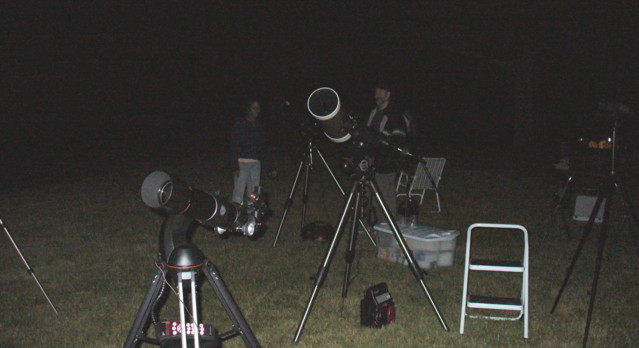
Gathering at the Patio Sunday Night

A LITTLE OBSERVING, A LITTLE IMAGING, JUNE 17-8

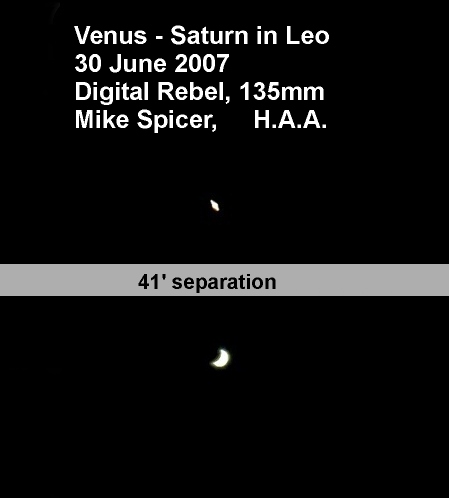
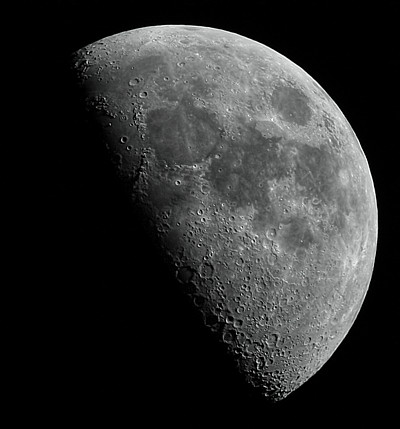
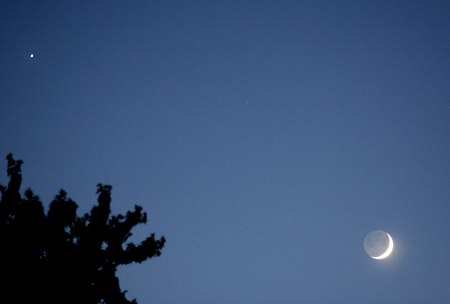
The predicted morning rain failed to develop, but the CSC prediction for the evening changed from blue to grey. Steve K and I shelved our plans to image at Binbrook. As evening fell the sky didn’t look too bad. I was shooting the crescent Moon below Venus when Steve dropped by (Monday night the Moon will be between Venus and Saturn):

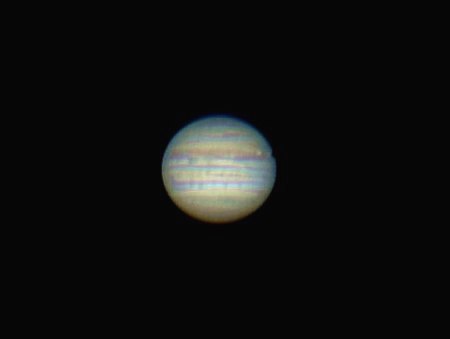
The air was heavy with moisture and the seeing was only 4 or 5 arc-seconds (components of Epsilon Lyrae scintillated badly and planetary nebulas didn’t show detail). We looked at a number of objects but decided to image Io’s transit of Jupiter starting about 1:30 am when the moon’s dark shadow, closely trailing the moon, was just on the planet’s limb:

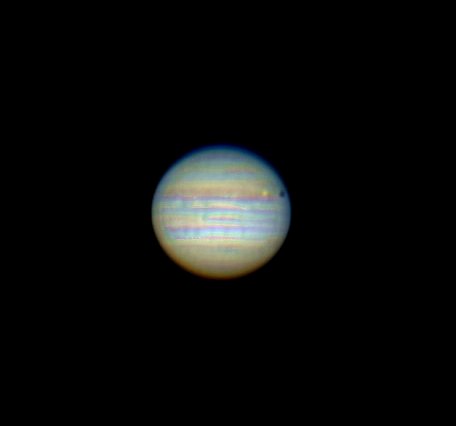
The seeing never really improved but by 1:45 am it was possible to see both Io (transiting against the NEB) and its shadow against the planet’s disk:

Monday night is looking better for observing and imaging. Steve K and I plan to go to Binbrook; email me if you are interested in joining us!

Very brief night out – Saturday 16 June

By: KerryLH
After checking the satellite and a few forecast profiles for YHM (hamilton airport) I figured that there would be a brief clear break in the late evening before the cloud from the approaching front arrives. Because I wasn’t expecting prolonged stargazing conditions I set my c6 up on the camera tripod (These kind of nights I wish I had a dob on wheels) for some quick viewing. The plan was to check out the binoviewers that Mike loaned me. After the initial set up I was a little disappointed because I couldn’t reach focus with them but then realized if I took the focal reducer off the C6 I might have better luck. Sure enough I did and spent a good hour touring the night sky with no star charts, no finder and two eyes. I managed to stumble across many open clusters… what beautiful sites. The stars weren’t as sharp as I was hoping but that could have been due to the shake from the tripod and the high upper winds. Overall though it was extremely comfortable and enjoyable to view with them. On my next clear night I will have to do further testing but on my steady cg5 mount.

Side note: I couldn’t believe that I completely ran into M57 by just scanning the sky… unfortunately the binoviewers weren’t on at the time. Anyway that’s it for me….

The ISS and Space Shuttle

The next several days offer excellent chances to view passes of the International Space Station. It should be particularly bright since the Space Shuttle is currently docked with it.
For a schedule, go to the Heavens Above website at:
http://www.heavens-above.com
The last time Gail and I saw the ISS, the Shuttle had just undocked and we could see them both racing across the sky together – well worth the effort to catch!

Tuesday, 12 June

SOME LOVELY LITTLE FLOWERS

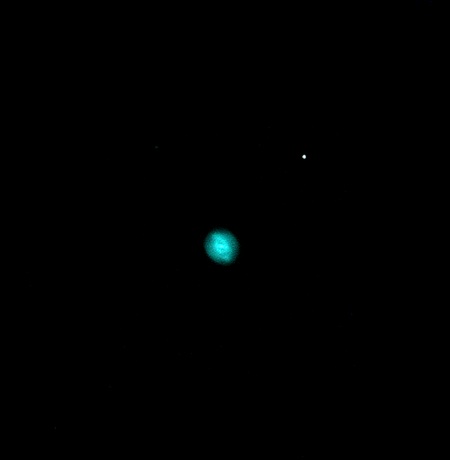
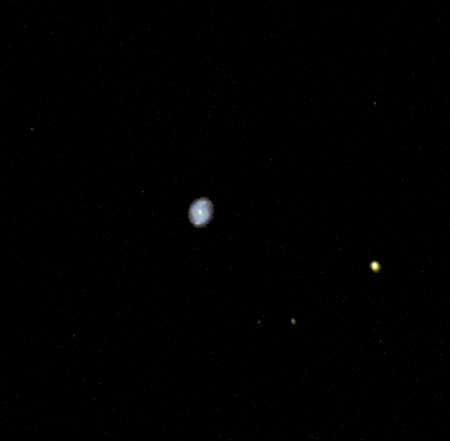
Even using a large-format Digital Rebel imaging chip on the Nexstar 11, one could still obtain some pretty little images of planetary nebulas through the very still air over Hamilton on Tuesday night, here is an example, even after reduction to 450 pixcels wide in jpg format for posting here, do you recognize it as the Cat’s Eye nebula NGC 6543?:

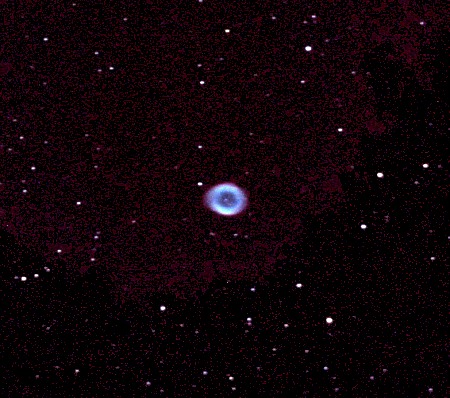
Here’s an old favourite in a 30 second image, same scope and camera:

Finally, here’s a pretty number, recognize it as NGC 6210 in Hercules?

A good start to the summer.

I got two excellent nights and one very good night in a row (last night was still very clear, but there was a slight twinkle to the stars). I tried my hand at imaging the North American Nebula – this one is very faint – I took three 20 minutes exposures as wisps of the nebulae could just barely be made out in the five minute test exposure. Even at 20 minutes I had to adjust the raw image exposure by +1 which made them all that much more grainy. Unfortunately though there was a problem with the tracking – I thought I had tracked all three exposures ok but afterward discovered I hadn’t firmly locked down the guide scope so I still wound up with star trailing. Anyhow, here is a first attempt 3 x 20 minute exposure of the North American Nebula drastically reduced:

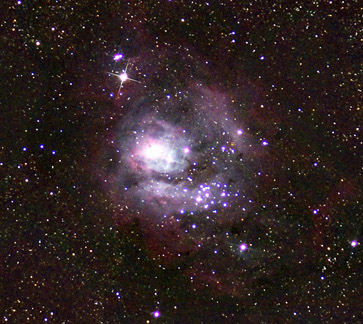
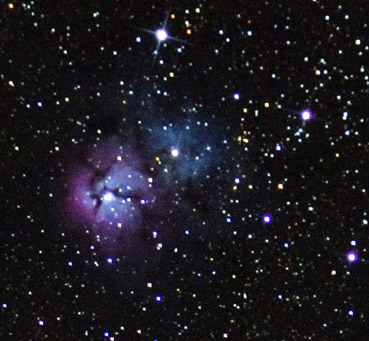
Also, the re-attempt at the Lagoon & Trifid resulted in much sharper detail which really shows on the lager image in my gallery (I did lock down the guide scope for this one) – this is 1 x 5, 2 x 10, and 1 x 15. I didn’t get a chance to post it yesterday as the phones (and DSL) went down:

Looks like it was a good weekend of observing for all.

Three Beautiful Nights

So Far, Three Beautiful Nights in a Row

Another all-nighter. Beautiful images of many deep sky objects, and at the end, a slim crescent Moon rose over the city just two hours before the sun. Hanging low in the slow-moving clouds that hug the horizon, the ashen light was visible in a small telescope. Here is a much reduced image:

Grimsby Report Sunday June 10, 2007

Sunday night unfortunately I did not meet up with the group in Binbrook. With the 9pm gate opening, I was thinking that I would not have enough time to set up for imaging before it got dark.

Anyway it worked out great in the end. I really enjoyed the comforts of observing and imaging from home and the bonus was that the sky was absolutely crystal clear and fairly dark (mag 5.5). I started out by observing my usual favourites. M51 and M101… what a huge difference in view compared to Thursday night. I could cleary make out the two bright cores and the fuzzy spiral arms of M51. M101 was much easier to see without averted vision. Afterwards I spent the rest of the night imaging targets like NGC4565, M57 and NGC6871. By the time I was ready to pack up it was late enough that I could catch a glimpse of the beautiful summer milky way.

My Sunday night setup

NGC4565 – I love observing this edge on galaxy. (NGC4562 is the faint smudge below)

M57 – I had to try this target again. I wanted to get a sharper focus so that I could capture the 15th magnitude central star

NGC6871 – an interesting looking open cluster in Cygnus.

Realizations after the long night:

-An LPR filter needs to be on my ‘must buy list’
-imaging with the 80mm APO and using the 6in as a guidescope might help with getting
better quality longer exposure images
-It might be a better idea to concentrate on imaging only one target per night
-Imaging is more challenging than I ever imagined.. gathering the light frames
is only half the battle, post processing is the other half.

Binbrook, June 10

Observing report, June 10, 2007

5 of us arrived at Binbrook a bit before about 9pm. The gate was still open so i went in.
A ranger followed me about 10 minutes later and i explained i was with the astronomy club.
Some people came by on foot with their dogs, and then continued on their walk. I had arrived first and set up down at the beach but everyone else thought the top of the hill was much better. Not one to reject experience, i carried my scope and binoculars up the hill and moved the car.

My first project was the alignment of my finder scope. I used the distant trees, but it turned out that the trees are fractal in nature and i actually had aligned my finderscope with a different bunch of leaves that looked like mickey mouse.
Once i established that venus was nowhere to be seen in the scope, i repeated it with a more distinctive bunch of branches and had it perfectly aligned. It made a big difference since i could now use a high power eyepiece and verify with the finderscope that all was well.

First there was a fine sunset, with pastel hues of pink and purple. Venus and Saturn were out in the twilight, and we were able to bring them into view, and even see titan, long before the constellations were out. Before long we also spotted Jupiter from behind some trees near the horizon. John pointed out to us that we could now see 4 planets, almost half the solar system. I fell for that one and asked which was the fourth planet. “You’re standing on it”.

View over the lake from our observing site.

The low clouds might not be good for observing, but they serve to enhance the sunset.

The space station was due to cross the sky at about 10:36 pm. In spite of some low
clouds we were able to pick it up with unaided eyes, and also find it in binoculars,
although it occurs to me that an orbital mount angle might be a handy way to track it
without all kinds of hand adjustment. John had printed out a chart of several expected satellites with timing and path predictions.

We saw several other satellites, but could not follow them all the way across the sky. They seemed to be bright for a few seconds and then dim down almost to invisibility in the skyglow over Hamilton.

We went over to the water’s edge and watched Venus reflected in the water. A fine meteor
shot past Venus and 2 of us saw it. Back up the hill after that.

We then toured the sky for globular and open clusters, M53, M57. Exchanging views in various scopes and binoculars.

I used my star charts and the EH to locate Vesta, first in binoculars, next in the spotting scope of my newtonian and finally in the scope itself. Star charts in the binoculars showed it to be a third ‘star’ near 2 charted stars of similar brightness.

The transit of Io across Jupiter was due to begin at 11:40 PM. We watched as it became not more than a bump on Jupiter, and then eventually we were able to see the shadow on Jupiter,
as a small black dot.

It was a nice evening, but there was almost no wind. In spite of that, we got no problems from dew except for Jackie’s scope which got packed up around midnight. She remained to look through John’s 80 mm refractor.

Our scopes and observers on the hill.

I asked all to close their eyes for this flash photo. I think next time a tripod assisted time exposure with my camera.

I tried to locate M4 in my scope. Although i could pick it up in the binoculars, it was much harder to find in the finderscope. Eventually i found it.

The 4.5 inch Newtonian served me well, again, but had some problems too… for one thing, there was not a very rich star field along with Vesta. I am spoiled by my binoculars.
So with the widest eyepiece, all i really had in the eyepiece was Vesta. The lack of a RA motor for it is one inconvenience, and the other is that there’s a lot of backlash and play in the motors, such that nudging the scope or turning the focuser will reposition it.
Also the focuser mechanism is not silky smooth, and this makes it harder to adjust the focus for planets.

John tried Jackie’s bino-viewer on his Orion 80, and the star fields were nice and dark
and sharp. John was positively delighted with the improvement in comfort, detail and ease of use with the bino-viewer. An additional bonus is that when you refer to the orientation of objects in the field of view, clock hours can make sense, since all observers will be in the same orientation. This is not the case with a single eyepiece.

John then attached a 2 inch diagonal and one of his wide field eyepieces. We looked at several nebulae including M16 and M17. John demonstrated that with a 2 inch diagonal, they could both be seen in the same field of view. This is possible on a shorted refractor but not with a SCT.

We returned to the Jupiter transit several times, while in the meantime seeking out Messier
objects against the rich background of the milky way in Saggitarius.

Compared to wintertime, it was balmy. I did not even have to do up my jacket, although
some people were a bit colder. A few hand warmers helped immensely. The weather was perfect, and the seeing was steady, the wind was not buffeting us or the scopes, and we remained there till after 2 am, then packed up and headed for home.

Once again it was worth the drive to Binbrook.
Clear skies!

Two perfect clear nights in a row

I decided to use my laptop to assist with focusing last night (no special software – just the ability to see the image on a large screen) – this helped drastically – I used Jupiter as my focus object (shown below cropped but at FULL size – Jupiter is really tiny with my widefield setup). Then I moved on to the Eagle Nebula (Kerry this time it is the Eagle and not the Seagull) and took 2 x 5 minute and 2 x 10 minute exposures – I also used my LPR filter – the focus and clarity was so much better than the previous night I decided to re-image the Lagoon/Trifid – 1 x 5 minutes, 2 x 10 minutes, and (ooops – forgot to start the timer) 1 x 15 minutes. Even under a darksky sight such as Tobermory the LPR really made an improvement in contrast. I was going to do a set of the Omega (or Swan) Nebula but my camera battery ran out after the first 5 minute exposure so I only got one frame and thus can’t stack it. A good 4 hours of observing and imaging.

My focus target (at full size cropped):

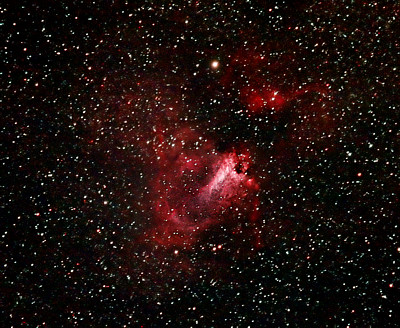
M17: The Omega (or Swan) Nebula – single exposure:

M16: The Eagle Nebula – 2 x 5min, 2 x 10min:

…close up of the Eagle showing Pillars of Creation:

I will post the last image once processed – larger versions are being uploaded to my gallery.

Turning into a beautiful summer for astro imaging

It was a comfortable 10c with almost no wind, no bugs, and easily managed dew. I only imaged the Lagoon & Trifid Nebulae – but did some visual observing of the region afterward – what a rich area of sky – on low power you can starcluster hop all along the Milkyway (which was very clear up here). The weather for tonight is supposed to even be better than last.

My focus was off a little but the image still turned out reasonably good – especially when reduced. The Trifid is the blue and red smaller nebula on the top – the Lagoon is the big one on the bottom. A larger version is now on my website www.ArtisticDigitalScenery.com. I think I may try again tonight with my laptop connected for focusing and my LPR filter for contrast.

UPDATE: I’ve rotated the image as it would appear in the sky.

Imaged using Canon Digital Rebel XTi mounted prime focus on Celestron 80mm Onyx APO

3 x 5 minutes and 1 x 10 minutes – manually guided – stacked in Registax – colour balanced in Corel PhotoPaint – final clean up with NeatImage. Seeing was very steady and clear.

I did not use my LPR filter for this shot – light pollution was cleaned up digitally during colour balancing.