Weather Report for the Mercury Transit

MERCURY TRANSIT WEATHER REPORT

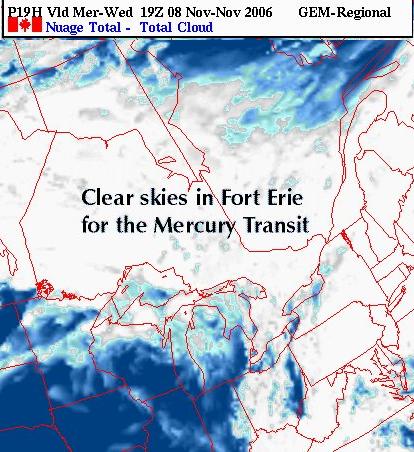
The entire province and neighbouring states seem socked in with thick rainclouds for Wednesday, 8 November. You are likely wondering if you have an umbrella for your solar filter….

…. take heart! With 11 hours to go, the weatherman says the sky over Fort Erie will be reasonably blue from 2 pm, and the clearing will improve as time (and the transit of Mercury) progresses. Fort Erie! Only an hour away by excellent highway! Of course, it’s best to check the weather reports close to noon Wednesday – weather is changeable and we offer no warranties. Here is that weathermap for you:

Comet Swan in November

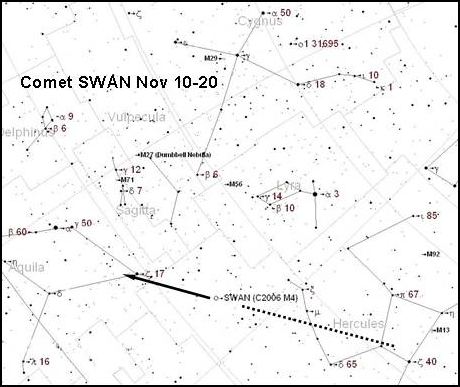
COMET SWAN AS IT APPROACHES ALTAIR IN NOVEMBER:

The comet was magnitude 4 a week ago and may brighten further (you never know with comets) although it is moving away from the sun now, low in the West in the evening as it appears to approach the bright star Altair. The pronounced green colour of the comet is noticeable even in small telescopes.

First Light (sort of)

The clear skies predicted for tonight let us down some what. As I approached the main gate at Binbrook, Mike Spicer passed by and Tim Harpur was just leaving. Mike had been imaging earlier. But by the time Tim arrived, he felt it was getting too hazy to bother setting up. After a quick check at the alternate site to verify no one else was there, I went back to our primary location and met up with a couple of other observers.

I had high hopes for this evening since it was going to represent first light for my new SkyWatcher Pro 180mm Maksutov. I was determined to break the new scope curse. I did set up, but between the haze and the intermitent clouds, it was tough finding good objects to look at.

After doing a rough polar alignment, sorting out the finder and waiting a little for the scope to thermally stabilize, I decided to make M31 my first target since some of the others were also looking at this object. With the clouds, it was hard to locate Andromeda, but peeking between them, there it was high overhead. Despite the conditions, the bright center of the galaxy was quite visible (sometimes) and I could make out a fair amount of the “fuzz” around it.

Since M44 was fairly bright and an easy target, I decided to give it a try. With the 20mm EP and the narrow field of view with the f/15 Mak, I could only center a few of the main stars, but many smaller stars came into view amazingly clear that I hadn’t been able to see previously with my small refractor or the 6″ Newtonian.

As we were discussing various night sky objects, someone suggested the Ring Nebula. Lyra was still reasonably high so I swung around and quickly found M57. I was surprised how easily it stood out considering the difficulties I had in previous scopes. I added a narrow band filter and the contrast improved, but conditions were still not good enough to make out colours.

By this time, it was after 11 and some of the others were starting to suffer dew problems, so they packed up. Since I couldn’t stay too late anyways, I decided to join them. While it wasn’t what I hoped for in the way of a viewing night, it did allow the new scope to see first light and I was very satisfied with the results. It’s given me high expectations for what I will see in the years to come.

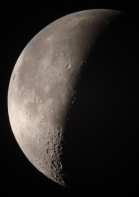
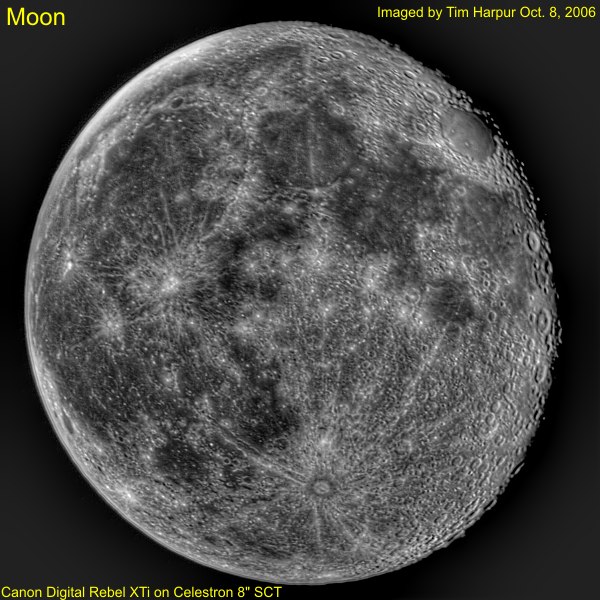
22d 17h 28m moon

This is my first blog, so shoot me if it’s not readable. I haven’t the faintest why or when I need to use the above HTML blocks but I’ll manage somehow.

Woke up at 5:00 am to image my favourite observing target. Looked out the window and saw nothing but dense clouds. Watched TWN (Canada’s Weather Channel) for about 20 mins and took a chance that the clouds might break up a tad. Took my refractor and 40 mm eyepieces (Scopetronix Maxview and Maxview II) outside to cool down, then got dressed.

Assembled tripod and carefully levelled it, then mounted my Sphinx Goto. Sporadic clearings in cloud cover was encouraging. No Polaris, so I input the time using my cell phone’s clock, set Sphinx to go to Moon. Positioned it then clicked “Align” and let the mount track it. Unbelievably it did. Attached the Maxview II to my newly-acquired Sony DSC-H5 and took five images in all only two of which were worth saving.

Set camera to M for manual. Focusing is much easier when you have a 3″ LCD viewer. I set self-timer for 10 seconds so that the camera would settle down after I pressed the shutter button – two seconds is not enough. Because of the cloud cover, I had to anticipate the approach of a clearing (well not exactly, more of a thinning) and didn’t expect much when I had to set the exposure to 1/3 sec. From previous images, ISO higher than 200 resulted in “noise” and loss of “colour”. OK I’ll let you decide if it’s any good.

Moon Oct 15, 2006 6:14 am Hamilton ON Canada

22d 17h 28m moon imaged at 6:14 am EDT Oct 15, 2006 using a Vixen ED130SS, Sphinx Goto mount and Maxview II 40mm eyepiece attached to Sony DSC-H5 set at ISO 200 F3.5 1/3 sec.

This photo will hopefully be posted in my gallery of HAA.

What to dew on a Sunday night

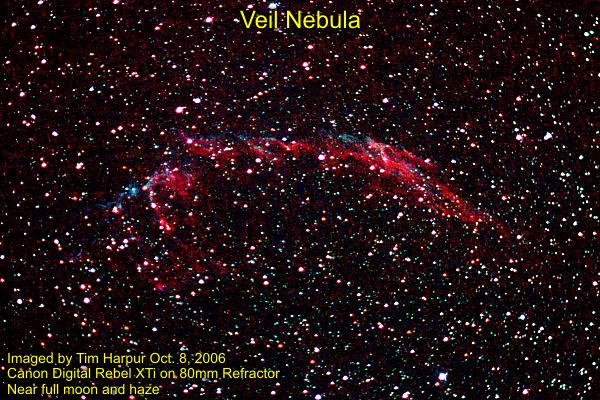
Well, it was a relatively clear night again – some haze patches floated by – but for the most part clear. The observing session started with a very promising sign – I had set up the telescope in my brother’s backyard in the heart of Guelph during daylight hours. I had never setup there before and had to guess roughly where Polaris would be – when night came and I went to do the alignment I discovered that Polaris was already in the main scope’s FOV at 63x power and only required minor fine adjustments. Unfortunately the dew set in within a half hour – even with the dew shield. Since I had access to 120v power I decided to fight back at the dew with the help of an occasional blast from a hair dryer – and managed to get about 3 hours of observing and imaging in. I used my broadband pollution filter for the first time doing imaging and took a number of 30sec, 2min, 4min, and 6min exposures of the Veil Nebula through my guide scope while guiding through my main scope (a practice I am finding myself doing more and more lately – gives nice wide field images). I then turned my attention to the very present, near full moon – and took images through my guide scope and then my main scope.

Anybody know where to buy a 12v travel hair dryer?

Veil Nebula
Moon – Near Full
Moon – Crater Petavius

First Light!

Today was first light on my new telescope. I was in Toronto with Mike Spicer to buy some filters when I saw a Coronado PST. It was the best price that I had seen at any store, so I bit the bullet and bought it.
My first experience was less than ‘stellar’ as I had difficulty getting proper focus. When I did get focus, the image was pretty bland… even considering that we are at the low point of the 11-year sunspot cycle.
You know, it is amazing what you can learn when you actually take the time to read the instructions. While I had used this kind of telescope before, it had always been set up by someone else. There are two controls on this scope, one to focus and the other to detune the H-alpha filter. Once you focus, you may need to adjust the filter to get fine detail on the surface of the sun. This is especially true if you are looking at features that are moving toward or away from you. The doppler effect can change the frequency of the H-alpha light enough to make some details completely invisible!
Once I got the hang of it, I managed to get some spectacular images of the sun. There were at least 4 flares that I could see as well as the faculae on the surface. There are areas of instability on the surface, but no sunspots! These areas are completely invisible with just a white light broadband filter.
I need a better tripod (Mike?) but I plan to find a way to mount it to an equatorial mount so I can track the sun and take pictures.
Solar observing does not have the same cache as night-time observing, however, it is a damn sight warmer!

New images of the Trifid Nebula and Lagoon Nebula by Tim Harpur

Fall season – colder nights but dark earlier. I got to Binbrook just after 8:00pm on Thursday and the gate was already opened – Glenn and Gail had arrived ahead of me. With their DOBs they were set up and observing about 1/2hr before I was finished aligning. DOBs certainly have that advantage going for them – but I’m a Photographer, and in the end the extra setup time of the EQ GT mount is well worth it. I concentrated mainly on the Lagoon Nebula (M8) – all the images were shot with a Digital Rebel XTi mounted on a Celestron 8″ SCT GT at ISO 1600 – 36 minutes total exposure (2 x 8min, 2 x 4min, 6 x 2min) – stacked and processed. Before leaving I snapped off a few shots of the Trifid Nebula but didn’t spend much time as it was getting too low to the horizon – total exposure time was only 10 minutes.

Observing tonight?

OBSERVING SATURDAY NIGHT, 16 SEPTEMBER

IN GRIMSBY,
it was pretty much the same thing – clear but with so much moisture in the air that my laser pointer had the beam of a mile long light sword!
It was, however, a good opportunity for Gail to get more familiar with her new 4 1/2″ f4 reflector.

That morning, I’d replaced the stock red-dot finder with my Rigel Quickfinder and Gail found the “bull’s-eye” sight a better tool for locating the Messier objects on her star charts. In fairly quick succession she found M57, M13, M92, M27, M103, M31, and CR399 which is Brocchi’s cluster aka “The Coathanger”.

Before we packed up I had a quick peek through our 6″ reflector – the first time since it had been blown over at Starfest. For some reason the view appeared dimmer than shown in the little Starblast so I did a quick star test and only got half a star! Looks like I have another opportunity to use my new Cheshire collimator 🙂 – Glenn M.

Rare Outburst of SW UMa

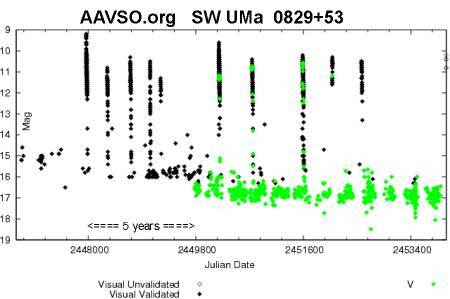
The AAVSO has reported that SW UMa (R.A. 08:36:42.74 Decl. +53:28:38.1 (2000)) has recently outburst to 10th magnitude from a normal minimum visual magnitude of 16.8. The last time an outburst for this star was reported was in October 2002 when it was brighter than magnitude 13.5 for 17 days. Previous eruptions took place at shorter intervals… Here is a chart of eruptions over the past 20 years:

AAVSO charts for this cataclysmic variable star can be found at this link:

http://www.aavso.org/cgi-bin/searchcharts3.pl?name=sw%20uma

The original AAVSO special notice can be found at this link:

http://www.aavso.org/publications/specialnotice/18.shtml

Reflections of Orion

Dickey Lake is a small body of water about an hour and a half northeast of Peterborough. My wife and I rented a cottage on the lake for the past two weeks (I just got back yesterday). Our cottage adventure began with a yellowjacket infestation, with the beastly critters flying and crawling in places they had no business–down the hall, in our bed, in a towel I grabbed to dry my hair with after a shower… So the first week was more of an Alfred Hitchcock experience than a holiday. And for various reasons I didn’t get my telescope out to investigate the wondrously dark sky above the lake until 8 days after arriving (which would be Sunday August 27th, after a rather wet weekend–those of you who went to ‘Tarpfest’ know what I mean). As you can imagine, I was more than eager to get down on that dock by the water and look up!

We got back to the cottage late that night after being in Bancroft at a friend’s for supper, but I was determined to do some stargazing, though I didn’t get my telescope set up until about 1 o’clock in the morning. I am so glad I did, because I had a great night! The conditions were average, and the seeing was so-so, but the darkness more than compensated. Before my session was over at around 3:30, I had observed 6 new Messier objects and become more familiar with some of the dimmer autumn constellations that I had never really seen clearly before, such as Aquarius and Cetus. As the night progressed, the winter constellations Auriga, Gemini, Taurus, and my favourite Orion slowly rose above the lake where their bright stars reflected in its calm, serene waters. I had toyed with the idea of pulling an all-nighter, but the dew finally got the better of me and my equipment by around 3 o’clock.

As I packed up my scope, an interesting thing happened: Instead of seeing the sky as a kind of treasure map hiding celestial treats to hunt out and log in my book, I was able instead to just gaze up and appreciate the incomparable beauty of the night sky. I will never forget the sight, with the shimmering stars on the calm lake, the dampness of the night air, the smell of the water, and the soft sounds of nature around me (the splashing of fish in the lake, the hooting of an owl, a rustling in the brush). Isn’t it interesting how the vastness of nature as embodied in the starry splendour of the night sky can make a man feel so small, and yet somehow affirm his place in the grand scheme of things? I look forward to the upcoming months, as my friend Orion makes his grand march across the sky until he once again bows out next spring. I wonder what secrets I will discover by then?