Asteroid Erigone to occult Regulus

Here’s an interesting upcoming Astronomical event you may wish to try to take in. In the early hours of Thu 20 March 2014, an asteroid will pass in front of the bright star Regulus (mag 1.2). This is called an occultation when one object pass in front of another (we also use the term “eclipse” for things like the Moon or Sun).

The cool thing is that this is going to happen fairly close to us in the Hamilton area. Of course this is dependent upon whether the skies are going to be clear or not.

Continue Reading

Halo Season

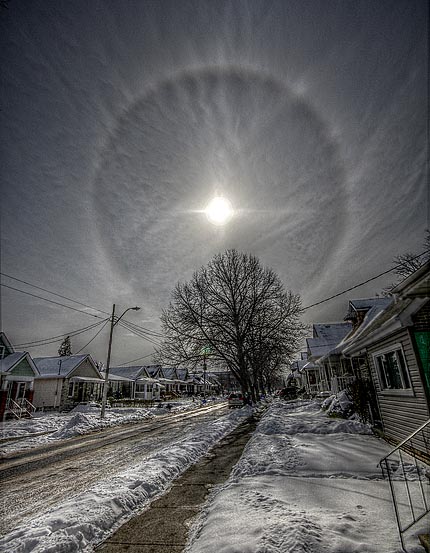
At any time of year spectacular solar and lunar halos may appear in the sky, but this time of year is particularly good. No special equipment is needed to observe these beautiful sights, but care must be taken as solar halos appear around the sun. Remember to always use proper precautions when observing near the sun.
This image was taken a couple of days ago in front of my house. I have exaggerated the contrast of the image to better show the detail in the sky, however these phenomena are easily seen with the unaided eye. Keep an eye out for halos, sun and moon dogs, arcs and other atmospheric phenomena during the upcoming season.

Super Nova in M82

Hi, just saw news of a mag 11 nova in m82. Could get as bright as mag 8 over the next few days. I know its darn cold outside, but if anyone can image it, I would be happy to show it to the club next month.
Matthew

John Dobson

John Dobson, whose name has become synonymous with large, easy to use telescopes, has passed away at the age of 98. He started building large reflectors with alt-az mounts on them for the purpose of taking them to the streets and sharing views of the night sky with passers-by. He not only pioneered the concept of sidewalk astronomy, but of course we now refer to this style of telescope as a Dobsonian. These scopes were easy to make and used inexpensive materials, making large apertures achievable and affordable for many amateurs. Few other individuals have had such great influence on the world of amateur astronomy.

I had the pleasure of meeting him a few years ago, and he was still vigorous and invigorating. I know that the other HAA members who had the same pleasure also found him to be quite a character, even well into his 90s. A club like ours, which does so much outreach, is a fitting legacy to Dobson, along with the many scopes that bear his name, that so many of us use.

Sunspot grouping

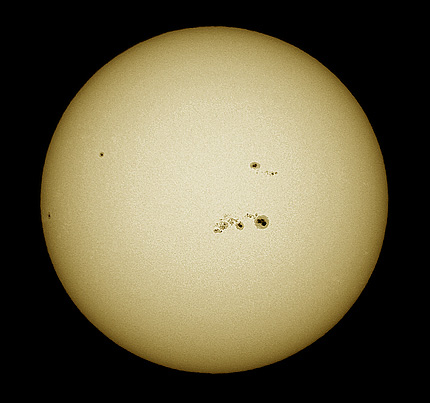
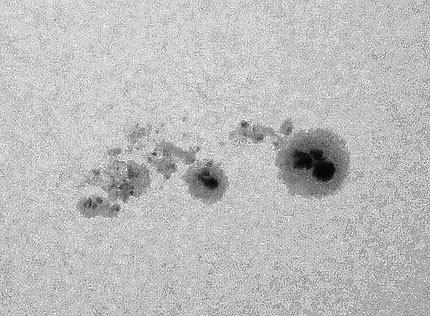
Although the sun is at solar max, and has finally flipped its magnetic poles, it hasn’t felt like there’s been too much solar activity. Now, finally, we have a big sunspot grouping. AR1944 has not only been active, but is large enough to be seen with the naked eye. Remember, always use appropriate solar filters when observing the sun. I could see the spots naked eye, using my Baadar mylar solar material, and through my 90mm refractor it looked quite spectacular. Unfortunately the seeing today was terrible, producing wavy images, but I did manage to get an image through the scope. Here it is below, with a second one showing a blow-up of the largest group. If you have a solar filter, don’t miss this magnificent sunspot grouping. It’s the best we’ve had so far this solar cycle.

Close-up of the above image

Halton Arp

Halton Arp, an American astronomer and creator of the Arp catalogue, passed away on December 28th. He imaged and created a database of galaxies that didn’t fit any of the recognized galaxy types, creating a catalogue of unusual galaxies. Published in 1966 it is called the ‘Atlas of Peculiar Galaxies’ and you can still get a copy of the catalogue, which is still in print. It makes for fascinating reading, and gives you some fun targets for your scope.

Full Moon night

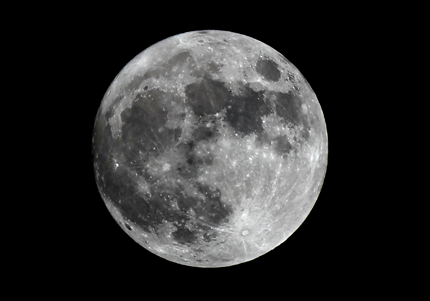
Although I became fascinated with the images of Jupiter’s moons, as seen in the blog entry below, I actually went outside to see the full moon. Here it is, this winter’s Snow Moon and the smallest full moon of the year. (Canon 60D through a 90mm refractor)

Jupiter tonight

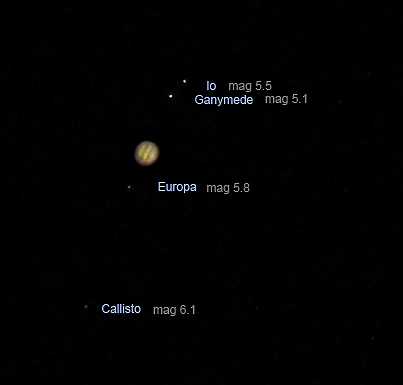
Here is a picture that I just took tonight of Jupiter and its moons. The image was made with my Canon 60D at the prime focus of my 90mm refractor. Visually, there is much more detail visible on Jupiter through the scope, but this is just two frames (one exposure for Jupiter and another for the moons) at the prime focus of a 570mm focal length system. What I found most interesting is that you can see colour differences in the moons. Of course you can see the difference in brightness, but Io shows as a distinct yellow colour.
Jupiter 1/125 second ISO 100
moons 1/100 second ISO 800

See Comet ISON close approach

Check out this NASA page

Most nasa sites are overloaded, but this page works.

Select LASCO C3 and a number of frames (5 per hour) to see a cool video of the comet approaching the sun.

http://sohodata.nascom.nasa.gov/cgi-bin/soho_movie_theater

Solar Eclipse

I rose early this morning as i had set my alarm for 6:09 AM.
I then verified that the daylight savings time no longer applied, and that the 6:58 sunrise
meant i had another hour to go.

I decided to bring my 4 inch solar filter, my DSLR and my pocket camera.
I also packed a tripod and my finderscope (a 3.5 inch refractor) on the off chance they would be handy.

At Burlington Waterfront Park, a place where the HAA has held public astronomy events in the past,
I knew that there would be a clear view of sunrise over the water.

The cloud bank on the horizon was another matter. It appeared that there was rain in the Grimsby area,
and the clouds extended out over the water to the east, obscuring the point of sunrise.

I did, however, get to watch a nice sunrise.

The eclipse was predicted to end at 7:08 AM.
Using the solar filter, i could see a chunk missing from the lower right portion of the Sun,
but due to the nearby clouds there was no way to guarantee that the interesting part of the Sun was not
simply being blocked by the cloud bank right below it, as it peeked through the clouds.

So I might claim to have seen the eclipse, but i might simply have seen the Sun.

I shared the view through my solar filter with 2 people who had come to take a look.
By holding up the (highly reflective) filter in front of my face, and angling it so that the image of the Sun
matched the dark part of the pupil of my eye, I had a clear sharp view of the Sun, albeit small.

I hope other members had more favourable cloud arrangements.