Great night at Binbrook

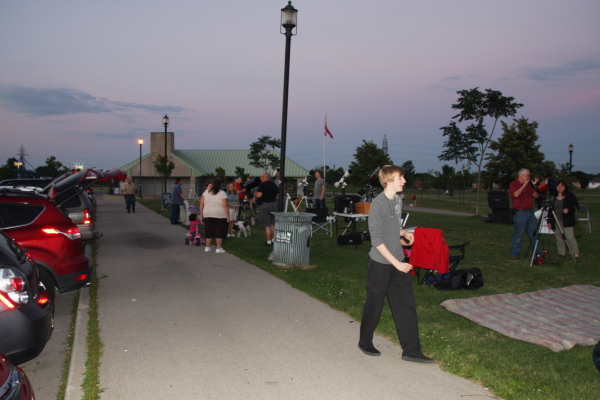
Last night several HAA members came out to join Jim when he opened the park for observing. Five members and five scopes were set up on the hill and enjoyed views of double stars, clusters, galaxies and nebulae. Everybody looked through everybody else’s scopes and encouraged each other. The club’s loaner eyepiece was put to good use, and several members enjoyed the very wide fields that the University Optics 55mm eyepiece offered.
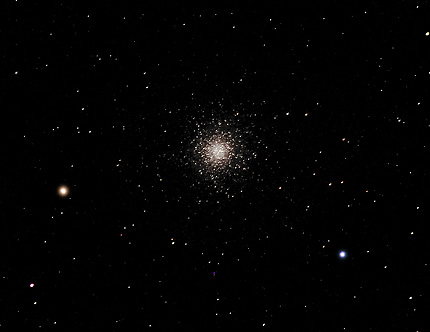
I was lucky enough (and yes, some if it was luck) to get a very good polar alignment and a very good focus on my camera and ended up with some of my best astrophotos to date. Here is one sample from last night, a view of M13, the globular cluster in Hercules, taken through my 90mm refractor.
Next time you get an email from a keyholder inviting you out to the park, why not come on out and join us for another great night.

M13, the great globular cluster in Hercules, through a small scope

Kerry-Ann Lecky Hepburn to speak at David Dunlap Observatory

Long time HAA member Kerry-Ann Lecky Hepburn is speaking to the public at the David Dunlap Observatory this Saturday. Kerry spoke to the HAA earlier this year, and is an engaging speaker. Set against the backdrop of the largest telescope in Canada, this should be a special occasion. Details can be found here:

http://theddo.ca/ScheduleTickets/tabid/64/Default.aspx

Nova Delphini 2013

According to reports from the AAVSO, the nova in Delphinus peaked earlier today at a magnitude of about 4.5. I just looked at it this evening, and the nova has dimmed to 4.9. Finder & comparison charts can be found by clicking on the title above and following the links.

Nova in Delphius

Janice and I went out this evening to try to see the nova that appeared today. We spent a few minutes identifying the field and then found the nova easily by about 9:55. This is the first time we’ve actually seen one. Thanks to Joe for the notification. This one is an easy binocular target with 7×50 binos. A chart can be found at the sky and telescope web site. John Gauvreau has determined a magnitude of 5.7 which based on what we saw is pretty darn close.

Perseid Meteor Shower

Just a quick note reporting on my observations tonight.

I arrived home from my week-long road trip too late to attend the picnic, but made it to the Perseids night at BCA, arriving at about 10 PM.
I had studied the clear sky chart and was convinced that if the sky was not already clear at BCA, it ‘soon’ would clear.

People were already leaving after enjoying an evening of interactive meteorite exhibits and other stuff. I had a chance to buy a Klondike before the snack bar shut down for the evening.

I looked up and saw a complete gray sky, but “I paid my 4 bits to see a high diving act, and I’ma going to see a high diving act”, so I said to the clouds, “start climbing”, and then waited.
(I wonder if some young people might not recognize that quotation.)

I think i was last to leave the parking lot, but i headed to the alternate site, and along with 4 others, waited for the sky to clear.
The sky eventually cleared around 1 AM, and I saw 7 ‘average to above-average’ meteors in the sky.
I was starting to get pretty tired when I packed up around 2:30 AM.

I saw Vega a few times at the zenith, and that sustained my hopes.

Later, I observed Arcturus in the Western sky, and it was the only star that pierced the thin clouds for a time. It was hard to discern whether it was a star or the headlight of an airplane for a while, but eventually it’s location and steadiness won me over.

There were still clouds to the north and the sky-glow was pretty bad. I could see the Milky Way through Cygnus, though.

We had a long conversation about observing techniques and everything else.
Others who were there may like to comment.

I saw one strange thing. In the tail of Cygnus, on the north side, I saw 3 evenly spaced strobe flashes, as from an airplane, but no more flashes. It was strange. I don’t think it was my imagination, but I wonder what kind of satellite could have done it. Perhaps a weather balloon?


HAA on the radio

CBC Radio 1 interviewed Mcmaster astronomy professor Christin Wilson (who spoke to our club at our June meeting) and yours truly for a radio program on stars. The link leads you to the webpage and the one hour program can be heard by clicking on the entry titled “A Star is Born”.
I haven’t heard the program yet, but I do know that they credit me as president of the club (when in fact I am a past chair and current observing director), so I offer apologies to our current chair, Jim, and figure that considering the nature of the media, if that’s as bad as it gets then we could have done worse. Enjoy!

http://www.dzintarscers.com/

McQuesten Park Public Night – Sat Jul 13, 2013

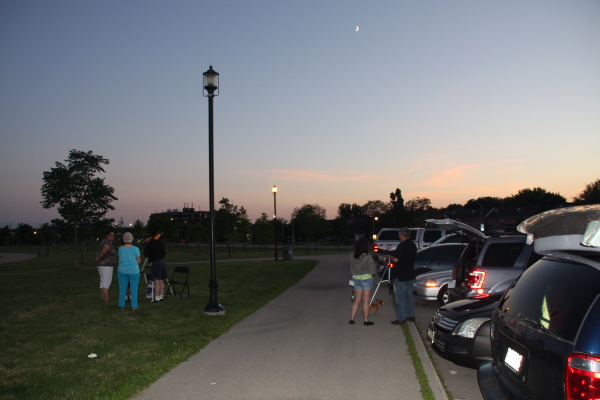
We had a great night tonight for our public stargazing night at McQuesten Park in Hamilton. Well over a hundred people visited more than a dozen members with a wide variety of scopes. We had clear skies so lots of interesting things to see. Moon, Saturn, Globular Clusters, double stars and more. Met a lot of really nice people and had fun showing night sky objects and answering lots of good questions.


McQuesten Park Public Night

McQuesten Park Public Night

(click on image to see larger version)

We even saw a new, previously unrecognized (as far as we know) feature on the Moon which we have affectionately identified as the Lunar Diamond – Palus Somni – which in the lighting we had tonight, formed a perfect large diamond shape right next to Mare Crisium. While visible in scopes, it was more pronounced in a pair of 15×70 binos where it was first identified. Perhaps the 3D nature of binos makes it easier to spot.

Any way, the HAA would like to thank everyone who came out to help and those who participated. We’re glad you joined us and had fun. We really enjoyed your company.

The Dark North

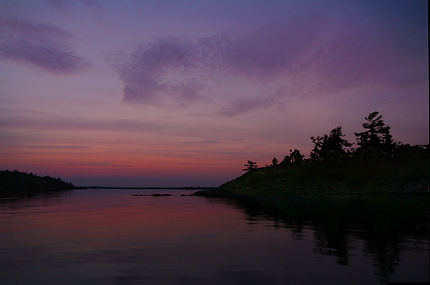
I was lucky enough to be invited to spend the Canada Day long weekend on a boat in the North Channel, above Manitoulin Island. Although being on a boat didn’t allow me to set up a telescope on a tripod (although ever so slightly, the boat was in constant motion), I did enjoy some amazing naked-eye and binocular views. I was able to see naked-eye stars of magnitude 6.0, but could not see a magnitude 6.3 star nearby, so that gives you an idea of the limiting magnitude. Deep sky objects like the Lagoon Nebula, the Andromeda Galaxy, the Double Cluster in Perseus and the Coathanger were all easily visible to the unaided eye. Perhaps most spectacular was the Milky Way, showing an abundance of detail and dark tendrils through the Great Rift, and the Scutum Star Cloud was perhaps at the best I’ve ever seen it. There were also many, many satellites and meteors. Even without a telescope, it was a wonderful observing experience. So this summer when you’re up at the cottage or vacationing in a dark site, remember to bring your scope and binoculars, or even just take the time to get out under a really dark sky and enjoy.

Even though I couldn’t get any astrophotos, at this point I was eagerly awaiting the fall of night and some very dark skies.

Triple Conjunction

Lots of members were out at the Binbrook Conservation Area last night for the triple onjunction of Venus, Jupiter and Mercury. Lots of good skies, good observing, good people and good times.
Here is one image of the three planets reflected in Lake Niapenco. There were lots of shutters clicking, so hopefully there will be more images soon!
More information on the conjunction can be found in the May issue of the club newletter, Event Horizon, under “The Sky This Month”.

Venus, Jupiter and Mercury conjunction

I know some of the HAA members ventured out to Binbrook tonight to enjoy the scenery and the clear skies to watch the 3 planet conjunction. Tonight is the night that the 3 planets (Venus, Jupiter and Mercury) form a perfect triangle. But the conjunction has been visible for several nights and will remain visible for a couple of more (if weather permits) – though the ideal triangle shape won’t be there. However they are within 5 degrees of each other low in the western sky shortly after sunset.

I visually saw the conjunction last night from my backyard so tonight I decided to take some pictures from my deck. Here is what I consider to be the best of my bunch. As you can see, you don’t have to travel to enjoy astronomy. Often your backyard is good enough. Just remember to look up once in a while.
Venus Jupiter Mercury Conjunction 26 May 2013
(click on image to enlarge in new window)

Lower right is Venus (brightest), to the left is Jupiter (next brightest) and to the top right is Mercury.