Upcoming ISS Transit of the Sun viewable from Burlington

Upcoming transit of the Space Station across the disk of the Sun
About 1:20 PM on Monday afternoon.

If you have a PST or a solar filter, or even some welder’s glass, you
can use the same precautions as for an eclipse to see the silhouette of he Space Station against the disk of the sun.


Click for a map

The map shows the ground track of the event, for the center of the shadow path.
At a distance of 350 km, and about a quarter degree, you will see some of it
even if you are as much as 3 km off track.

The other thing to keep in mind is that the orbital predictions for the ISS are
not very accurate. Wish we could do more.
Crossing the disk of the moon, of course, is a naked-eye event you don’t need any
precautions for.

Messier Marathon Online

In honour of this month’s speaker’s topic (March Madness) and being related to the Messier Marathon which is attempted by many amateur astronomers, here’s an interesting link. March/April is considered to be the most favourable time to attempt to view all 110 Messier objects in a single evening. Considering the cool weather for our latitude and the poor viewing conditions we’ve had over these past many months, the odds appear to be against us to having a good night to attempt this.

However, you can “do” the marathon from the comfort of your own home on Sun April 1, 2012. The Virtual Telescope in conjunction with GAM(Global Astronomy Month) and Astronomers Without Borders, is holding a Messier Marathon Night. They will use various remote, robotic telescopes to attempt to view all 110 Messier objects in a single night.
Messier Marathon Online

Astronomy badges for Oakville Cubs

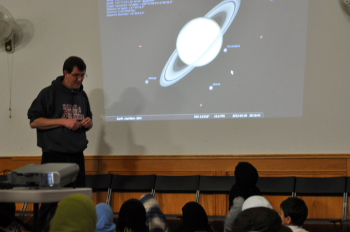
A small team of HAA’rs visited a Cub pack near the north end of Oakville on Leap Day (Feb 29) to teach astronomy to about 25 enthusiastic kids. This is the second time in recent history that the HAA brought astronomy to a group of cubs (also did a camp in Jan) in the Oakville area.

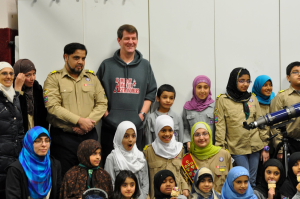
A partial group shot of the cubs we taught astronomy to.

John, Jim, Joe and Don covered all aspects of the cub badge requirements including:
– Locating the North Star (for navigation).
– Learn about some of the constellations and some folklore.
– Planets (including the usual talk about why Pluto isn’t anymore).
– Meteors and comets.
– Moon phases and how the Moon affects the Earth.
– Basics of how telescopes work.
– And how to use a planisphere/starfinder.

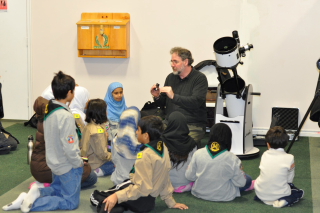
John has the kids enraptured.

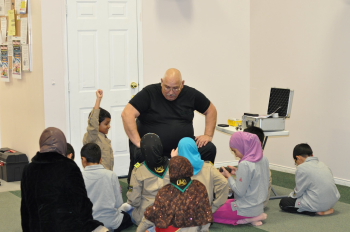
Jim passing around meteorites.

The kids were really good and we all enjoyed ourselves. They had lots of questions and it was clear they learned a lot. A bright and fun bunch.

Don covering the basics of constellations and planets.

Our thanks go to their leaders Latif and Jasmine for contacting us and asking for our participation.
Larger/higher resolution photos available on our Facebook page:
www.facebook.com/hamiltonamateurastronomers

Transit of Venus Symposium

The Dunlap Institute for Astronomy and Astrophysics and the Institute for History and Philosophy of Science and Technology are holding a full day symposium about the Transit of Venus which may be of interest to HAA members and those with some astronomy background. It appears to be a fairly comprehensive program, it doesn’t seem particularly well suited to someone completely new to astronomy. (However review the program at the link below and see if this will be a good fit for you.) This is a FREE event running on Saturday April 28, 2012 from 10am to 5pm (with breaks).

Doctors Mike Reid, Ralph Chou, James Graham and others will be discussing various aspects associated with the transit. It includes how to view safely, historical events, science learned from transits, how it affects current exo-planet searches and more. It will also include a tour of astronomical instruments on display at the Institute for the History and Philosophy of Science and Technology.

More information, including location and a full schedule of seminars and events can be found:
Transit of Venus Symposium

The Cosmic Gift of Pulsars

The University of Toronto and the Dunlap Institute are sponsoring a FREE public talk on Thursday March 15, 2012 from 7pm to about 9pm.

Prof Victoria Kaspi from McGill will introduce pulsars, and show how astronomers are using them to study topics which range from the origins of the Universe to the very nature of matter.

University of Toronto – Earth Sciences Centre – Room 1050 (auditorium)
5 Bancroft Ave (near Spadina and College)
More info can be found at:
http://universe.utoronto.ca/special/hsh2012

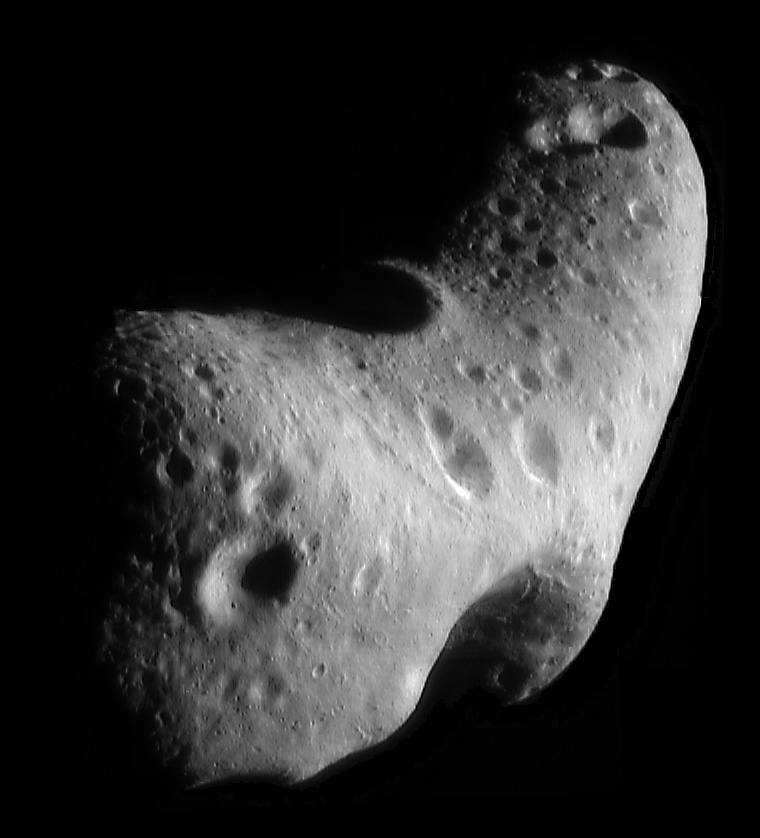
Asteroid Eros close approach

Asteroid Eros will be making closest approach to Earth on Jan 31. Might get to magnitude 8 or even 7 – visible in backyard telescopes and perhaps even binoculars. It will be closest it’s been to our planet in 37 years. Will be passing through Leo, Sextans and Hydra so will be visible after midnight over next few nights (assuming we get some clear skies). Info can be found here: http://tinyurl.com/845yx8z and charts from Sky&Tel found in this PDF file: http://tinyurl.com/79cbdxo . It should be moving fast enough to notice motion over a short period of time making it easier to identify.

Asteroid Eros

Possible Northern Lights (Aurora) Jan. 24/12

Here is the latest news from SpaceWeather.com:

Space Weather News for Jan. 24, 2012
http://spaceweather.com

CME IMPACT: As predicted by analysts at the Goddard Space Weather Lab, a CME hit Earth’s magnetic field on Jan. 24 at ~1500 UT (10 am EST). A geomagnetic storm is brewing in the aftermath of the impact, but as this alert is being written it is too soon to say how weak or strong the storm might be. High-latitude sky watchers should be alert for auroras after local nightfall; the hours around local midnight are often best for seeing the Northern Lights. Chances for a good display favor observers in northern Europe, Greenland, Iceland, Canada, Alaska, and possibly northern tier US states such as Maine, Wisconsin and Minnesota. Check http://spaceweather.com for updates.

Possible Northern Lights

Space Weather News for Jan. 23, 2012
http://spaceweather.com

INCOMING CME: Big sunspot 1402 erupted on Jan. 23rd, producing a strong M9-class solar flare and a fast-moving coronal mass ejection (CME). Analysts at the Goddard Space Weather Lab say the CME should reach Earth on Jan. 24th at 14:18 UT (+/- 7 hr) and Mars a little more than a day later. Strong geomagnetic storms are possible when the cloud reaches Earth. Our magnetic field is still reverberating from a CME impact on Jan. 22nd, so another blow could spark impressive auroras at high latitudes. Sky watchers in northern Europe, Canada, Alaska, and northern-tier US states such as the Dakotas, Minnesota and Wisconsin should be alert for Northern Lights.

HAA and Winter Cub Camp

Sat Jan 14, 3 members of the HAA attended a regional cub camp at Blue Springs Scout Reserve near Acton. The HAA had been asked (via Brenda Frederick – HAA member and cub leader) to do a series of presentations to help over 60 cubs work towards earning their Astronomy badges. Since this is the type of thing our club loves to do, we jumped at the chance to help. My thanks to Joe McArdle and Steve Germann for coming along with me to put together an effective and enjoyable program for the kids (and their leaders too). We talked about types of telescope, showed them meteorite fragments, helped them find the North Star, talked about some constellations and legends surrounding them – and more. A full program where we broke up into 3 teams and rotated the kids through the various sessions.

We actually had clear skies, but their program was so full, we didn’t have time to set up any scopes afterwards to show the kids views through them.

A lot of fun as always, but now I have a sore throat from all the talking 🙂

ASX 9th Annual Symposium

The Astronomy & Space Exploration Society, based out of U of Toronto, will be holding their Annual Symposium on Fri Jan 20, 2012 at Convocation Hall (UoT) from 7pm to 10pm. There are 3 very interesting speakers lined up and admission is very reasonable if you order in advance. More information can be found at: http://tinyurl.com/79n7yc9
This may be of interest to HAA members and others who frequent our website.