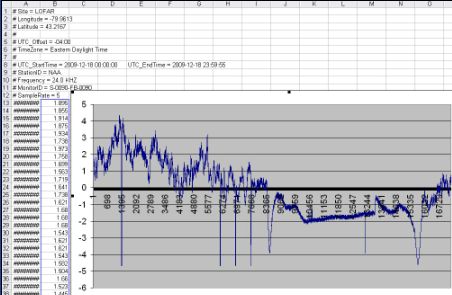
This chart is new data from the LOFAR antenna, and sent by Mike Jefferson.
On Friday, December 18, 2009, LOFAR detected a C7.6 solar flare in the blue (negative voltage area)
![LOFAR Data for December 18, 2009 [24 hour period]](http://www.amateurastronomy.org/wp-content/uploads/archive/reports/lofar20091218.jpg)
This chart is new data from the LOFAR antenna, and sent by Mike Jefferson.
On Friday, December 18, 2009, LOFAR detected a C7.6 solar flare in the blue (negative voltage area)
![LOFAR Data for December 18, 2009 [24 hour period]](http://www.amateurastronomy.org/wp-content/uploads/archive/reports/lofar20091218.jpg)
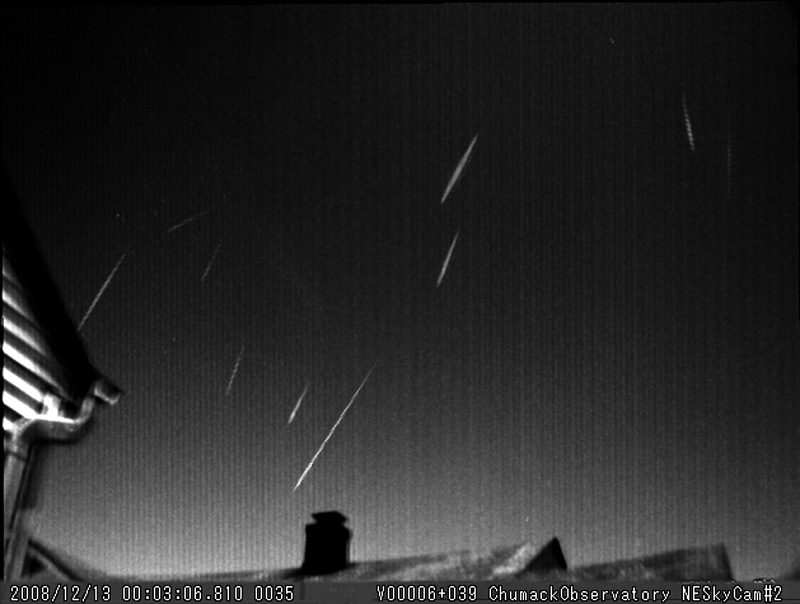
The night of Sunday, Dec 13/2009 and into the morning of the 14th marks the height of the Geminid meteor shower. Peak is expected around midnight EST (04:00 UTC).
On average this is the best meteor shower of the year, with rates of up to 120 meteors per hour or more from a dark location. A nearly new moon will result in dark skies allowing you to see more of the fainter displays.
This meteor shower is dust and ice left over from the extinct comet 3200 Phaethon which crossed Earth’s orbit more than a century ago. It’s called an extinct comet since all of the ice has sublimated from multiple passes around the sun and no longer produces a tail.

This is a “broad” shower meaning the show will last for hours or even days on either side of the peak. Some have already reported seeing some Geminids and it will only get better as we get closer to the 13th. If it’s cloudy on Sun, then consider venturing out the night before or after.
While the Geminids back in the 19th century were rather unimpressive, they have continued to get better each year to become the most prolific shower of the year. Some scientists believe that Jupiter’s gravity has caused the debris stream from 3200 Phaethon to drift so that we are penetrating deeper into the stream, resulting in the better shows we now enjoy.
More info here
As the name suggests, these appear to originate from the constellation Gemini. At this time of year for North America, Gemini is visible most of the night. From our location, it is just east of Orion. Here’s a skymap showing you where to look.
The full size chart can be found here.
Needless to say, now that we’re into winter, it’s likely to be cold. (Current forecast for Sun night is for a low of -1C, cloudy and a chance of showers or wet snow. Sat night might be the clearest night.) So be sure to dress warmly and bring lots of hot chocolate to stay comfortable. As with all good meteor showers, the best way to observe these is to lay back on a lounge chair to take in the whole sky. Perhaps bring a sleeping bag to help keep you warm.
Back on Nov 16, I saw more than 70 Leonids and 20 sporadics from our observing location at Tyneside and thought this was a pretty good show. The Geminids should be even better. Hopefully you’ll brave the cold and enjoy this display.
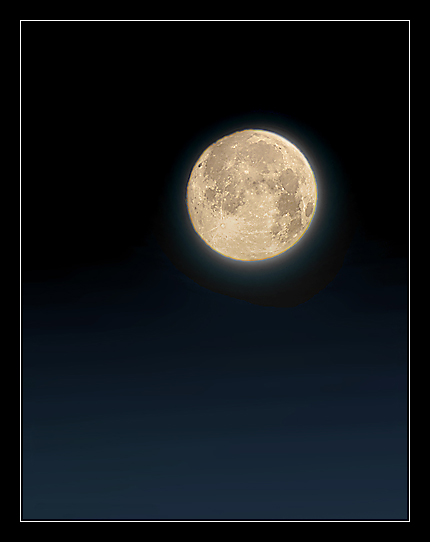
Tonight the moon is full and certainly worthy of a good look (technically, the moon is full on December 2nd, but in the early morning hours. why not look tonight and tomorrow?). This being December 1st, we will have the opportunity to observe two full moons this month. The second full moon will occur on December 31st, the last night of the year.
As has been described by others, the full moon of each month carries several names. Autumn’s Harvest Moon is best know, followed by the Hunter’s Moon. Tonight’s full moon is known as the Cold Moon, or the Long Night Moon, both very appropriate names. It is also known as the Moon before Yule. The next full moon, on New Year’s Eve, will be the Moon after Yule, not surprisingly.
I went out late last night (really early this morning; I almost forgot all about it!) to have a look at the moon, as November 30th marked the 400th anniversary of Galileo’s first telescopic observation, and the first thing he looked at was naturally the moon (it was a waxing crescent, and he watched it set). I took a photo to commemorate the occasion, and you can see it below.
Have a look at the moon this month, and think of the passing seasons, how we are treated to two full moons this month and how after so many years, Galileo’s first steps into a new science still carry so much meaning for us.

This Announcement / Report is from HAA member Jeff Lillycrop:
JOURNEY TO THE AMNH
If anyone is planning a trip to NYC (aka: the big apple) soon , you are in luck. I was lucky enough to be in New York over the past weekend and took the time to check out the American Museum of Natural History (AMNH) and the Hayden Planetarium. The planetarium is just one part of many wonderful earth and space exhibits at the AMNH. I took in the planetarium show ?journey to the stars? which was narrated by Whoopi Goldberg ?! ( she did an excellent job ) and was presented on a 67 foot wide hemispheric dome in a room that held 250 people +/-. The show was supported in a partnership with NASA Science Mission Directorate, Heliophysics Division. It presented information to keep everyone riveted from beginners to full blown space junkies. Here is the description of the planetarium from the web site, to give you a measure of the experience
?The Hayden Planetarium is unlike any other such facility in the world. In the top half of the Hayden Sphere, the most technologically advanced Space Theatre in existence will use advanced visual technology (including a customized, one-of-a-kind Zeiss Star Projector) to create shows of unparalleled sophistication, realism, and excitement. With this high-definition system, the Hayden Planetarium is the largest and most powerful virtual reality simulator in the world.
The bottom half of the Hayden Sphere houses the Big Bang, where visitors will be transported to the beginning of time and space, experiencing a dramatic, multisensory re-creation of the first moments of the universe. From here, visitors continue on an awe-inspiring journey that chronicles the evolution of the universe by following the Harriet and Robert Heilbrunn Cosmic Pathway ? a sloping walkway that takes them through 13 billion years of cosmic evolution
The Digital Dome System takes the astronomical information of the Digital Galaxy and stores it on a Silicon Graphics® Onyx2? InfiniteReality2? visual workstation, one of the largest supercomputers ever dedicated to creating visual simulations and equivalent in power to those used by NASA or the largest military research laboratories. When the Digital Galaxy software is booted, the Hayden Planetarium’s supercomputer generates a three dimensional map of the galaxy that is so realistic that the dome itself seems to disappear. Thirty times a second, the Onyx2 calculates the real location and visualizes the appearance of every star and nebula that is about to be seen by the audience. The Onyx2 has 28 central processing units and can store up to two terabytes (2,000 gigabytes) and simultaneously process 14 gigabytes of data ? the equivalent power of about 200 desktop computers.
The Digital Dome’s computer graphics are composited with the output of several other instruments, including the Zeiss Mark IX star projector and an Omniscan all-dome laser that provides images of superior color and brightness. The central platform, which holds the Zeiss projector, a “2PI” All-Sky slide projection system, and the Omniscan laser, can be lowered to create more space inside the theatre. A state-of-the-art spatial sound system controls the direction of sounds, enhancing visitors’ experiences of moving objects, and subwoofer speakers are wired into each seat giving a sense of vibration and “lift off” at the start of the presentation.?
All I can say is WOW!! I was blown away , but that was just the start of many excellent exhibits offered including:
Scales of the Universe, let?s you investigate the vast range of sizes in the universe.
Cullman Hall of the Universe, let?s you examine how the universe evolved into galaxies, stars, and planets
Gottesman Hall of Planet Earth, let?s you explore how our own Earth took shape over 4.5 billion years ago
And the crowning jewel
Arthur Ross Hall of Meteorites which features Ahnighito the largest meteorite on display in the world , its huge !! weighing in at a mere 34 tons standing 5? tall 10? long, very cool !!!!
And all this was located in Rose Centre for Earth & Space, that is just one wing of this amazing place. I had planned on doing a tour of the entire Museum but spent 4 ½ hours in this wing alone , then they gave us the boot because they were closing. I had completely lost track of time. I highly recommend this experience to everybody , it will not disappoint. The funny thing is that admission is a suggested $28.00 USD but you can pay what you like. The planetarium show is an extra $4.00. It is the best deal in the city.

With winter fast approaching I decided to do an imaging marathon back when we had a few really nice clear nights around the new moon. Clear skies and a sleeping baby helps :). Also thank goodness for some semi-automation!!!
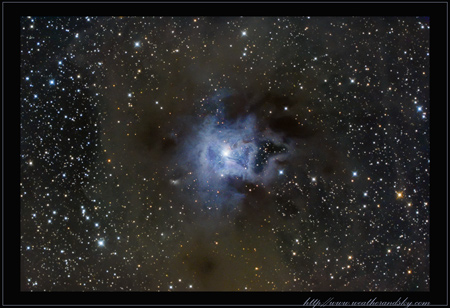
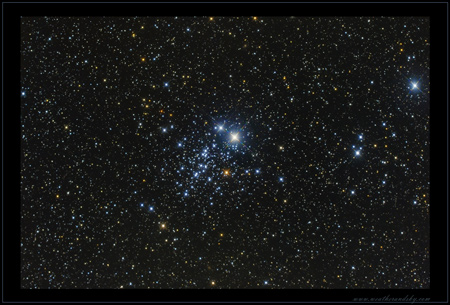
Here are some of the images: Taken with the QHY-8, Astro-Tech 8in RC and TV 0.8 reducer.
Iris nebula: although this was imaged back in the early fall I finally found some time to process it. This is a whopping 12 hrs of total exposure time but believe me it was needed from my location. Although the light pollution is not terrible, this is a dark nebula and for that you really should have pristine skies.
http://www.weatherandsky.com/main.php?g2_view=core.DownloadItem&g2_itemId=7553

ET Cluster: This is a neat looking cluster that looks like ET. I remember seeing it for the first time in the eyepiece from Glenn and Gails dobservatory last year.
http://www.weatherandsky.com/main.php?g2_view=core.DownloadItem&g2_itemId=7558&g2_serialNumber=3

In addition to those I have frames of M1, m42, the horsehead and the cone nebula region that I’ll post when I get the chance to process them.
KerryLH
Hopefully you had a chance to get out and observe some of the bright meteors from the Taurids during the last week. These were few but quite bright.
If you didn’t, then tonight is your night. The Leonids will be starting after dark overnight tonight Nov 16 and into the early morning of Nov 17. They will appear to emanate from the constellation Leo rising a little after midnight. These are one of the better showers during the year (behind Geminids and Perseids). They are the result of debris being left behind from Comet Tempel-Tuttle which returns every 33 years.
The forecast tonight is for clear skies and no Moon. So get yourself out to a dark location and enjoy the wonderful show that nature will be providing. The peak for our area is expected to occur around 4 am in the morning of Tues 17 Nov as we pass through a slightly more dense stream of debris, but any time after midnight should provide a good show with rates ranging from about 20 per hour to more than 50 per hour.
Link to larger version
Since Mars is also currently located near Leo, it will be rising at the same time. And we are now only a few months away from opposition so Mars will be getting closer and brighter than it’s been for almost 2 years. So you have a double incentive to get out observing. Perhaps you will catch a meteor passing in front of Mars – now that would be a real photo-op!
The Taurid meteor shower peaks tonight, making this an excellent time to go out and look for shooting stars.
The Taurids originate with a debris stream left from Comet 2P/Encke. There are actually two streams from this comet, and we passed through the first one about a week ago. Taurids are not that numerous, but are usually quite bright, so it’s always a treat to see one.
No special equipment is needed for meteor watching; just keep an eye on the sky for the next couple of nights. And getting some practice now will have you good and ready for next week’s Leonid shower.
There are two things to keep an eye on today. First, there is a fine sunspot grouping on the sun right now, and if you have proper solar filters to use (very important! Don’t even try unless you do!), this is an uncommon treat. Sunspot group 1029 shows several large spots and should be worth a look. After all, it could be a while before we get another one!
After dark be sure to look to the south, where the Moon joins Jupiter in a lovely pairing that will be eyecatching even without optical aide. Only 4 degrees apart, the two should fit in the field of most standard binoculars. Of course, with a telescope the Moon will show fine detail along the terminator, being just past first quarter, and Jupiter is always amazing!
Whenever you have a free moment today or tonight, enjoy the sights the sky has to offer.
Ann, Alex, Steve and Don went to the Oakville Sixers-Seconds camp last Friday to assist with the Astronomy Badge for the Cub Scouts, aged 8-10 years old. Brenda Frederick, HAA member and also the Akela, was there in her official capacity, running the camp, and was very helpful making sure we were well supported by the leaders. It was raining, so the skies were not inviting, but in the spacious indoor chapel, a pair of stations were set up.
At one end of the room, Don had Stellarium running on the projector, and was able to give the kids a sky tour, and help them learn their constellations, finding north, etc. The program conveniently can be configured to omit the lines that are often found in sky charts. Meanwhile, Ann, Alex and Steve set up at the other end of the room, to present information about the Solar System, meteorites, comets, and asteroids, legends, and astronomy equipment.
It was encouraging that most of the kids could already name the 9 planets in order (but they knew about Pluto, whose goofy name has got it disqualified from the list).
There were 40 cubs at the camp, and they were divided into 2 main groups. One group was doing uniform and badge work elsewhere, and the other group was doing the Astronomy badge with us. For the astronomy part, we divided them further in half, so we presented to small groups of 10 or so, for about 20 minutes, then switched to the other half. Then we did the whole thing again for the other main group.
The Cubs had never seen comet Hale-Bopp. They missed a treat. I hope we see another great comet in a few years.
Ann and Alex had brought a chunk of a meteorite that fell in Argentina, for the Cubs to handle and pass around while we talked. They were rightly impressed with the weight of the meteorite. Ann explained that meteors look fast, but comets move very slowly indeed by comparison, and the kids understood that it was due to parallax. She also talked about meteor showers, being dust that is found along a comets orbit, that the earth happens to pass through once a year.
Comets and asteroids can sometimes hit the earth, but not often. Ann mentioned that the Sudbury Impact Crater had lots of nickel because of a meteor.
We then discussed some Iroquois legends about the constellations. Suffice it to say that the legends of the Iroquois are pretty cool. Especially the one about Orion. I would like to see it presented with more detail sometime. According to the legend, Orion works 6 months of the year keeping the sun high in the sky. When the sun is far from Orion, he rests, and his son does the job, not nearly as well, so the sun rides low in the winter sky, but Orion is seen at night resting.
There’s truth and lessons there at several levels.
I brought along some equipment we use during astronomy, partly on the off chance the skies would clear. The Cubs had a great time with my 25×100 binoculars, looking both forward and reverse through them. It was important to explain that we don’t touch the lenses of optical equipment, and why. I explained how binoculars magnify, but are large because otherwise the magnified image would be very dim.
We also showed them star charts, and explained that Messier collected a list of non-comets, that were actually pretty interesting to look at.
Don’s green laser was a hit for pointing at his projected star charts. Mine was out of service (needed a battery charge) but got the idea across. We explained how pointing in the sky with a laser makes it easier for a group to see where you are pointing.
Several of the leaders also tried the Binoculars. After the presentations were done, we packed up and then went for ‘mug up’ in the dining hall, where timbits (an HAA necessity; thanks, Brenda) and hot chocolate with marshmallows, and Rice Crispies Squares, were to be had. We also had a chance to listen to the leaders talking to the Cubs. It’s a well organized event and well worth attending. I had a great time, and got home a bit after 11 PM.
If you have volunteered at public events, and are interested in participating in this valuable scientific and cultural outreach, contact me and I can let you know when these invitations come up.
It appears that at least one fragment of the meteorite that lit up night skies over southern Ontario last month has been found. It was responsible for breaking someone’s windshield!
Check out the story by the Hamilton Spectator: http://www.thespec.com/News/Local/article/654095 and the St. Catharine’s Standard : http://www.stcatharinesstandard.ca/ArticleDisplay.aspx?e=2127299
Ann T.
Update Oct.17/09:
Today’s Hamilton Spectator is reporting another fragment of the meteorite has been found. Check it out: http://www.thespec.com/article/655154