NOVA episode on Hubble mission

Tonight’s episode of NOVA, the PBS science series, is about the most recent mission to repair the Hubble Space Telescope. You can catch it at 8:00 pm on PBS. Here is the synopsis provided:
“NOVA was on hand from the beginning of training onwards when NASA decided to send a space team up for a final repair on the Hubble Telescope. See the footage of in-space repairs to the telescope on one of the most intense space walks ever.”
.
This episode will repeat Thursday night at 11:30 pm

LCROSS Lunar Impact Friday Morning – 9 Oct 2009

As Steve posted the other day, NASA’s LCROSS satellite will impact near the Moon’s south pole on Friday morning in an attempt to detect ice.

Based on strong circumstantial evidence from earlier missions, scientists believe that some of the Moon’s craters at the poles, which are permanently in shadow, may harbour ice from ancient comet impacts. Being in shadow, they never receive light/heat from the sun which would cause the ice to sublimate. This could be very significant as we head back to the Moon, hopefully on a permanent basis since water is heavy to transport and essential for life. Plus it can be used to create oxygen and rocket fuel.

The impactors, actually consist of 2 parts. The spent Centaur rocket booster which sent the main probe to the moon, will hit first before the main satellite meets the same fate. This booster, with a mass of 2200kg, is expected to raise a plume of water ice and dust up to 10 kilometres high, clearing the shadow of the crater and once exposed to sunlight, will be visible from Earth. Earth based telescopes, mostly in western North America and the Pacific will be trained to capture this event.

Four minutes later the main sensing probe will enter the plume and examine the contents for any elements, and then plunge into the surface. With a mass of about 700kg, it won’t raise as much of a plume, but it’s still expected to provide useful science.

What’s interesting about this event is that amateur astronomers have a chance to observe this event. It is expected to be visible in scopes of at least 10 inches and we have several that meet this requirement in our club. Unfortunately the impact is going to take place at 7:30am local time and it will be bright (assuming we’re not covered with clouds). This will make picking out the flash very difficult. Possibly with enough aperture, the right filtering and recording exposures, plus some post-processing, it may be possible to capture this event from our area. (I know, sounds like a long shot doesn’t it?)

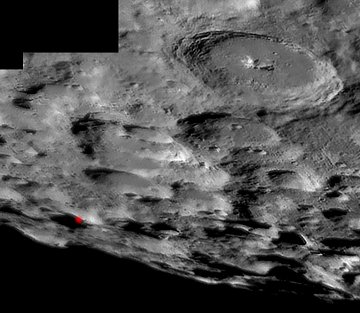
There are lots of resources to find out more about this event. Here’s a good one to get started with lots of info, including a lunar image showing the impact location.

LCROSS Info

Regrettably the weather is not looking too promising for our area in the morning (considering this year, it shouldn’t be a surprise). So if we can’t observe through our own scopes, the next best option will be NASA TV (online and cable). NASA has coverage of the event starting at 6:30am (local) and will be providing live images from the Moon and Earth.

NASA TV

Good luck and enjoy however you end up experiencing this fascinating event.

Burlington Public Night

After last weekend, i was mildly surprised to see HAA members back under cloudy skies, for our annual Public Observing Night in Burlington.

It was actually raining at 7:29 PM when i arrived, but presently the rain abated, and Brenda, Don and I proceeded to set up our stuff. The sky was cloudy but there was the odd dark spot implying that clearing was possible.

Ann came and in 2 seconds had her 6 inch Dob set up, and i decided to set up the GWS, with a tarp at the ready, should the rain return temporarily.
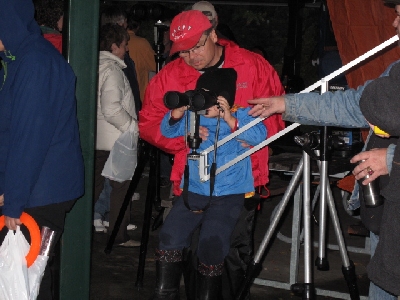
Don managed to get some photos of us admiring Ann’s scope, as night fell.

I was happy to see a few people who had been at Binbrook last week back for an actual look through telescopes.
They brought family members, and had a good hour of the Moon and Jupiter.

As the night got darker we started reaching for Messiers, and found M57, M15 and M31. In some cases, we had to wait a few minutes for clouds to pass, but it was not too bad.

I had a nice chat about astrophotography equipment, and telescope buying considerations with some of the visitors. As usual, the best answer is binoculars and sharing, until you know exactly what you want.

The street lights at that location are a bit annoying, but by casting a shadow in the right direction, it was possible to view the sky through the scope without too much glare.

The last of us packed up at about 11 PM. We had about 25 visitors, which is not bad for a night people would have thought was cloudy.

LCROSS to impact moon on Friday morning, 7:30 AM EDT

If you have a telescope, i suggest you set it up and see if you can spot the flash of light and rising plume of dust and gases as the booster stage of LCROSS kicks up a few hundred tons of dust and water vapour.

Then have a nap and plan to attend our AGM the same evening, when John will do an extended Sky this Month presentation.

Two news items

If the weather clears up a bit be sure to pop outside tonight for a look at the Moon and Jupiter. Separated by only 2 1/2 degrees, the two brightest objects in the night sky will make a lovely pair in the southeast sky after dark.

If the weather doesn’t clear up we can keep an eye on the news. Today the Messenger Spacecraft will be flying past the planet Mercury. This is the final flypast before the craft will go into orbit around Mercury two years from now. In previous flypasts the onboard cameras have returned spectacular images, and today they are scheduled to photograph some parts of Mercury that have never been seen up close before.

It’s an exciting day in the Universe!

Our Night With(out) The Stars

Setting up under less than ideal conditions.

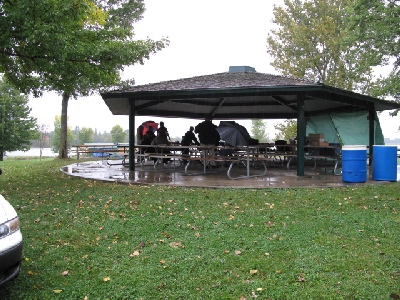
When we arrived about 2:45, Don Pullen and a growing army of HAA volunteers were hanging tarps on the pavilions to keep out the rain. Bill, Alexandra and I fanned out to help wherever we could and the next two hours were a blur of setting up canopies, moving picnic tables and unpacking as we tried to stay dry in a steady downpour.

The rain dampened spirits and many of us began to worry whether any members of the public would show up. As if on cue and right at 5:00 pm, Mother Nature eased up on the rain and the first people began arriving.

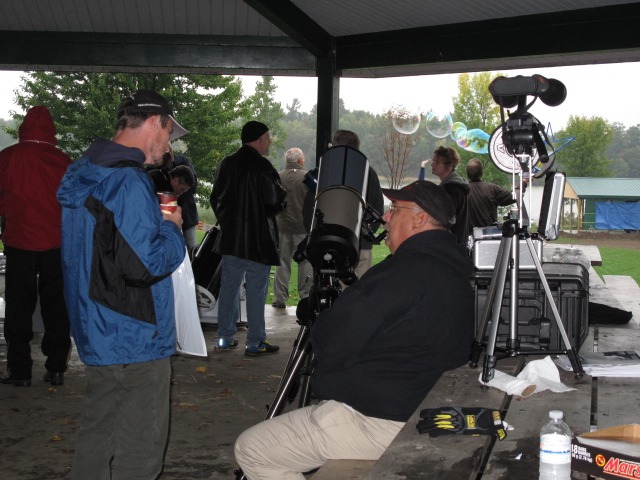
Our members entertained the public with a well-stocked kids’ tent, views through various equipment set up inside the round pavilion, answers to astronomy and equipment related questions and even a a huge bubble wand.

Meanwhile, Don struggled to get the computer projector to run on power provided by a generator. He eventually had to give up and move the talks to the old pavilion which had apparently been double-booked by the park. Fortunately, the soccer team that was supposed to be there, had abandoned it. The projector was quickly re-located and the talks got underway.

At the end of the evening, after most folks had left, Jeff?s truck got stuck in the mud and sand down by the new pavilion. Don, Steve, John, Jackie and I pushed him out and his spinning tires threw mud everywhere ? well mostly on Steve!

Rain-soaked, mud-caked and exhausted, the last few volunteers literally staggered into Tim Horton?s about 11:00 p.m. for hot coffee, cleanup and more than a few laughs.

In all of the years I?ve been associated with this club, I don?t think I?ve ever been prouder of it. Under the worst of conditions and against dreadful odds, we came together and put on a show that put smiles on kids? faces and had members of the public so enthralled they were reluctant to leave. Well done, everyone!

Ann T.

Binbrook Observing for September

Report from Binbrook observing Sept. 19

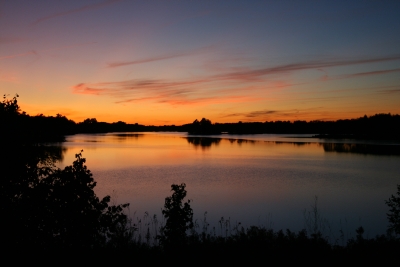
The clear sky chart promised fabulous clear skies at Binbrook Conservation Area this past Saturday night. When I arrived, the sun was setting and the colours were spectacular. I couldn’t resist taking a few quick shots before setting up!

Steve continued his sequential Messier Marathon by spotting at least one more object: M74. Joe, Vince, Doug and Darrell were also doing some visual observing with scopes and binoculars. Doug Black has put together a very respectable binocular stand and I had a chance to use it to look at the Andromeda Galaxy through his binoculars.

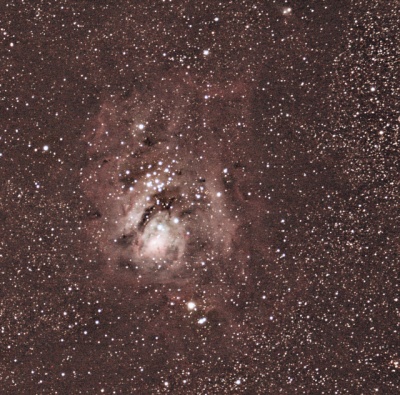
I?m afraid I didn?t do much observing (or socializing) because I was concentrating on guiding some astrophotos using a KWIQ autoguider, my CG-5 mount and an 80 mm refractor. I gathered images of M8 (Lagoon Nebula), NGC7000 (North America Nebula) and M31 (Andromeda Galaxy). While I was imaging M31, I encountered problems with the mount not tracking and that?s when I discovered that my battery packs were not up to the night?s demands ? they were just as exhausted as I was!

Don was also imaging and had some pretty impressive shots of M45. I hope he posts them here. (hint, hint).

I?ve done some basic processing of the M8 images (stacking in Deep Sky Stacker, basic Photoshop stuff). The image consists of 5 three minute images at ISO400.

Ann

Lagoon Nebula (M8)

Comet Christensen (C/2006 W3) by Bob Christmas

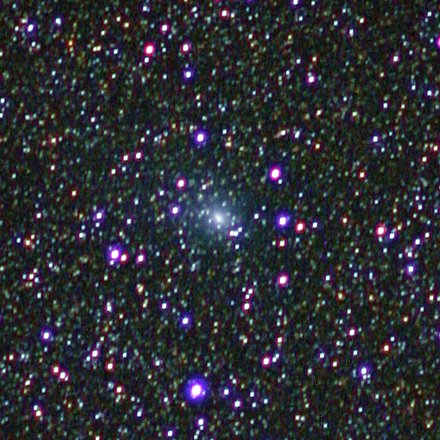
Below is Comet Christensen (C/2006 W3) in Aquila, within the cacaphony of stars that is the Summer Milky Way.

Equipment: Canon Digital Rebel 300D, Tamron 300mm f/2.8 telephoto lens on Super Polaris mount at ISO 1600.

Location: Spectacle Lake, Barry Bay, ON, around midnight September 15 –> 16, 2009.

Excerpt from an image which is a composite of 11 shots (11 X 65.18 seconds (on average)) = 11 minutes 57 seconds of total exposure.

Stacked and processed using DSS.

Comet Christensen (C/2006 W3) by Bob Christmas

Magitude of this comet is approximately 8.5.

This comet is moving southword through Auriga for the balance of September and part of October.

More info and finder charts here:
http://www.aerith.net/comet/catalog/2006W3/2006W3.html

Early Morning Venus

If you’re an early riser, try stepping outside tomorrow morning for a view of Venus and the slim crescent Moon, which will be paired low in the east before sunrise. The Sun comes up around 7am, so there should be a lovely view starting around 6, if you have a view to the east that allows you to see the pair very low to the horizon. Once the sun is up, keep an eye on the pair, as they are both bright enough to view in the daylight.

You may notice a star to the lower left of Venus. That is Regulus, the brightest star in Leo. Keep an eye on it over the next few days, as Venus moves closer and closer to it. By the morning of September 20th, the Moon will be long gone from the morning sky, but Venus and Regulus will be a lovely pair, only half a degree apart. What a magnificent ‘double star’ that will seem, with just the eye or through binoculars. Through a telescope, Venus shows a small gibbous phase, but here is a good chance to compare the colours of Venus and Regulus. How do they compare to you?

The Moon, Venus and Regulus on the morning of September 16th.

Bob C. Back At Spectacle Lake

I’m back at my favourite dark sky “preserve” at Spectacle Lake near Barry’s Bay, Ontario.

I arrived just before 5 pm Sunday, and I was bagged. But later on, when the night sky was clear, the adrenaline rush wiped away any tiredness.

And Sunday night was beautiful, despite the presence of high, hazy cirrus cloud.

Here is the Helix Nebula (NGC 7293), in Aquarius, from just after midnight (therefore Monday morning). This is a cropped version of a stack of 7 images (7 X 92 seconds on average) for a total combined exposure time of 10 minutes 44 seconds. Images taken with Canon Digital Rebel 300D with Tamron 300mm f/2.8 telephoto lens on Super Polaris mount at ISO 1600. Stacked using DSS. Another version will be posted later.

Bob Christmas

The Helix Nebula (NGC 7293) by Bob Christmas