
Sunday 4th of November 2007 | Bob Christmas
Just thought I would pass on this interesting news article that Bill found on the front page of the CBC website.
http://www.cbc.ca/news/background/space/light-pollution.html
Just thought I would pass on this interesting news article that Bill found on the front page of the CBC website.
http://www.cbc.ca/news/background/space/light-pollution.html
I arrived at the Binbrook main gate at 8:00pm – shortly after KerryAnn then Don showed up. I stayed until just after 11:00pm when my camera battery was just about to die – Don and Kerry were still hunting DSO’s when I left.
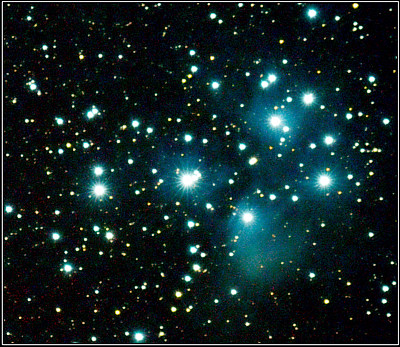
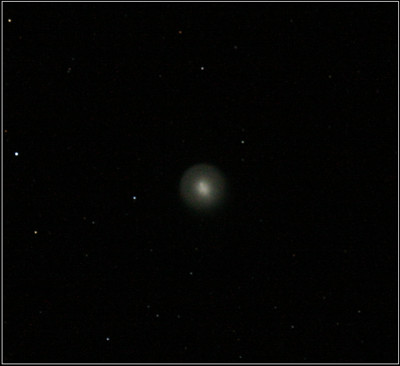
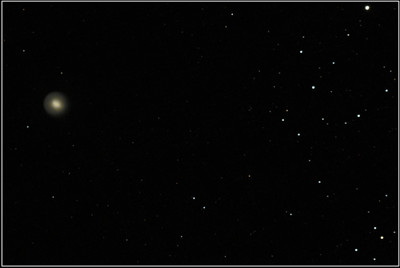
I imaged using my new Canon 40D and timer remote through my Sigma 50-500 APO lens – I imaged at 191mm so I could leave the setup on auto-pilot (no guiding required) taking series of 2 minutes exposures for the Pleiades and 10 second exposures for the comet. The Pleiades and the comet:
_______________________________________________________________________
UPDATE By: KerryLH
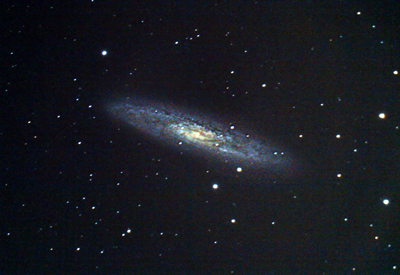
As Tim mentioned, I also did some imaging. This time I concentrated on NGC253 Sculptor Galaxy. This almost edge on spiral galaxy looked fairly large and bright in the 6in SCT. Surprising, considering how close it is to the horizon. It is also very cool to be able to see some mottling in the eyepiece. I’m sure larger scopes will show much more.
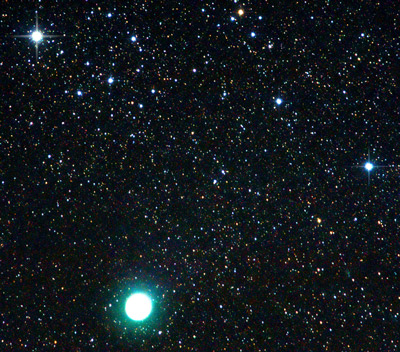
Don wanted me to get a widefield image of Holmes… so here it is. I stacked a few 3 minute frames. I saw a pic on the web showing a very large and faint tail emanating from the soft edge and fanning out towards Mirfak and Delta Perseus. Pretty interesting eh? Anyway it is really hard to see, but the large fanning tail(extremely faint green hue) is just barely detectable in the image below. I will do another widefield image of this region… but with much longer and many more exposures to see if I can capture it better.
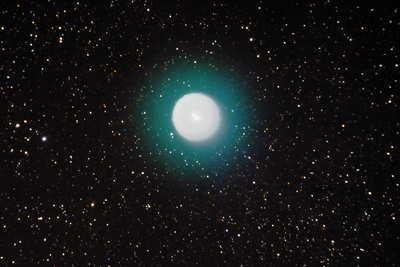
Below is another image which is a composite to try and show the very faint green outer halo and the bright compact inner core. Exposures ranged between 2 minutes and 30 seconds at iso800
Note: I posted a few more pics below in Glenn’s post as well.
I took some more pictures of Comet 17P Holmes just after midnight on Saturday, November 3, 2007 from outside my front condo door.
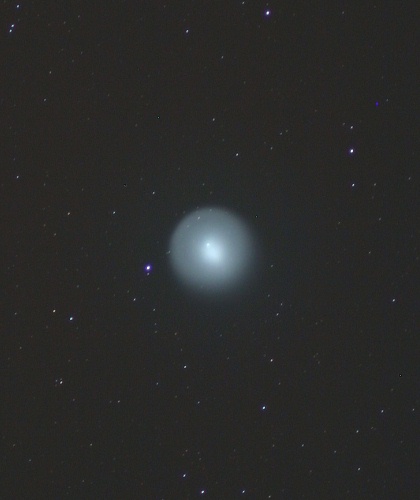
This comet has certainly grown over the last several days, and, I’m wondering if that’s an ever-so-slight hint of a tail inside the inner coma at about 5:00 relative to the nucleus.
Here’s a cropped version of one of my 20 second exposures, colour-balanced, at ISO 200 through my Tamron 300mm lens @ f/2.8 + Canon Digital Rebel 300D:
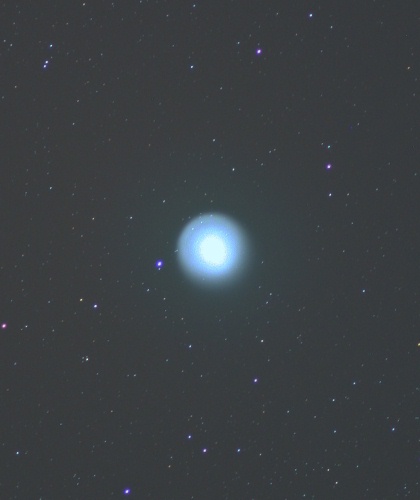
Here’s an overexposed colour-balanced and gamma-corrected image; as above, but a 2 minute exposure:
Kerry, Gail and I got together for an observing/imaging session, last night. Naturally the comet was high on the list for both. An amazing sight in our 6″ reflector, yet it wasn’t until Kerry captured a few images on her computer that we noticed it seemed to have a well-defined bow-front on one edge of the halo and the opposite edge had softened. A closer visual inspection through our dob confirmed it, and the fact that it looks that way in Mike’s picture (below) seals the deal. I’m wondering it if has something to do with sunlight defining the bow-front and the “back-end” being in shade – what do you think..
To me it no longer looks like little Comet Cutie but more like Comet PacMan -LOL! Hopefully Kerry can upload her image(s) soon for a comparison.
I also wandered across an object I hadn’t logged before: NGC 6819. This is a small, compact, open cluster described in the Night Sky Observers Guide as “a small splash of stars”. They range from about mag 11 on up and, within the star field that is part of the Milky Way stream, the cluster is reminiscent of M71. It has also been called the Foxhead Cluster but I couldn’t see any relation.
Although we were enjoying each other’s company, the low temperatures turned the heavy dew into frost that soon coated everything not generating heat. We reluctantly packed up but I’m sure it won’t be long before we’re once again checking out “Comet What’s Next”.
________________________________________________________________________
Update By KerryLH:
Sorry for the late image post… I finally got around to organizing and processing.
Helix was a tough target since it was pretty low and also very faint. I didn’t have much luck with tracking and guiding either… I might attempt this again another time

As Glenn mentioned there is a soft edge to the comet. Look along the lower right edge. 30sec exposure, stretched. It is getting more diffuse so longer exposure are needed now with my f10 scope.
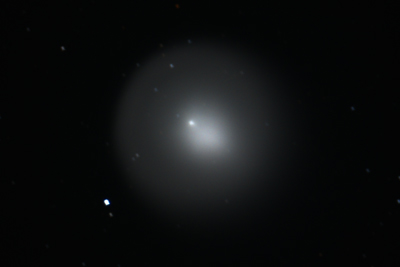
When I saw the clouds clearing out, around midnight, at the start of the morning of Tuesday, October 30, 2007, I decided to haul my rig out my front door and set it on my front landing, and I snapped a pile of images of Comet 17P Holmes.
This is a very unusual looking comet, but, with it being nearly at opposition, close to being on the opposite side of the Earth from the Sun, we’re essentially looking down the barrel of its tail, if it indeed has one. As for a second nucleus, neither I nor my camera can see one.
Here’s probably the best of my shots; zoomed and cropped; I took this through my Tamron 300mm lens at f/2.8; Canon Digital Rebel 300D; ISO 200; 5 second exposure.
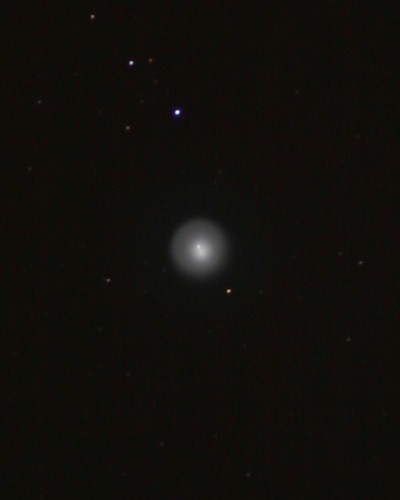
It is just past midnight, and I have just returned home from Binbrook where Jim W., Steve G. and I were joined by a guest for a round of comet watching. Jackie stopped by to make sure that everyone got in the park safely, but her cold kept her from enjoying much of the night. Binocular views were being enjoyed and stories of comet sightings from the past couple of days were being compared while three scopes were set up. As if planned to give our guest variety, Steve set up the GWS (16″ dob), Jim set up his 8″ SC and I set up my small but mighty 80mm refractor. Jim was first out the gate and with his first telescopic view of the comet his shouts of two cores had Steve and I racing to finish our set-ups. Seconds later we were all staring through our scopes and pondering this new development. As the night wore on many images were made (a truly collaborative effort, with Steve’s camera being attached first to my scope and then to Jim’s, and all the while being supervised over by our etherial fourth member). Soon, there was speculation on the true nature of the split core (a third star was immediately agreed upon to be a background star). We plotted the nearby background stars to reference against while we watched for movement of the comet(s) and by the end of the night we were of the opinion that there were two background stars and still one cometary core. But oh, what a comet. Even if it didn’t split as was speculated, it has still been the most surprising comet in many a year and as was said tonight, truly worth the price of admission. I am looking forward to Steve’s images, more member’s comet tales, and more nights with the good company of these fine HAA members.
A quick scan of the sky with binos confirmed that the comet had grown considerably in size and magnitude. The big surprise, however, is that the telescopic view reveals not one but two tiny bright stellar cores – matching “eyes” in the center of the inner coma. This is turning into one very interesting comet!!!
Update By KerryLH:
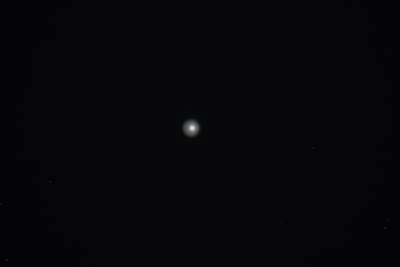
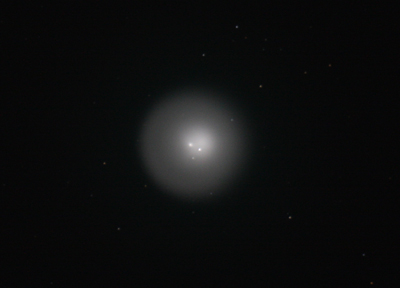
Yes get out and catch this comet. It is a nice sight even in binoculars. In the long exposure I can see what looks like three cores but am wondering if they are background stars??? Can you confirm? below are quick snaps one from the 25th and the other from a few minutes ago showing how much of a difference a few days have made.
Taken with my c6SCT@f6.3
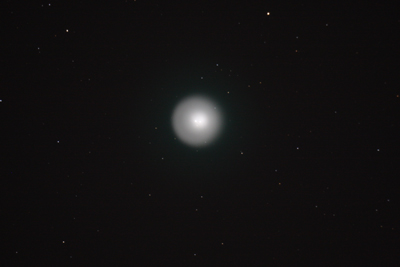
Here’s a close up to show the three steller looking points
UPDATE by Glenn
The nuclei look so stellar I was wondering if that was a possibility – on the Cloudy Nights forum, an imager in the UK is fairly certain that the extra point(s) of light are field stars, and Starry Night does show at least one mag 9.2 star very close. Would those stars be bright enough to penetrate the core with such definition, though… keep watching for answers!
?WOW!!! That is sooooo CUTE!!!?
Jackie has a way with words! I?ve never seen a comet like Comet Holmes. Actually, I?ve never seen ANY astronomical object anything like this little cutie. After arriving at the alternate site about 9:50 and missing Jackie by about 5 minutes, I viewed the comet with my 7 x 50 binocs and estimated its brightness at about 2.5. It appear orange-ish to me and definitely shows up as a non-stellar object in binocs. In spite of being alone on a dark road in the middle of nowhere, I could not resist setting up my telescope to get a better view of the comet. Because it is so bright, the comet bears magnification well. (I can’t wait to see it in a bigger scope!!)
Jackie came flying back to the alternate site after calling my cell and discovering that I was there. We spent the next hour and a half observing the comet and photographing it through my 70 mm Pronto. To pick up the beautiful structure within the comet, we needed to use short exposures. Longer exposures did not show any sign of a tail or outlying structure.
To me, the halo around the bright, inner core appeared like a finely and faintly made spirograph pattern ? textured, not uniform. Both Jackie and I thought the core appeared at times oval and then round. It could have been the seeing or possibly (especially in my case) astigmatism. In any event, it is a beautiful sight and I?m sure it is going to continue to be full of surprises.
You can bet that these two enthusiastic Astrodollies will be glued to our eyepieces and cameras as long as Comet Cutie is in the sky!
Ann T.
Astrodollie
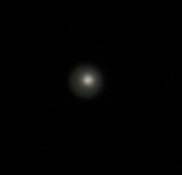
Last night from home I did a quick setup on the driveway, with binoculars, camping chair, and c6 on the goto mount. I really wanted to meet up with the group in Binbrook but was just too tired to pack up the equipment for the long haul.
After looking at various star charts, it took my no time to scan around and find the comet that everyone is talking about. It was so cool to see it as an unusual glowing yellow ball in binoculars. It was so bright that you could even see it with your unaided eyes even with the full moon. I set up my mount for tracking and aimed it at the comet. You could definately make out a tiny bright core surrounded by a large circular glow. I hooked up my camera and snapped a few 30sec shots at a high ISO… wow… It was so bright that no detail was picked up on the camera I just looked like a large solid ball. I had to slow down my shutter speed to 16 sec and knock the iso down to 200. Ok now I was able to see something, the tiny bright core was very evident and there looked like the beginnings of a tiny stub of a tail. I snapped away to get as many frames as possible so that I could stack them. For fun I took one really long exposure to see if there was a tail but I could not see one. Could it develop a noticeable tail in the coming days or weeks??? Anyway my best captures as well as my experimental shot is below.
Canon40D + c6SCT @f10
ISO 200 exposures ranging from 16 to 30 sec. totalling ~3min
I increased saturation a bit and noticed some other colours.
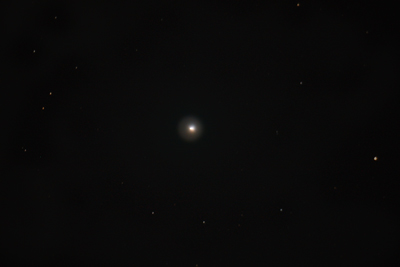
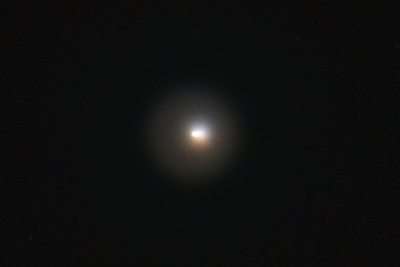
underexposed to show the tiny core
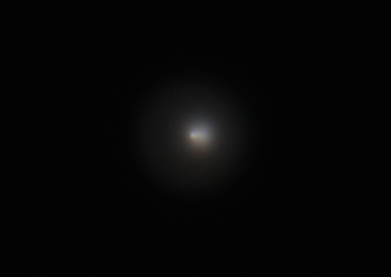
The experimental shot… looking for a possible faint tail…
I read somewhere that the green glow from overexposing is probably from ionized gas, and can’t be seen visually. Cool eh?
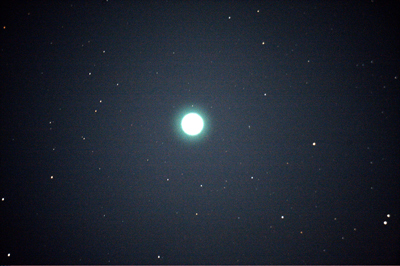
By KerryLH
While a group headed out to observe the comet from the alternate site, I observed it from my backyard last night with my 7×50 binos around midnight. It appeared to be a little larger than Mars and had distinct colour. I could easily see a yellow core surrounded by a soft green coma (even with the moon, street and house lights). I didn’t notice that the core was slightly offset from the center, but then binos didn’t provide enough magnification. No perceptable tail.
I’ll be looking forward to when I can train one of my scopes on it to bring out more detail at higher magnification. This “star” was very easily naked eye observable. Didn’t need any charts to figure out that the upside down stylized “F” of Perseus had a new visitor. It appeared to be the 2nd brightest object in Perseus. It’ll be interesting to observe it’s position change over the next few days and weeks (if it stays this bright).
Let’s see and hear the reports from the others that were out observing. I understand that some photos have been taken, and I know we’re eagerly waiting to see some of them. Hopefully the “Astro-Dollies” will post some of their antics and adventures from last night.