The occultation expedition O2007-alpha

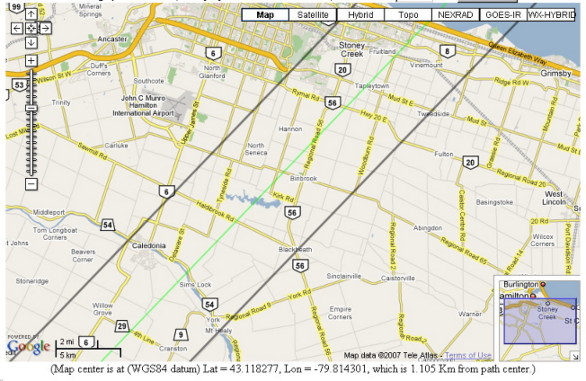
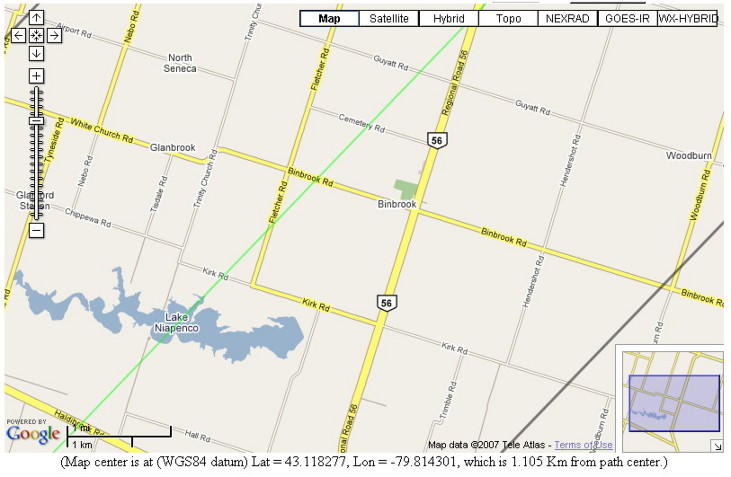
Armed with maps, bearings, a compass, and a bevy of telecsopes and binoculars, we arrived at about 5:45 PM at the community center in georgetown. Thanks to Don’s use of the internet, and our previous research, we had a good idea where to set up and where to look, as well as how high the moon would be and when the event was due to happen. We had WWV radios which broadcast a ticking sound with extra info every minute, sufficient to synchronize commentary with time, and also a GPS for accurate locations of our positions.

I shot a zillion pictures of people scouting the best vantage point to use.
10 mega-pixels each. Perhaps there will be a short multimedia presentation next meeting to highlight the expedition… Occultation expedition O2007-alpha.

The sky showed signs of clearing. We decided to stay here rather than going west for a possibly clearer horizon, although the hay field across the street was also considered. A delegation was dispatched to ensure that a better vantage point was not available nearby. We thought up a cover story rehearsed in case the clouds rolled in, to explain why we set up our scopes. It’s too good a story to relate here… we may need it another time.

We scouted out some nearby hills and checked our bearings as to the best place to set up, and eventually decided to use a grassy berm on the northwest end of the parking lot. I set up my 3-inch finder-scope from the GWS, (sufficient for 7th magnitude stars, easy) and had at the ready 15×70 binoculars.

Alas the moon could not be seen due to too much sky-glow from the milky way, and perhaps a few clouds, so Jackie demonstrated the effect of an occultation using some down-to-earth props, including a round stool and a flashlight.

We had some chats with passersby who were out walking dogs or playing in the park.

Subsequently the sky cleared, enough to spot the summer triangle,
large and near the zenith, and Cassiopia. Ed’s 12 inch Big White Scope was there,
and we had a chance to check out the stars in his 8-24 zoom eyepiece. I was impressed with how sharp the stars were near the edge of the field. I will ask him to try it on my scope next time we go to Binbrook. People packed up early though, partly due to the lights in the parking lot, which i must say were full cutoff and therefore sky friendly. The lights in the sports fields were not switched on.

We reconvened at Kelsey’s in Milton and had our dinner, and safe trip home.
The round trip turned out to be shorter than a trip to Binbrook, for my starting point in Burlington.

I am looking forward to Occultation expedition O2007-beta, whenever that happens.

The occultation that almost was

Well, as the old quote goes – the best laid plans of mice and men(and women)…. An intrepid group of adventurers set out on an expedition to the Georgetown area in search of an elusive grazing lunar occultation. Jackie F, John G, Jim W, Steve G, Ed S, Anne T and myself set out from the Hamilton area and arrived early enough to check out the primary observing site and a few alternates in hopes of finding the best view to the southwest horizon. After deciding on staying at the community park, the weather didn’t cooperate and remained cloudy throughout the entire occultation period. It teased us a few times with a number of breaks in other directions, but alas, no joy for us.

Not to be disenchanted, we set up anyways, hoping against hope that the skies would part for us at the last minute. Due to the absence of our lucky “weather-chick”, the skies failed to reveal the wonders that might have awaited us.

We were quite the sight with more than half a dozen of us set up along a hillette at the community centre. We had a few people interrupt their walks with their dog (or children – hopefully no “stoop and scoop” required for the latter group), stop by and wonder what the fuss was about. All of their good wishes were not enough to bring forth our quarry.

Jackie, the ever-eager crowd pleaser, wanted to ensure that we had a chance to see an occultation, so she managed to conjure one up for us with her many talents. Hopefully there will be some video to follow (and maybe some pictures from Steve or Anne).

Anyway, after enjoying the company at the observing sight, we decided to pack it in and try to occult some drinks and food at Kelseys in Milton on the way back home (thankfully everything disappeared and none reappeared – was that too gross to include in a blog??). While the observing session wasn’t as rewarding as we hoped, we certainly enjoyed ourselves. The HAA has a great bunch of observers and it’s always fun getting together – regardless of whether there are heavenly sights to see or not.

Undaunted, we’ll try again. Now that we have a better idea of what to look for and how to get information about upcoming occultations, hopefully we’ll be better prepared the next time Mother Nature chooses to let us observe another of her wonders.

Cheers & clear skies

University of Texas – Webcast entitled “Exploding Stars in an Accelerating Universe”

Dear Organization,

On October 19, 2007 at 7 pm (central) Dr. J. Craig Wheeler, renowned astrophysicist and author, will lead an exploration of ideas at the cutting edge of current astrophysics. His extraordinary journey to investigate explosions of supernovae, resulting neutron stars, mysterious black holes, and elusive gamma ray bursts are far from science fiction. (Full summary below)

We would like to invite members of your organization and/or visitors of your website to view our Live Webcast of the lecture, October 19, 2007 at 7 pm (central). If possible, posting a link to this event on your website or forwarding the information to your members who may be interested in this lecture is greatly appreciated. Our webcasts are very high quality, and viewers can submit questions to the speaker through our website and the speaker answers the online questions in real time. The webcasting software we use requires viewers to download a small plugin, but it is very simple and quick to install.

A link to the details of the lecture and the webcast could be found at:
www.esi.utexas.edu/outreach/ols/lectures/Wheeler

What is the lecture about?

Dr. J. Craig Wheeler, renowned astrophysicist and author, will lead an exploration of ideas at the cutting edge of current astrophysics. His extraordinary journey to investigate explosions of supernovae, resulting neutron stars, mysterious black holes, and elusive gamma ray bursts are far from science fiction. These exotic objects in our universe make up the life cycle of stars, are the basis for planets and life, and measure the history and fate of our Universe. Dr. Wheeler_s lecture follows the formation of supernovae, their characteristic shape and its significance, as well as the resulting celestial objects formed by the collapse of a star. Along the way, Dr. Wheeler examines evidence suggesting that the Universe is actually accelerating. He also explains recent developments in understanding gamma-ray bursts – perhaps the most catastrophic cosmic events of all.

Cubs on the Hill!

Under a beautifully clear sky, about ten HAA members played host to just as many cubs plus their leaders and parents. As the sun left a gorgeous pallet of russet shades on the western horizon, views of Jupiter with many belts and four moons started the show.
The cubs ran excitedly from scope to scope as the astronomers gave explanations of what they were looking at. Then, once it was dark enough, Glenn led a discussion of what could be seen in the night sky, and demonstrated how to find the North Star.
Since October 4th was also the 50th anniversary of the the start of the space age, he also spoke about rocket flight and satellites. To give the cubs some idea on the time span a few people admitted (with some difficulty) to being older than Sputnik.
As if to pay homage, right on cue, the ISS made a flyby to everyone’s delight. For the cubs, though, Ann and Alex Tekatch provided the highlight of the night when they gave everyone small light sticks. These actually proved very handy in keeping track of that very active cluster.
After a few more views of the Andromeda Galaxy and Albireo, the cubs gave the astronomers 3 cheers and departed.
The sky remained clear though moisture-laden. The remaining HAA members took in some more of the showpieces and experimented with different eyepiece combinations. Friday morning commitments meant an early Thursday night for most, but overall it was another great outing.
Thanks to all who came out 🙂

Update By Kerry

I arrived a little later so by the time I got setup and aligned the cubs were ready to leave 🙁 They certainly were a very happy and excited group. Hopefully we can do this again… it’s always fun showing kids the night sky. Anyway, as it started to get darker we were noticing how incredible the Milky Way looked. It was probably the darkest that I have ever seen it at Binbrook, and then it dawned on Tim H that the fog overlying the surrounding area and cities was cutting out a good amount of the light pollution 🙂 I measured an SQM of about 20.47. Better than the average 20.1-20.2. We all tried to soak up as many DSOs so that we could take advantage of the conditions. A group of us stayed out observing till past midnight.. and still no fog. Binbrook was like a little clear sky oasis. As soon as I packed up and headed out onto the road I hit the wall of fog, and it never let up during my entire drive home. After I got home Bill (my hubby) reported some cool sights with the fog overlying the town of Grimsby below and moments of wonderful dark clear skies at our home a top the escarpment.

While observing in Binbrook, I concentrated mainly on the southern objects since I can’t see them from home:
Helix nebula- really large and diffuse,
Sculptor Galaxy- a tilted spiral that looked fairly large, diffuse and elongated in the 6in. This would probably look a little better if I waited till it rose a bit higher.
Both those targets will have to be on my AP list for next time I go to Binbrook.
We also viewed the Saturn Nebula… and I am proud to report that it does look a little bit more than just an out of focus blue fuzz and this is only in my 6in. With averted vision you can sort of make out a bit of the Saturn shape. I am sure Steve’s 16in would show much more.

Happy 50th Anniversary

Today, 4 October 2007, marks the 50th anniversary of the beginning of the Space Age with the launch of the first artificial satellite Sputnik 1 by the Soviet Union. From the Soviet test facility in the Kazahk Republic, the Russians sent aloft on their R7 booster (bigger then anything the Americans had at the time) a 180 pound (80kg) satellite which shocked the world with its little beep-beep-beep signal.

In addition to the initial fears of nuclear strike capability by the Soviets, it also began an age of unprecedented space exploration. This rocket, along with Sputnik 2 (Laika the dog) a month later and subsequent responses by the Americans in 1958 were all part of a international joint plan started in 1955 to mark the International Geophysical Year (Jul57-Dec58) to send satellites into orbit and explore earth and its environment.

As astronomers, this event ultimately had a huge impact on our activities, since it eventually spawned explorers such as Hubble, COBE, SOHO, Chandra, Galileo, Voyagers, Cassini and many others which has resulted in seeing space in ways we never imagined 50 years ago. And it generated new technologies which we take for granted today such as GPS, Goto mounts, CCD imagers, etc.

To mark this occasion, I wandered outside last night at around 1:30am to just look up and reflect on the wonder of our favourite pastime, the changes we’ve seen in our lifetimes, and gaze into the infinity of our universe. Without any optical assistance, I gazed upon many constellations like Perseus, Cepheus, Pegasus, Cygnus, and others. I saw Mars shining brightly, rising slowly over the roofline of the house. I was able to enjoy a bright green meteor that lingered for several seconds after its passing. And the primary goal I was seeking – 2 satellites passing overhead.

It’s fitting that tonight, we’ll be meeting up with a Cub pack at Binbrook to introduce them to the excitement of exploring space. Maybe we will be planting the seeds for a new generation of space explorers.

Happy 50th Anniversary! I can hardly wait to see what the next 50 years will bring.

Mid Night Sky

Finding yourself awakened in the middle of the night is often a stressfull event for people, with worries of how to fall back to sleep, how tired they will be the next day, and the stillness of the night giving room for all their anxieties to run rampant. Then there are we lucky few that call ourselves amateur astronomers, and see such opportunities to get outside and catch a glimpse of the night sky that seasons to come will bring.
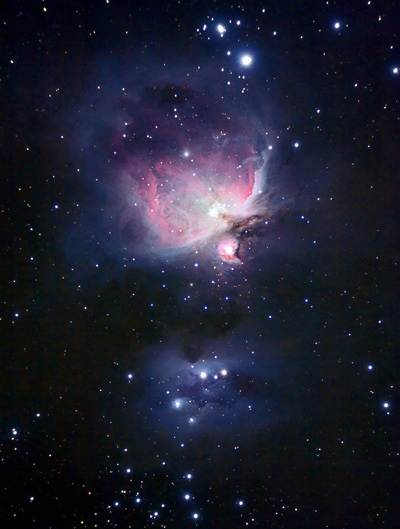
This is how I found myself at 4am outside with my pair of 15×70 Oberwerk binoculars in hand. Thew was a low (and I mean very low) cloud wafting past and obscuring the escarpment, and although it didn’t reach the ground, it was obviously no more than a couple of hundred feet high. Then a sudden break revealed that there was nothing above this low cloud, and a crystal clear sky showed through with a brilliant number of stars against a dark background. The entire Little Dipper stood out easily, so that should tell you how good the sky was. My binoculars roamed around the sky as breaks in the cloud presented first one constellation and then another to me. There was no order or sense to my tour of the sky; I was guided by the holes in the clouds and found myself looking north to the Double Cluster in Perseus, but no, the Andromeda Galaxy was obscured. Now overhead to Taurus, and the Pleiades never look better than through a good pair of binoculars. Mars looks so bright and is so high in the sky. Through the binos it appears in the same field as M35, that wonderful open cluster at Gemini’s foot. There’s Orion cutting through the fog, and even partially obscured the nebula still shows. The winter constellations are showing off their wealth of bright stars and as the fog thins in the east the path I am following leads to an extra star that would be found among the spring constellations just rising. The fog is still filtering it, and at first I don’t recognize it as Venus, but as the east clears it shines forth brighter than 4th magnitude, and my binoculars show a small crescent. It shows a similar phase as the Moon, which is not far from the head of Gemini, and which is showing a rich landscape that, as good as the binos are, makes me wish I had brought my scope out. A good part of the sky is clear now, and I move to find a view of the south and Orion again. Yes, here is a chance to see him without the filter of the fog and again I lift my binos to the sword. Of course I’ve seen it through these binos before, but perhaps because I saw the thinned out version through the clouds earlier I was now amazed at the extent of the nebulousity! Sitting amidst the stars of Orion’s sword, it seemed so large, with the wings going off the sides of the nebula were so clear. It’s wonderful what a pair of binoculars will show. Of couse I have had views through large scopes that show intricate detail and colour, but this has to be one of my favourite views of M42. A parting glance at the now completely clear sky shows the winter Milky Way cutting through many of these constellations
That’s it. A half hour of my time and a little fog to dance around, and back in bed after a wonderful observing experience. Well worth being tired the next day. And if anyone asks why I am so tired, well I’ve got stories to tell.

Adventures in Astrophotography

After just over 3 years with my trusty Canon 300D DSLR Camera I decided to move onwards to the new Canon 40D. It was well worth the wait to make this huge upgrade!

DPreview:
http://www.dpreview.com/previews/canoneos40d/

Astrophotography Reviews:
http://astrosurf.com/buil/eos40d/test.htm
http://www.cameralabs.com/reviews/Canon_EOS_40D/live_view_astro-photography.shtml

Last Friday was my first clear night to test it out… and even with the moon high, and in Gibbous phase I was still able to get some decent captures. The Liveview focussing was one of the many reasons that I decided on this camera. It is very hard to focus through a dslr on stars through the viewfinder and now with Liveview the task was made much easier. I could zoom into stars down to magnitude 4.5 for fine tuning. With it’s high speed for transferring raw files I was able to check each frame that was captured and view/organize them indoors for processing. Since my laptop is part of my imaging train.. it was nice to be able to focus on the laptop screen with fast response time, set up a timer for scheduled shutter release, and transfer each image… all with one USB cable.

Only negative… I now need more RAM. Processing went soooo sloowly.

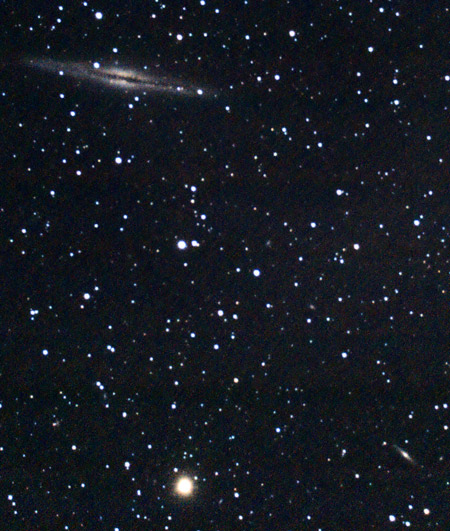
Object: M15 By KerryLH
Scope: Celestron 6in SCT @ f6.3 ( with wires for diffraction spikes), No Filters
Mount: CG5-GT (ASGT)
Camera: Canon 40D (unmodded)
Exposure: 7x1min,8x2min, 23min total, ISO 800, darks and flats
Guiding: DSI-C with SW Equinox 80mm APO, PHD Guiding
Processing: Deep Sky Stacker, PS (Curves, Levels, Saturation, Filters, Noels Actions)

Object: M27 By KerryLH
Scope: Celestron 6in SCT @ f6.3 ( with wires for diffraction spikes), No Filters
Mount: CG5-GT (ASGT)
Camera: Canon 40D (unmodded)
Exposure: 42min total, each frame ~3min, ISO 800, darks and flats
Guiding: DSI-C with SW Equinox 80mm APO, PHD Guiding
Processing: Deep Sky Stacker, PS (Curves, Levels, Saturation, Noels Actions)

NOTE: Half of those frames were lacking detail due to dew 🙁 … but I still stacked them anyway.

Focussed with live view on Sham mag 4.37 (Alpha Sagitta)

Full Frame no cropping

100% crop

Of course I wouldn’t just buy this camera for only AP. I also do a lot of daytime photography and after shooting with it for a few days I have noticed nice improvement in detail and colour saturation (especially in skin tones), and more reduced noise at high ISOs. I’m sad to have to give up the 300D but happy to have moved on. I’ll be looking into selling the 300D body with all original manuals, software, battery charger and Hap Griffin Astro Cable.

Under the Light of the Moon

I got a call earlier today from Jim W. and was easily persuaded to head out to Binbrook, despite a nearly full moon. We had the place to ourselves, aside from some noisy raccoons and a few coyotes , and the moonlight gave a spectacular lustre to the lake and surrounding countryside. Jim mentioned that the CSC was forecasting a particularly steady night, and he was right. Comfortable temperatures, very little dew and deadly calm air promised a wonderful night of observing. So naturally I forgot my tube rings at home and couldn’t set up my scope. Alas! Jim, ever the gentleman, not only gave me a lift up to Binbrook, but now also offered to share his scope. We took in several nebulae (aided by a narrowband filter) a few good globulars (M15, M13 and M22) and several lovely open clusters, which did a good job of cutting through the moonlight. M11 proves to be outstanding under any observing conditions. I’m going to try observing it on the next cloudy night. Alas (again) even Jim’s 8″ couldn’t spot the Saturn Nebula. I guess you really do need a 74″ scope.

An early view of Jupiter showed an abundance of detail even though it was nearly on the horizon, and that was our first clue to just how good the seeing was. When we finally yielded our attention to the overwhelming brightness of the moon we were astounded by the amount of detail visible. The finest part of the evening was spent going over every bit of the lunar surface at high power. Jim set a new personal high by taking his scope up to 400x with the help of my 5mm Pentax eyepiece. This wonderful combination of objective and ocular elicited many oohs and ahhs (and a few other comments not suitable for a family website)as the moon showed nothing but a rock steady view and a landscape rich with detail. Terraced crater walls, rilles and ripples, and suspended crater rims hanging is the blackness of space over the terminator reminded us that our nearest neighbour is a much overlooked object. Even this most light polluted of nights gave us a wonderful observing experience just because that big, bright old moon was out there.

A little side bar on the DDO trip. Mike S. decribed the trip well and posted some wonderful pictures. He also offered Jackie much deserved thanks. I have to say that I had a wonderful time. The presentation was excellent, we had a chance to see a truly amazing instrument, and each of us undoubtedly came away with wonderful stories. I got Ian Shelton to recount to Mike J. and myself a firsthand account of the discovery of SN1987A, and Doug B. got the staff to let the two of us in to the library where we were able to peruse the books of Chant and others. And the view through the telescope was startlingly bright and richly colourful; both reminders of just how big a scope we were lucky enough to be looking through. Most of all though, there was lots of laughing and talking and enjoying the company of others, because as Michael S. so often reminds us, this really is a great astronomy club!

A quick outing to binbrook with the GWS

I arrived at Binbrook at 8:30 and joined some other intrepid observers and the keyholder.

The moon was high in the sky and quite bright… you could read by it, (unfortunately).

I set up the (Great White Scope) GWS and its trimmings, intent on performing the key experiment to determine what needs to be done with my XTi to get it imaging on the GWS… and with a sheet of paper i projected the moon into space in front of the open eyepiece portal.

It comes to a focus about 1.5 inches away from the edge of the scope, which is just a shade too short
to bring it to a focus within my Xti, so i guess i need to get fancy with the Crayford Focuser.
Jackie was amazed i could bring the moon to a focus on paper beside the scope.
Even more amazed when a large version of the moon appeared on paper when the eyepiece was returned.

I tested out my newly constructed switch for holding the ‘bulb’ mode of the camera, and made some time exposures of Andromeda, while Ann did the same. I noticed a difference in the amount of background glow and noise in ISO 1600 vs ISO 100 mode. Using the GWS as a mobile tracking camera mount was not my style, and i was finished after 3 exposures. The focus was good though. ISO 1600 really brightens up the photos.

We set the camera up to lock the mirror with a separate operation, to eliminate vibration when the exposure starts. I guess it’s overkill for the kinds of photos i was taking, but i am still keen to stretch Andromeda out of the noise.

Despite the sacrilege of using the GWS for astro-photos, i still want to see if it’s possible.
My next project will be to shorten the focuser and get a low profile t-ring so that the camera can snuggle close enough to the scope to get a focus. I guess i have not completely exhausted the chance to adjust the location of the primary mirror, which might propel the focal plane a bit further out of the focuser.

In one of my longer time exposures, i got some star smearing, indicating as misalignment of the EQ platform, (which i had set up by eying Polaris at the start of the evening).
I guess this is a case for using the DSI Pro as a tracking aid, along with a laptop and the tracking port on the EQ platform.

I did not have the luxury of waiting for the moon to set, even though i wanted to seek
M46 and M47 (as part of the Sequential Messier Marathon), which should be rising in the early morning. It turns out M49 is very near the sun right now, so that it will likely be mid October before that hurdle is cleared. By then it will be easy to get from M46 to M53, but M54 is in Saggitarius and will be setting too early. (I think i might be planning too far ahead here).

It’s going to be at least mid December before i get to M68, i reckon, so this is not going to be a quick romp. Some of those galaxies will be pretty low on the horizon, further complicating things.
So, with the SMM on hold…

I found a pumpkin orange star in Perseus, and noted it in my star charts. It does not have a name, and it’s probably 7th magnitude, but it sure is a nice colour. Definitely want to trot it out on visitors nights.
I was able to find for the first time Rho Cassiopia, and see it as a normal looking, if bright star.
There’s an open cluster not far from it, which i was also able to find.

I looked up M15, not far from the moon. The zoom eyepiece eventually served up a smatteing of individual stars, but the moon was definitely working against the deep sky objects.
The moon shining into the GWS caused all kinds of distraction in the eyepiece, as i could see the interior of the scope as i approached for a view.
Things were dewing up but my dew busters and primary fan kept everything nice and dry.

Time to make lemonade, and observe the moon, i guess.

I put a heater on my eyepiece, to keep it dry. It worked fine that way.

I finished the evening with a hunt for M74, brushing up on when i will need it first thing for the (non-sequential) messier marathon in march. I had the stars all aligned, and centered it nicely in the finder and the GWS, but i could not see it with the moon high in the sky.
That’s a clue to how hard it’s going to be.

It took 23 minutes to pack everything back into the car and i was out the gate before 12:15 am.

There’s plenty to see through the GWS whenever the SMM is not on, and the dew busters are working just fine. I now hear about frost, a whole new dimension of telescopic entertainment.

Early morning at Binbrook

Got to Binbrook for a 3:00am gate opening – Jackie was soon to follow. The sky was crystal and calm as predicted (the CSC is going to get it right once in a while – it’s just a matter of odds). The moon had just set – the Pleaides were high in the sky and Orion was just clearing the trees.

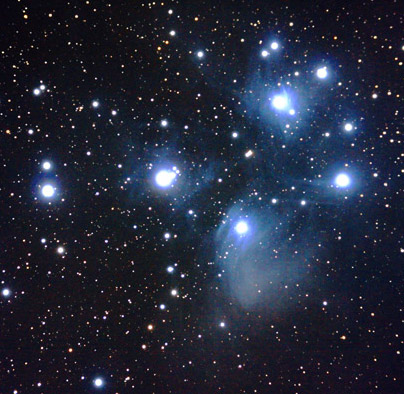
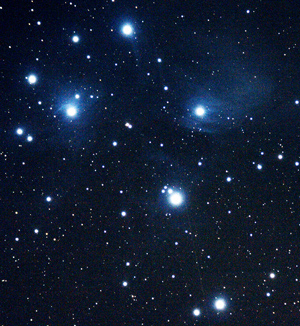
After setting up and polar aligning I started testing my new IDAS LPR filter – first with the Pleaides – then with Orion’s belt and dagger.

It was the first time I saw Venus since it crossed over to the morning – it sure is high and bright.